
ACLU Warns U.S. Drone Policy Is Building a Two-Tier Airspace — What Commercial Operators Need to Know
Situation Report
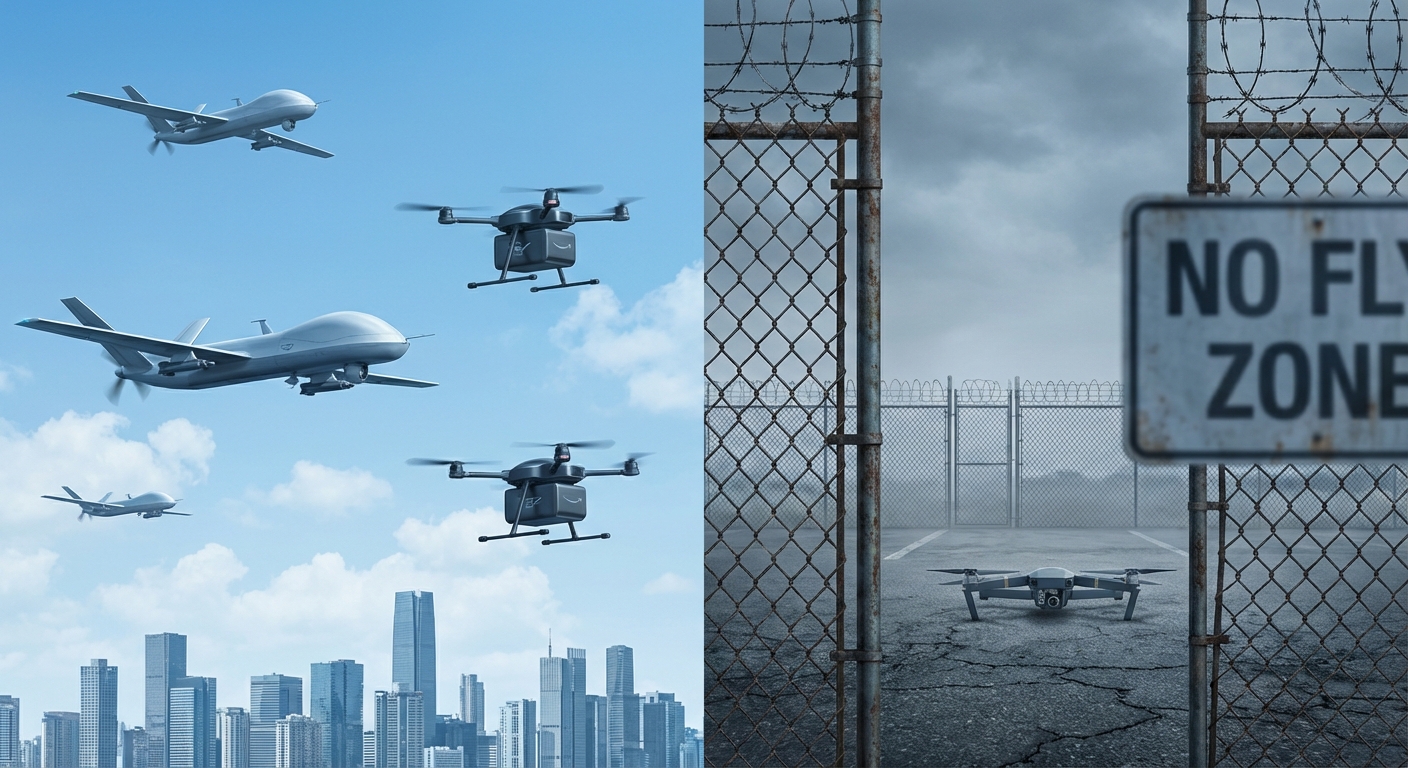
On March 26, the American Civil Liberties Union published a sweeping whitepaper titled "Drones For Them But Not For Us?" that argues U.S. drone regulation is systematically concentrating aerial access in the hands of government agencies and large corporations while locking out journalists, small operators, and the general public.
Written by Jay Stanley, Senior Policy Analyst with the ACLU's Speech, Privacy and Technology Project, the 30+ page report identifies five interconnected regulatory mechanisms that tilt drone access away from citizens and toward institutional actors:
The Five Regulatory Asymmetries
- Overbroad counter-drone authority: Federal agencies can interdict civilian drones with minimal oversight while their own surveillance flights face no equivalent checks
- Import bans that price out small operators: The FCC's December 2025 ban on Chinese-manufactured drones eliminates affordable hardware, leaving only government-budget platforms like Skydio
- FAA preemption of local control: Communities have no authority to regulate drone flights over their neighborhoods while federal agencies write themselves exceptions
- Unchecked law enforcement surveillance: Police agencies (NYPD logged 20,000+ drone flights in 2025 alone) operate with minimal transparency or accountability
- Remote ID asymmetry: The public can see where drones fly but cannot identify the operator unless they're law enforcement
Stanley put it bluntly: the current administration "thinks it gets to watch us, but not allow the people to watch the government." The paper cites DHS using drones to monitor protests and immigration enforcement while simultaneously issuing TFRs and NOTAMs that ground civilian aircraft attempting to document the same activities. Specific examples include NOTAM FDC 6/4375 (issued January 16, 2026), which designated airspace above ICE vehicles as restricted — effectively creating "national defense airspace" around immigration enforcement operations.
Operational Impact
If you run a commercial drone program, the ACLU's report reads like an abstract policy argument. It isn't. The regulatory framework Stanley describes affects your operations in concrete ways, and the trends he identifies are accelerating.
The Hardware Squeeze Is Real
The FCC's foreign drone ban didn't just remove DJI and Autel from new-purchase consideration — it restructured the entire cost curve for commercial drone programs. Before December 2025, a capable commercial platform (DJI Matrice 350 RTK) ran about $11,000. The non-Chinese alternatives that passed Pentagon security review start at $15,000–$20,000 and go up fast. For enterprise programs with fleets of 10–50 aircraft, that's a six-figure procurement delta that lands directly on your budget.
The four drone models the FCC exempted on March 18 are a start, but they're all military or industrial-grade platforms. The affordable tier of the commercial drone market has a gap that nobody is filling. Stanley's observation that "the only people who can afford drones are the wealthy, police, and the military" is now a market reality, not just a civil liberties concern.
Counter-Drone Authority Creep Affects Your Airspace
The expansion of counter-drone authorities under the Safeguarding the Homeland from the Threats Posed by Unmanned Aircraft Systems Act isn't limited to hobbyists flying near airports. When DHS, DOJ, DOD, or DOE can interdict any drone they deem a "threat" without judicial oversight, commercial operators face an environment where legitimate, authorized flights can be disrupted or forced down by agencies that don't coordinate with the FAA's UAS facility maps or LAANC system.
We've already seen this play out. The El Paso airspace shutdown in early 2026 demonstrated that counter-drone responses can have cascading effects on commercial aviation well beyond the target area. If your operation depends on predictable airspace access — and every commercial program does — the unchecked expansion of interdiction authority is a direct operational risk.
Remote ID Cuts Both Ways
The ACLU's critique of Remote ID is nuanced and worth paying attention to. The current 14 CFR § 89 framework broadcasts your drone's location, altitude, velocity, and takeoff point. Law enforcement can query your registration to identify the operator. The general public cannot. That means your commercial flight is visible and trackable, but government surveillance flights overhead are effectively anonymous to the communities being monitored.
For commercial operators, this creates a perverse accountability gap: you bear the full transparency burden of Remote ID compliance while government operators flying the same airspace face none. If a community association or local official receives complaints about "drones overhead," it's your Part 107/108 operation that gets the scrutiny — because you're the only one they can identify.
Regulatory Analysis
The ACLU's report arrives at a critical inflection point for drone regulation. Three major regulatory threads are converging simultaneously, and each one intersects with the asymmetries Stanley identifies.
Part 108 and the Access Question
The proposed Part 108 rule for BVLOS operations is designed to normalize scaled drone operations. But the ACLU paper raises an uncomfortable question: normalized for whom? If the hardware required for Part 108 compliance costs $20,000+ per airframe (thanks to the import ban), and the operational infrastructure requires shared surveillance networks or proprietary DAA systems, the rule may effectively limit BVLOS access to well-funded enterprise operators and government agencies — exactly the two-tier system the ACLU describes.
The recent ResilienX BVLOS waiver using NUAIR's shared surveillance infrastructure is a positive model. But that infrastructure exists in one corridor in New York. Part 108's promise of national BVLOS access means nothing if the practical requirements create barriers that only large operators can clear.
The FCC Ban's Second-Order Effects
The expanding FCC crackdown on foreign-manufactured technology (now including consumer routers) suggests the import ban on Chinese drones won't be rolled back anytime soon. The four exemptions granted in March required individual Pentagon security reviews — a process that doesn't scale. For commercial operators, this means fleet planning around non-Chinese platforms is now baseline, not contingency.
From a regulatory standpoint, the ban operates under FCC authority (47 U.S.C. § 302a, equipment authorization) rather than FAA authority. The FAA can't override it. The result is a regulatory gap where your airframe may be fully compliant with 14 CFR Part 107 but unauthorized for import or sale under FCC rules. Two federal agencies, two different compliance frameworks, zero coordination.
Surveillance Without Guardrails
Perhaps the most operationally significant finding in the ACLU report: there is no federal law restricting how law enforcement agencies use drone-collected data. No warrant requirements for persistent surveillance. No data retention limits. No audit trails. For public safety agencies building DFR (Drone as First Responder) programs — an area where UAVHQ provides consulting support — this regulatory vacuum is both an operational opportunity and a legal liability.
Agencies that deploy DFR programs without proactive privacy policies and data governance frameworks are building on sand. When federal drone privacy legislation eventually arrives (and the ACLU report makes the case that it will), programs that already have robust governance will transition smoothly. Programs that don't will face costly retrofits, public backlash, or both.
The Bottom Line
1. Budget for the New Cost Reality
The import ban has permanently restructured commercial drone economics. If your fleet plan still assumes DJI pricing, revise it now. Factor in 40–80% higher per-unit costs for non-Chinese alternatives, and build replacement cycle costs into your operating budget. The four FCC exemptions granted in March are military-tier platforms, not commercial replacements. The affordable commercial tier is gone, and it's not coming back on any near-term timeline.
2. Build Privacy Governance Before You're Forced To
The ACLU report is a signal flare. If you operate a public safety drone program or any operation that collects imagery over populated areas, develop formal data governance policies now: retention limits, access controls, warrant requirements for law enforcement requests, and community transparency reports. The agencies that build these frameworks voluntarily will have a regulatory moat when federal privacy legislation arrives. Those that wait will scramble.
3. Track Counter-Drone Authority Expansion as an Operational Risk
The broadening of federal counter-drone interdiction authority is not a policy abstraction — it's a variable in your operational risk calculus. Monitor active NOTAMs and TFRs in your operating area with heightened vigilance. If your operations overlap with areas of federal law enforcement activity, document your authorizations thoroughly and maintain real-time communication with your FSDO. An authorized flight that gets interdicted by an agency that doesn't check LAANC is your problem to sort out, not theirs.
The ACLU's whitepaper frames the current regulatory environment as a civil liberties problem. They're right. But for commercial operators, it's also a business environment problem. The same regulatory asymmetries that concern the ACLU — hardware restrictions, expanded interdiction authority, uneven transparency requirements — directly affect your cost structure, airspace reliability, and compliance burden. Understanding the political landscape isn't optional. It's operational intelligence.
Sources
ACLU — "Drones For Them But Not For Us?" Whitepaper ACLU — Press Release: Civil Liberties Risks if Only Police and Corporations Can Use Drones DroneXL — ACLU Says Drone Regulation Is Becoming A Tool Of Government And Corporate Power PCMag — US Drone Ban 2026 Explained: FCC Rules on DJI, Autel, and What's Still LegalNeed Expert Drone Consulting?
UAVHQ offers professional consulting for BVLOS waivers, Part 107/108 compliance, enterprise drone programs, and regulatory strategy. 25+ years of aviation expertise at your service.
Explore Our Services →