
By Wesley Alexander • May 7, 2026 • 9 min read
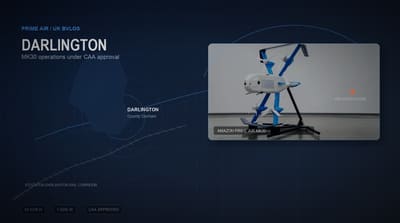
Amazon Prime Air has started flying out of its Darlington fulfilment centre in northeast England, making the UK the first country outside the United States to host live MK30 operations. The company confirmed this week that flights are underway under UK Civil Aviation Authority approval, with full Prime customer deliveries planned to go live later in 2026. It is a quiet milestone, dressed up as a marketing announcement, but the operational story underneath is the more interesting one: how a US-built BVLOS delivery system gets rebuilt to fit a different regulator, a different airspace structure, and a different population density profile.
For commercial operators paying attention, this is not really a story about Amazon. It is a stress test for whether autonomous last-mile drone delivery can be ported across regulatory regimes without redesigning the aircraft, the procedures, and the safety case from scratch.
What Amazon Actually Announced
According to Amazon's own UK announcement and reporting in the STAT Trade Times, the Darlington operation flies the MK30, the same airframe Amazon has been pushing in College Station, Texas and Phoenix. The headline operational specs Amazon is publishing are familiar:
- Payload up to roughly five pounds
- Target delivery time under two hours from order to door
- Fully autonomous flight with onboard detect-and-avoid
- Independent monitoring computer that can hand control to a backup flight controller and trigger an automated return-to-base
- Acoustic profile Amazon describes as "as quiet as an average delivery van"
The MK30 has been certified by the UK CAA to conduct operations from Darlington, with deliveries to opt-in Prime customers slated for later in 2026. Amazon has explicitly credited close coordination with both the CAA and Darlington Council, which is the polite corporate way of saying the regulatory and local-authority approvals took longer than the engineering.
Why Darlington, Why Now
Darlington is not a random pick. It sits in a region with relatively benign airspace, a cooperative local council, and a population density profile that gives Amazon room to demonstrate operations without flying through dense urban airspace on day one. That matches the pattern Amazon has used in the US, where Prime Air picked smaller markets (College Station, then Tolleson) before attempting metro-scale delivery.
The timing also matters. The UK CAA has spent the last two years pushing structured BVLOS approvals under its own framework while the FAA has been wrestling with Part 108 and the electronic conspicuity debate. The CAA does not have to relitigate the noncooperative detect-and-avoid question every time a new operator asks to fly. That regulatory clarity, even when slow, is a competitive advantage when a delivery operator is choosing where to plant a flag.
It also gives Amazon a useful narrative reset after a rough year of US press coverage, including the hard landing in a Richardson, Texas apartment complex that triggered a fresh round of skeptical reporting on the College Station operation.
The Detect-and-Avoid Story Is the Real Story
If you have followed Prime Air for any length of time, you know detect-and-avoid is the issue Amazon has been fighting about, publicly and loudly. When Amazon walked out of the Commercial Drone Alliance in March, the breakup letter was almost entirely about noncooperative DAA: detecting aircraft that are not broadcasting ADS-B or any other electronic conspicuity signal.
The UK launch is, in effect, a real-world demonstration of Amazon's preferred architecture. The MK30 is not depending on every helicopter, glider, or general aviation aircraft within its operating volume to be electronically cooperative. It is using onboard sensing to handle whatever shows up. That is the model Amazon has been arguing the FAA should normalize in Part 108. Darlington gives it an operational data set to point at when the comment file gets opened back up.
For the rest of the industry, that is worth watching. Wing, Zipline, and other operators have been pushing the alternative position: lower the cost burden by mandating ADS-B Out on all crewed aircraft below 500 feet and letting cooperative airspace solve the problem. The UK environment has its own electronic conspicuity profile, but the Darlington flights will produce months of data about how a sensor-based DAA stack behaves in real airspace with real noncooperative traffic. Whichever side you sit on in the Part 108 BVLOS rule debate, that data is going to matter.
What Operators Should Take Away
A few practical observations for crews and program managers watching this unfold:
Routing and obstacle libraries do not transfer cleanly. Amazon highlights detect-and-avoid for clotheslines and trampolines as a feature, but the underlying point is that ground clutter in a UK back garden looks different from a Texas backyard. Computer vision models trained on US suburbia have to be retrained or augmented for UK terraced housing, narrower lot lines, and different fencing patterns. Any operator pushing autonomous low-altitude delivery into a new country should expect the obstacle library to be a non-trivial engineering project, not a configuration switch.
Local authority coordination is half the work. The CAA approval is the headline, but Amazon's repeated mention of Darlington Council is the tell. UK delivery operations sit inside a planning-permission and noise-complaint environment that is structurally different from US local government. The acoustic spec is not a marketing line; it is a necessary condition for keeping a council on side once flights ramp.
Remote ID equivalence is not automatic. The UK is moving on its own electronic conspicuity standards, and any operator running US-built drones internationally has to think about how identification, broadcast, and law enforcement readout work under the local regime. Plan for documented procedures, not assumptions.
Failure modes need a local playbook. The MK30's automated return-to-base is fine in principle, but a contingency landing in a UK setting (smaller fields, more public footpaths, denser hedgerows) needs the same level of pre-cleared land-use agreements that mature US operators already maintain along their corridors. The first off-nominal event in Darlington will be scrutinized very publicly.
What This Says About the BVLOS Market
The international footprint matters because BVLOS delivery has been stuck in a kind of American introspection for two years. Operators have spent that time arguing about cost models, electronic conspicuity, BVLOS waiver pathways, and Part 108 timing. Meanwhile, Wing has been scaling outside the US. Zipline has been operating in Africa and Europe for years. Manna has been delivering in Ireland. The notion that American operators can wait on FAA action to get it right, then export the model, is increasingly hard to defend.
Amazon planting a UK operation under CAA authority shifts that picture. It signals that the company is willing to build its delivery network inside whichever regulator moves first, rather than waiting on a single jurisdiction. That is rational, and it is the kind of move that other large operators will study carefully. If the regulatory cost of operating in the UK is lower than the cost of operating in a major US metro, the market will follow the path of least resistance.
Operator Bottom Line
Darlington is not the moment Amazon Prime Air becomes a mass-market service. The early phase will look more like flight testing with friendly customers than a fully scaled delivery operation, and it would be surprising if the first six months did not produce at least one instructive incident. That is fine. That is how new operations mature.
What it does mark is a structural change in the global BVLOS conversation. The US is no longer the only place where serious autonomous delivery work happens, and the regulator that gets transit lanes, detect-and-avoid expectations, and local-authority integration right will end up shaping the playbook the rest of the world copies.
For US operators, the right posture is to read the Darlington rollout as field data. The detect-and-avoid architecture, the local-authority coordination model, the acoustic and contingency standards: each of these has a parallel in the unfinished US debate. When Part 108 comes out of comment and the next round of waivers and exemptions is decided, the operator who can point at international evidence is going to argue from a stronger position than the one who is still working from a slide deck.