
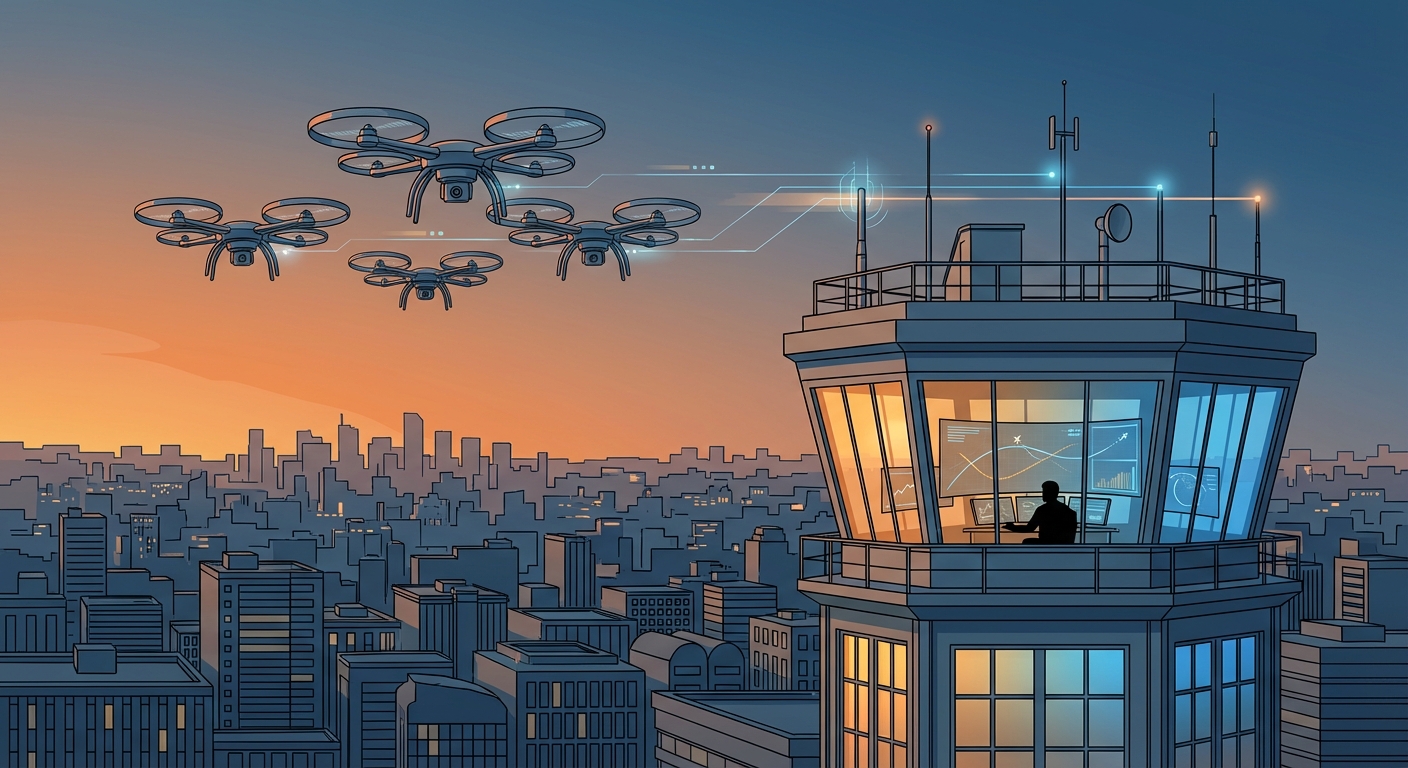
Multi-Drone BVLOS Operations: 14 Agencies Break the One-Pilot-Per-Drone Ceiling
The drone industry just shattered its most fundamental operational constraint. On March 26th, 2026, Skydio announced that 14 public safety agencies have received FAA approval to operate up to four drones simultaneously under a single remote Pilot in Command (PIC). The agencies include heavy hitters: New York City Police Department, San Francisco Police Department, Las Vegas Metropolitan Police Department, and Omaha Police Department among others.
This isn't just a technical milestone. For five years, BVLOS operations have been constrained by a one-pilot-per-drone requirement that made fleet-scale programs economically impossible. Multi-drone approval breaks that ceiling without adding headcount, fundamentally changing the math for every police department, utility company, and infrastructure operator considering autonomous drone programs.
Key Facts
- Approval: FAA multi-drone BVLOS waivers for up to 4 simultaneous aircraft per pilot
- Aircraft: Skydio X10 drones with AI-powered autonomy stack
- Agencies: 14 total (12 new + LVMPD and NY Power Authority from 2025-2026)
- Geographic spread: California, Texas, Louisiana, Florida, Nebraska, Oklahoma, Washington
- Framework: Shielded BVLOS operations (≤200 feet AGL or within 50 feet of structure)
- Technology: Unified interface, fleet commands, ADS-B integration, automated contingency management
- Precedent: First streamlined multi-drone approval pathway in US commercial aviation
- Industry impact: Removes primary economic barrier to scaled drone-as-first-responder programs
The Staffing Revolution: From 1:1 to 1:4
The economics are brutal and simple. Las Vegas Metropolitan Police Department logged over 10,000 drone flights in 2025 across 13 rooftop skyports. At one pilot per drone per dock, that program requires dedicated staffing for every active aircraft. The math doesn't work at scale.
Multi-drone approval flips the equation. One pilot can now supervise four aircraft, reducing staffing requirements by 75% while maintaining or increasing operational tempo. For public safety agencies already stretched thin, it's the difference between expanding drone operations and shelving them.
"The ability to fly BVLOS, remotely, and over people is the last regulatory hurdle we needed to clear to launch our ORION-X on-demand drone service." — Andrew Carter, CEO of ResilienX (separate BVLOS approval)
The breakthrough sits on proven foundation. Over 1,100 public safety organizations have already secured Part 91 waivers for shielded BVLOS operations. Multi-drone adds a software orchestration layer, not a new airspace regime. The FAA's decision to build a streamlined approval pathway signals this is now a validated operational model, not experimental technology.
The 14 Agencies Leading the Revolution
The geographic distribution tells the story. This isn't a California or Nevada curiosity — it's national infrastructure:
Multi-Drone Approved Agencies
First Wave (2025-2026)
- Las Vegas Metropolitan Police Dept.
- New York Power Authority
March 2026 Cohort
- New York City Police Department
- San Francisco Police Department
- Brookhaven Police Department
- San Mateo Police Department
- Sunny Isles Beach Police Dept.
- Oklahoma City Police Department
Additional Approvals
- Omaha Police Department
- Redmond Police Department
- Lakewood Police Department
- Jefferson Parish Sheriff's Office
- Pasco County Sheriff's Office
- Ontario Police Department
Jefferson Parish serves Louisiana. Pasco County covers Florida. Omaha anchors the Midwest. The FAA designed this approval pathway for national scale from day one. Each agency becomes a reference point for the next wave of applicants.
How Multi-Drone BVLOS Actually Works
The regulatory question was workload management: how can a single pilot safely supervise multiple aircraft without degrading safety? Skydio's answer leverages its AI-powered autonomy stack to shift the operator from hands-on flight control to fleet orchestration.
Three-Layer Safety Architecture
1. Unified Interface
All aircraft displayed on one map with live video feeds, telemetry, and ADS-B traffic for each drone simultaneously. Single-click manual control handoff to any individual aircraft when needed.
2. Fleet Commands
Simultaneous pause, descent, or return-to-land orders to all drones with one command. Critical for airspace incursions by low-flying crewed aircraft or emergency response scenarios.
3. Independent Contingency Management
Automatic return-to-land for low battery/lost link, parachute deployment on loss of control, and designated safe landing zones operate per aircraft. One drone's emergency doesn't cascade to others.
The foundation remains shielded BVLOS: operations at or below 200 feet above ground level or within 50 feet of a structure, combined with ADS-B In integration for traffic awareness. This keeps multi-drone operations in airspace where crewed aircraft rarely venture, reducing conflict potential.
Pathfinder Automation
Manual route planning doesn't scale to four aircraft. Skydio's Pathfinder system handles routing automatically, adjusting for terrain, structures, and altitude restrictions without requiring the pilot to hand-fly each aircraft to its destination. The pilot sets waypoints and objectives; autonomy handles the execution details.
This is the critical distinction between traditional drone operations and multi-drone BVLOS. The pilot isn't flying four drones — they're orchestrating four autonomous systems. The workload doesn't scale linearly because the aircraft handle their own navigation, obstacle avoidance, and routine contingencies.
Real-World Applications: Beyond the Headlines
Drone as First Responder (DFR) Transformation
The DFR use case demonstrates immediate value. When a drone responding to a long call runs low on battery, the pilot can dispatch a relief aircraft without ending overwatch or scrambling a second pilot. The original pilot maintains eyes on scene while Skydio Autonomy handles the return and dock landing of the depleted aircraft.
Overlapping calls become manageable. If a new 911 dispatch arrives while a drone is working the first call, the pilot can send a second aircraft immediately rather than waiting for mission closure. Response time drops; coverage area expands.
Infrastructure and Asset Inspection
For utility companies and infrastructure operators, the efficiency gain is straightforward. Pre-programmed inspection missions can run on up to four aircraft simultaneously, at one or multiple locations. The pilot supervises progress rather than flying each route manually.
Consider power line inspection over a 50-mile transmission corridor. Previously, that required multiple pilots across multiple days. With multi-drone approval, one pilot can deploy four aircraft along different segments simultaneously, completing the inspection in a fraction of the time.
ResilienX: The Parallel BVLOS Breakthrough
While Skydio dominates headlines, ResilienX quietly secured its own significant BVLOS milestone. The company received an FAA waiver for remote BVLOS drone operations using NUAIR's surveillance infrastructure in Syracuse, New York. The waiver, valid through September 2029, covers approximately 1,900 square miles in Central New York.
ResilienX's approval validates the FAA's NTAP (National Test Site) framework, where third-party infrastructure providers serve as the safety backbone for advanced drone operations. Instead of each operator building individual safety cases, shared infrastructure can help scale BVLOS approvals nationally.
"NUAIR has provided the infrastructure and now the FAA has given us the green light." — Andrew Carter, CEO of ResilienX
This approach could accelerate BVLOS adoption beyond public safety. If infrastructure providers like NUAIR can establish coverage areas with FAA-accepted surveillance networks, commercial operators could leverage existing safety infrastructure rather than building their own detect-and-avoid systems from scratch.
Skydio's Arc of Autonomy: Stage 4 Complete
In 2021, Skydio outlined its "Arc of Autonomy" — a staged progression from manual flight to fully autonomous drone infrastructure. Multi-drone approval marks Stage 4: the transition from "one pilot, one drone" to "one pilot, multiple drones."
Skydio's Regulatory Milestone Timeline
Each approval becomes the foundation for the next. The FAA's decision to build a streamlined multi-drone pathway rather than adjudicate these case-by-case indicates the agency now treats this as validated, repeatable operational practice.
UAVHQ Analysis: What This Means for Commercial Operators
1. Economics Trump Technology
The technical challenges of multi-drone operations were solved years ago. The barrier was always regulatory and economic: convincing the FAA that autonomy could safely reduce pilot workload while making the business case viable. Skydio cracked both simultaneously. Every mid-sized agency currently sitting on the fence about drone programs just saw their ROI calculation improve by 75%.
2. Commercial Multi-Drone is Next
All 14 approvals use the Part 91 public safety pathway. Commercial operations under Part 107 follow a separate regulatory track, but the precedent is set. Expect the FAA to announce a parallel commercial multi-drone process before year-end. Infrastructure inspection, asset monitoring, and delivery operations will see immediate impact.
3. Shared Infrastructure Accelerates Adoption
ResilienX's NUAIR-based approval points toward a future where operators leverage shared surveillance infrastructure rather than building individual detect-and-avoid systems. This could dramatically reduce barriers to BVLOS operations for smaller companies that can't justify the capital investment in their own safety systems.
4. The Autonomy Arms Race Intensifies
Skydio's regulatory proximity advantage compounds with each approval. Competitors face a choice: build equivalent autonomy capabilities or accept permanent disadvantage in regulated markets. The technical gap between basic autopilot and fleet orchestration autonomy just became competitively decisive.
5. Scale Changes Everything
Multi-drone approval transforms drone operations from boutique services to industrial infrastructure. When one pilot can manage four aircraft across different missions simultaneously, drones stop being specialized tools and start being foundational technology. The implications for emergency response, infrastructure monitoring, and public safety are profound.
The Road to Routine Operations
Multi-drone BVLOS approval arrives as the industry watches FAA Part 108 development with intense interest. Part 108 promises to enable routine, dynamic BVLOS operations at scale by allowing detect-and-avoid technology to substitute for human visual observers.
The timing isn't coincidental. Multi-drone approval demonstrates that current autonomy technology can safely manage complex operations with reduced human oversight. It's a real-world validation of the principles underlying Part 108: that well-designed autonomous systems can exceed human performance in specific operational contexts.
Industry Implications
The broader industry should pay attention to three trends:
Regulatory velocity is accelerating. The FAA moved from case-by-case tactical BVLOS waivers to streamlined multi-drone approvals in less than six years. This isn't cautious bureaucracy; it's methodical validation of new operational capabilities.
Safety cases are becoming repeatable. Early BVLOS approvals required extensive, site-specific safety analysis. Multi-drone uses standardized frameworks that scale across agencies and geographies. The regulatory burden is shifting from proving the concept to implementing proven systems.
Operational complexity is abstracting away. Pilots don't need to understand the technical details of obstacle avoidance algorithms or route optimization. They need to understand mission objectives and fleet management. The technology is becoming infrastructure, not specialty equipment.
What's Next: Commercial Scale
The logical next step is expanding multi-drone approvals beyond public safety. Infrastructure companies, utilities, and logistics operators face the same staffing economics that just changed for police departments. One pilot managing four inspection drones across a solar farm or wind farm fundamentally alters project economics.
Commercial operators should start preparing now. Professional consulting guidance can help navigate the waiver process, develop operational procedures, and establish safety management systems that align with FAA expectations for multi-drone operations.
The companies that understand this shift first will have significant first-mover advantages. The regulatory foundation is established. The technology is proven. The business case is clear. Multi-drone BVLOS operations aren't the future of commercial drones — they're the immediate next step.
Conclusion: The Ceiling is Broken
March 26th, 2026 will be remembered as the day the drone industry broke free from its fundamental scaling constraint. Fourteen agencies now operate under a regulatory framework that was unthinkable five years ago: one pilot, four aircraft, beyond visual line of sight, over populated areas.
The technology is proven. The economics are transformative. The regulatory pathway is established. What happens next depends on how quickly the rest of the industry recognizes that the ceiling just shattered above them.
For commercial operators, utilities, and infrastructure companies watching from the sidelines: the game just changed. The question isn't whether to pursue multi-drone operations. It's whether you'll be in the first wave or playing catch-up to competitors who moved faster.
Sources
Skydio — BVLOS: Introducing Multi-Drone Operations DroneXL — Skydio Gets FAA Approval For One Pilot To Fly Four Drones At Once Commercial UAV News — ResilienX BVLOS Waiver Report ResilienX — Company Receives FAA Waiver for Remote BVLOS Operations Federal Aviation AdministrationNeed Expert Drone Consulting?
UAVHQ offers professional consulting for BVLOS waivers, Part 107/108 compliance, enterprise drone programs, and regulatory strategy. 25+ years of aviation expertise at your service.
Explore Our Services →