
By Wesley Alexander • May 13, 2026 • 11 min read
The inspection most commercial drone pilots worry about is not always a dramatic enforcement action. More often, it is a simple question at the worst possible moment: can I see your certificate, your authorization, and the paperwork for this operation?
That question may come from the FAA. It may come from law enforcement on scene. It may come from a client, a safety manager, a public works director, or an airport operations employee who has been told there is a drone in the area and wants to know whether the operation is legitimate.
Under 14 CFR § 107.7, a remote pilot in command must have the remote pilot certificate and identification physically available when exercising certificate privileges, present them when requested by the FAA, NTSB, law enforcement, or TSA, and make required documents, records, or reports available to the FAA upon request. The same section also allows the FAA to inspect or test the small UAS, the remote pilot, the person manipulating the controls, and the visual observer when needed to determine compliance.
That is the legal floor. Professional operators should aim higher.
The goal is not to build a binder thick enough to impress someone. The goal is to make your operation legible. If an inspector reviews your records, they should be able to reconstruct three things quickly: who was responsible, what authority the crew had, and how the remote pilot in command determined the flight could be conducted safely.
The Big Misunderstanding: Part 107 Does Not Require One Magic Logbook
There is no single FAA-mandated “Part 107 logbook” that solves every compliance problem. That is where a lot of operators get sideways.
Part 107 is built around responsibilities. The remote pilot in command must hold the right certificate and maintain aeronautical knowledge recency. The aircraft must be registered if required. The aircraft must be in a condition for safe operation. Controlled-airspace operations require authorization. Certain operations require compliance with Remote ID. Reportable safety events must be reported within the regulatory window.
Those requirements live in different places, so the records that prove compliance also live in different places. A clean documentation system pulls them together into an inspection-ready file.
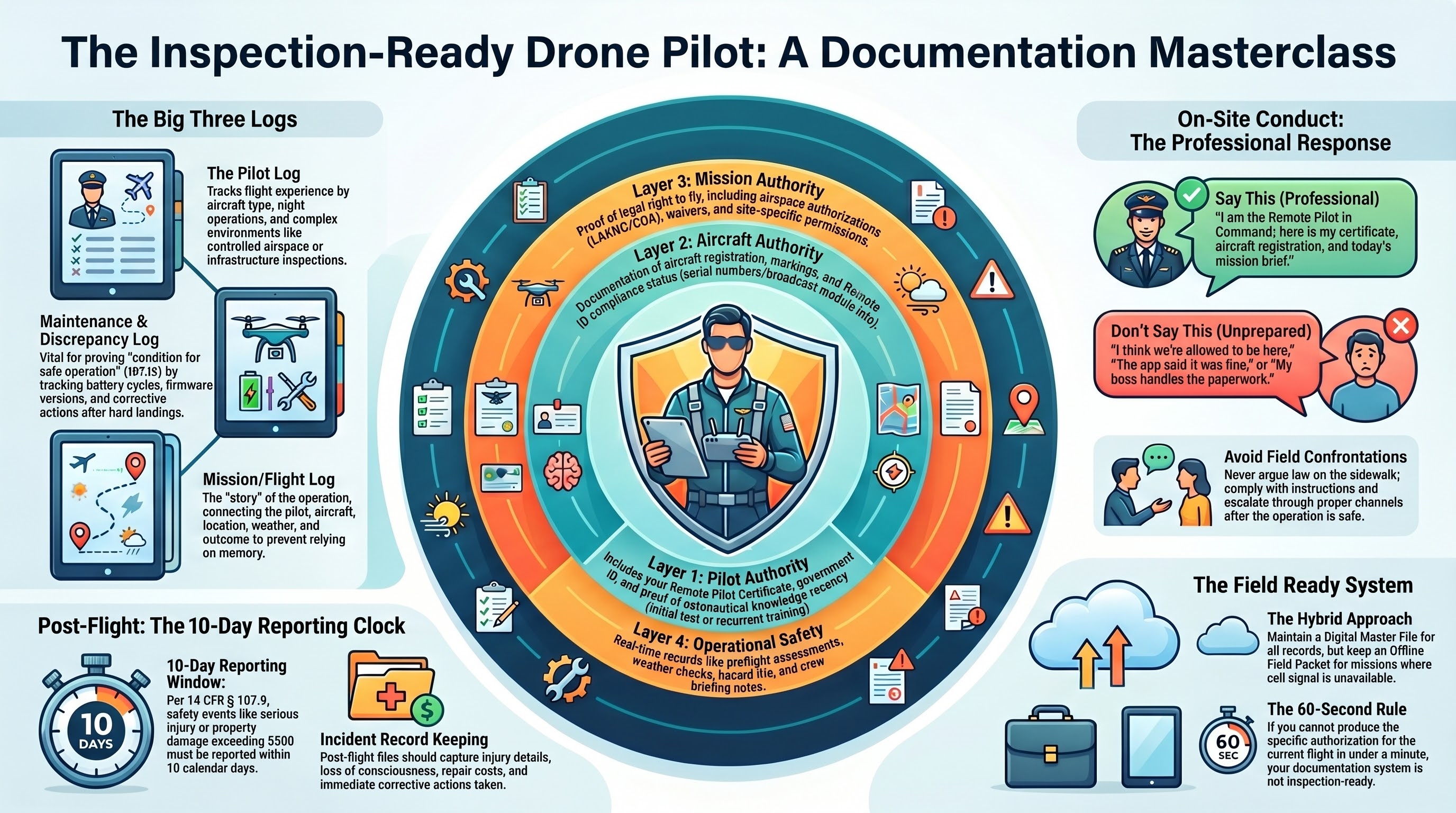
Think in layers:
- Pilot authority: certificate, ID, recurrent training, role assignment.
- Aircraft authority: registration, marking, Remote ID status, serial numbers.
- Mission authority: airspace authorization, waiver, customer scope, site permission where applicable.
- Operational safety: preflight assessment, aircraft condition, crew briefing, weather, hazards, contingency plan.
- Post-flight accountability: mission log, discrepancies, maintenance actions, incident or safety-event reporting if required.
That is the master file. Not because every item is always explicitly required as a “log,” but because every item answers a question an inspector, investigator, or competent customer may reasonably ask.
The Inspection-Ready File: What Should Be Available Before Takeoff
A commercial drone crew should be able to pull up the essentials on site without hunting through inboxes, cloud folders, and half-remembered app exports.
At minimum, the remote pilot in command should have ready access to:
- Remote pilot certificate with small UAS rating.
- Government photo identification.
- Proof of aeronautical knowledge recency under 14 CFR § 107.65, including the initial test or recurrent training record.
- Aircraft registration and matching aircraft marking information under 14 CFR Part 48.
- Remote ID compliance information for the aircraft or broadcast module, if the aircraft is registered or required to be registered.
- Airspace authorization if operating in controlled airspace under 14 CFR § 107.41.
- Any waiver, exemption, or operational approval used for the flight.
- Site-specific mission plan or job brief.
- Preflight risk assessment and aircraft condition check.
- Crew briefing notes if visual observers or other direct participants are involved.
- Emergency or contingency procedures appropriate to the site.
- Post-flight mission log and discrepancy log.
This does not need to be theatrical. A well-organized digital folder can beat a three-ring binder if it is accessible offline, clearly named, and backed up. The test is simple: if someone asks for the authorization tied to today’s flight, can you produce the right document in under a minute?
If the answer is no, the system is not inspection-ready.
The Big Three Logs Operators Should Actually Keep
Even though Part 107 does not prescribe a universal flight-log format, professional operators should maintain three practical logs: pilot, aircraft, and mission.
1. Pilot Log
The pilot log is not just about total time. It should show that the person acting as remote pilot in command is qualified, current, and experienced for the mission type.
For each pilot, retain:
- Remote pilot certificate information.
- Recurrent training completion date.
- Flight experience by aircraft type or mission category.
- Night operations experience, if applicable.
- Complex environment experience: controlled airspace, construction sites, public safety support, infrastructure inspection, mapping, operations near nonparticipants, or other higher-risk profiles.
- Company training, SOP acknowledgments, and crew-resource-management notes where applicable.
This becomes especially important when the operation is more complex than a basic visual-line-of-sight photo flight. If an operator is flying near critical infrastructure, in controlled airspace, around a construction site, or under a waiver, the record should show that the crew was not improvising.
2. Aircraft Maintenance and Discrepancy Log
14 CFR § 107.15 says no person may operate a civil small UAS unless it is in a condition for safe operation. Before each flight, the remote pilot in command must check the system to determine whether it is safe. If the aircraft is no longer in a condition for safe operation, the flight cannot continue.
That requirement is simple on paper and messy in the field.
A maintenance and discrepancy log gives the remote pilot a record of the aircraft’s condition over time. It should track:
- Aircraft make, model, serial number, and registration.
- Remote ID serial number or broadcast module information.
- Battery identifiers and cycle counts when practical.
- Firmware versions when updates affect flight behavior, geofencing, Remote ID, or control-link reliability.
- Propeller, motor, airframe, payload, and sensor inspections.
- Damage, hard landings, abnormal vibration, link-loss events, GPS problems, battery warnings, or payload anomalies.
- Corrective actions taken before the next flight.
- Who returned the aircraft to service.
Do not treat this as paperwork for paperwork’s sake. The maintenance log is how the operator proves that “condition for safe operation” was not a guess.
3. Mission or Flight Log
The mission log is the story of the operation. It connects the pilot, aircraft, location, authorization, weather, crew, and outcome.
A useful mission log captures:
- Date, time, location, and customer or project name.
- Remote pilot in command and any person manipulating the controls.
- Visual observers and directly participating personnel.
- Aircraft and batteries used.
- Airspace class and authorization reference if applicable.
- Weather and visibility check.
- Operating area, launch/recovery site, and hazard notes.
- Applicable waiver, exemption, or special approval.
- Preflight inspection result.
- Crew briefing confirmation.
- Start and stop times, flight count, and high-level mission outcome.
- Abnormal events, incidents, near misses, complaints, or law-enforcement contacts.
- Post-flight aircraft condition.
If there is ever a question later, this log prevents the operator from reconstructing the mission from memory. Memory is not a compliance system. It is a creative writing prompt under stress.
The Preflight Assessment Is Your Best Defense
The strongest inspection file usually starts before the aircraft is powered on.
14 CFR § 107.49 requires the remote pilot in command to assess the operating environment before flight. That assessment includes local weather, local airspace and flight restrictions, people and property on the surface, and other ground hazards. The remote pilot must also brief directly participating personnel on operating conditions, emergency procedures, contingency procedures, roles and responsibilities, and potential hazards. The pilot must confirm control links, available power, payload security, and, for operations over people, the applicable aircraft category requirements.
That is not just a checklist. It is the core of the professional operator’s defense.
A good preflight record should answer:
- What airspace did we check?
- Were there any TFRs, NOTAMs, facility restrictions, LAANC limits, or customer constraints?
- What weather source did we use, and was it suitable for the aircraft and mission?
- Where were people, vehicles, structures, utilities, roads, and other hazards?
- What was the lost-link plan?
- What was the emergency landing area?
- Who was briefed, and what were their roles?
- What changed from the original plan, and who accepted that change?
The last question matters. A lot of operations fail not because the original plan was bad, but because the crew normalized a field change that should have triggered a pause.
Waivers, BVLOS, and Flights Over People Need a Decision Trail
Basic Part 107 flights need documentation. Advanced operations need a decision trail.
If the operation involves BVLOS, operations over people, operations over moving vehicles, multiple aircraft, complex controlled airspace, or any other approval-driven profile, the file should show more than the final authorization. It should show how the operator stayed inside the operating envelope.
That means retaining:
- The waiver, exemption, or authorization itself.
- Any FAA conditions and limitations attached to it.
- The mission-specific method of compliance.
- Crew qualifications required by the approval.
- Aircraft configuration required by the approval.
- Communications procedures.
- Lost-link and contingency procedures.
- Ground-risk controls.
- Evidence that the actual flight matched the approved profile.
This is where many operators make a subtle mistake. They save the waiver, but not the operational proof that they followed the waiver. An inspector does not only care that the company has a permission slip. The real question is whether the mission was conducted within the conditions of that permission slip.
Digital vs. Paper: Use Whatever Survives the Field
There is nothing wrong with digital records. In fact, for most operators, digital is better. Tools such as AirData-style fleet logs, UAS operations platforms, cloud folders, maintenance trackers, and flight-planning apps can create a stronger audit trail than paper ever did.
But digital systems fail in very ordinary ways: no cell service, expired login, missing shared-folder permission, dead tablet, wrong aircraft profile, or a file named “final_final_realone.pdf” in the wrong account.
The best system is usually hybrid:
- Digital master file: all certificates, authorizations, aircraft records, logs, maintenance entries, insurance, SOPs, and customer documents.
- Offline field packet: today’s mission plan, certificate copy, registration, authorization, emergency contacts, and key procedures stored locally on the field device.
- Small paper fallback: certificate and ID already required physically, plus a one-page mission brief or QR-coded document index for larger crews.
Paper is not superior. Digital is not magic. The right answer is the system that still works when the site superintendent is waiting, the cell signal is gone, and a police officer is asking why a drone is over the jobsite.
What to Say On Site — and What Not to Say
If an FAA inspector or law enforcement officer asks about the operation, the remote pilot should be calm, factual, and narrow.
Good answers sound like this:
- “I am the remote pilot in command for this operation.”
- “Here is my remote pilot certificate and identification.”
- “This aircraft is registered, and here is the registration information.”
- “We are operating under this airspace authorization.”
- “Here is today’s mission brief and preflight assessment.”
- “The aircraft is broadcasting Remote ID through this aircraft/module.”
- “If you need additional records, I can make them available through our operations file.”
Bad answers sound like this:
- “I think we’re allowed to be here.”
- “The app said it was fine.”
- “My boss handles the paperwork.”
- “We always fly this site.”
- “I don’t have that with me, but I can probably find it later.”
- “The FAA never checks this stuff.”
The difference is not charisma. It is preparation.
Also: do not argue law on the sidewalk. If there is a disagreement, document the contact, preserve the records, comply with lawful instructions, and escalate through the proper channel after the operation is safe. A field confrontation is rarely where a regulatory interpretation gets smarter.
Reporting Events: The Ten-Day Clock
If a flight goes wrong, documentation becomes even more important.
Under 14 CFR § 107.9, a remote pilot in command must report certain safety events to the FAA no later than 10 calendar days after the operation. The reporting trigger includes serious injury, loss of consciousness, or qualifying property damage other than damage to the small unmanned aircraft itself. Property damage is generally reportable unless repair cost, including materials and labor, does not exceed $500, or the fair market value is $500 or less in the event of total loss.
That means the post-flight file should preserve the facts needed to decide whether a report is required:
- What happened?
- Who was involved?
- Was anyone injured?
- Was there loss of consciousness?
- What property was damaged?
- What was the repair cost or fair market value?
- What aircraft damage occurred?
- What immediate corrective actions were taken?
- Were flights suspended for that aircraft or crew pending review?
The worst time to decide what happened is nine days later with incomplete notes.
The Customer Angle: Documentation Wins Work
This topic is often framed as avoiding FAA trouble. That is too narrow.
Good documentation also wins serious customers.
Enterprise clients, utilities, public agencies, construction firms, insurers, and infrastructure owners increasingly care about aviation process. They do not just want pretty imagery or a point cloud. They want to know the operator can show up, manage risk, avoid embarrassing the organization, and produce records if something goes wrong.
A professional documentation package can become part of the sales process:
- Certificate and training matrix.
- Aircraft and Remote ID inventory.
- Insurance certificate.
- SOP summary.
- Site-specific risk assessment template.
- Airspace authorization workflow.
- Maintenance/discrepancy process.
- Incident reporting process.
- Data-security and customer-deliverable handling process where relevant.
For small operators, this is a competitive advantage. Many pilots can fly the mission. Fewer can prove they managed the mission.
A Practical Inspection-Ready Checklist
If you operate commercially, build a reusable folder structure before the next job. Keep it simple enough that you will actually maintain it.
Suggested structure:
/Compliance
  /Pilots
    Remote pilot certificate
    Recurrent training record
    Company training / SOP acknowledgment
  /Aircraft
    FAA registration
    Remote ID serial / declaration information
    Maintenance and discrepancy log
    Firmware / configuration notes
  /Authorizations
    LAANC / airspace approvals
    Waivers / exemptions / COAs
    Customer site permissions
  /Missions
    YYYY-MM-DD_Project_Location
      Mission brief
      Preflight risk assessment
      Airspace check
      Weather check
      Crew briefing
      Flight log
      Post-flight notes
  /Safety Events
    Event reports
    Photos / statements
    Corrective actions
Then set one rule: if a mission would be hard to explain without a record, create the record before launching.
That single habit prevents most documentation problems.
Tactical Briefing Pack
This article now has a companion tactical briefing pack with a video walkthrough, full-size documentation blueprint, and downloadable PDF field packet.
Operator Bottom Line
An FAA inspection should not feel like a pop quiz. It should feel like opening the right folder.
For Part 107 operators, the inspection-ready mindset is straightforward: carry your certificate and ID, know the authority for the mission, prove the aircraft was legal and safe, document the preflight decision, and preserve the post-flight facts. The FAA does not require a ceremonial logbook, but professional operations require a traceable record.
That distinction matters. Compliance is not just avoiding a violation after something goes wrong. It is being able to show, before anything goes wrong, that the operation was planned, briefed, authorized, and flown by people who understood the rules.
The pilots who survive inspections are not the ones with the most paper. They are the ones whose records tell a clean, boring story.
In aviation, boring is usually the point.
Sources
- 14 CFR § 107.7 — Inspection, testing, and demonstration of compliance
- 14 CFR § 107.15 — Condition for safe operation
- 14 CFR § 107.49 — Preflight familiarization, inspection, and actions
- 14 CFR § 107.65 — Aeronautical knowledge recency
- 14 CFR § 107.9 — Safety event reporting
- 14 CFR Part 48 — Registration and marking requirements for small unmanned aircraft
- FAA: Remote Identification of Drones
- FAA: Certificated Remote Pilots including Commercial Operators