
By Wesley Alexander • May 9, 2026 • 8 min read
The FAA has opened public comment on a draft environmental assessment for Wing Aviation's proposed drone delivery expansion across the Houston metropolitan area. On paper, it is a NEPA document: a review of noise, air quality, biological resources, historic properties, land use, and related environmental impacts. In practical terms, it is something more operationally interesting.
It is a scale signal.
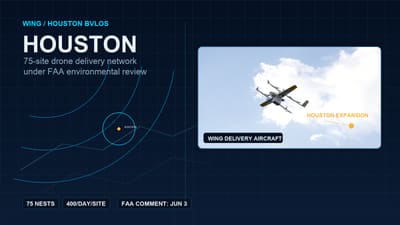
Wing is not asking to run a novelty route or a tightly bounded demonstration. The proposal describes a Houston-area network of up to 75 drone nests, each capable of supporting up to 24 aircraft and up to 400 deliveries per operating day. At full theoretical buildout, that is 30,000 deliveries per day across one metro area. Actual ramp rates will almost certainly be lower, but the important point is that the FAA is now reviewing metro-scale BVLOS package delivery as an operating model, not as a science project.
For operators, regulators, retailers, and local agencies, Houston is worth watching because it shows how the drone delivery market is likely to expand before broad Part 108 rules arrive: through Part 135 operating authority, site-by-site environmental review, and incremental amendments to an existing certificate holder's operating specifications.
What the FAA Is Reviewing
The FAA's May 2026 Draft Environmental Assessment evaluates Wing Aviation, LLC's proposed commercial drone package delivery operations in the Houston metropolitan area. Wing is an Alphabet subsidiary and already holds Part 135 air carrier authority for drone delivery. The federal action under review is not a brand-new rulemaking. It is the FAA's proposed approval of amendments and related authorizations that would let Wing expand its drone delivery service in Houston.
The comment period runs from May 4 through June 3, 2026, with comments due by 5:00 p.m. Central Time on June 3. The FAA says substantive comments will be addressed in the final environmental assessment.
The proposed network would place nests in commercially zoned areas such as shopping centers, malls, and large retail properties. Each nest would serve an approximately six-mile delivery radius. The draft assessment also describes 100 to 300 autoloaders — passive Y-shaped loading stands used for package pickup — placed at nests or partner locations.
That site model matters. Wing is not proposing a traditional airport-centered drone network. It is proposing distributed aviation infrastructure embedded in ordinary retail real estate. For local planners, that means the practical aviation footprint shifts from airports and heliports into parking lots, shopping centers, and neighborhood-adjacent commercial property.
The Operational Scale Is the Story
The headline numbers deserve to be read carefully:
- Up to 75 drone nests across the Houston metro area
- Up to 24 aircraft per nest
- Approximately six-mile radius per nest
- Up to 400 deliveries per operating day per nest
- Typical flights between 150 and 300 feet AGL, below 400 feet AGL
- Package delivery by hover and lowering line, with the aircraft descending to about 23 feet AGL at the delivery point
These are maximum planning values, not a promise that Houston wakes up one morning with tens of thousands of drone flights overhead. But maximum planning values are still useful because they reveal the envelope the FAA is being asked to evaluate.
The shift is from route approval to network approval. A single delivery nest is a local operation. Seventy-five nests become a citywide aviation layer. That changes the questions regulators and communities should be asking. Noise is no longer just about the acoustic signature of one aircraft. It becomes a question of concentration, routing diversity, delivery density, sensitive receptors, and repeat exposure over the same neighborhoods.
Airspace integration also changes. A few delivery drones are an operational accommodation. A full metro network becomes recurring low-altitude traffic. Even if each aircraft remains below 400 feet, the cumulative picture matters for helicopter operations, public safety aviation, emergency response routes, local airports, and other uncrewed operators working in the same urban volume.
Why This Is Happening Before Part 108
The timing is the tell. The industry is still waiting on the broader FAA BVLOS framework under Part 108. Meanwhile, certificate holders with mature safety cases are not waiting for the entire rulemaking process to finish. They are using the authorities that already exist.
Wing's Houston proposal sits inside the current toolbox: Part 135 operations, exemptions, operating specifications, environmental assessment, and FAA approval of defined operating concepts. That is not as clean as a universal BVLOS rule, but it is workable for a company with the resources to build a safety case and manage the approval process.
For everyone else, the lesson is uncomfortable but useful. The companies that can scale before Part 108 are the companies that can absorb bespoke regulatory overhead. That includes legal work, environmental documentation, community coordination, flight operations engineering, detect-and-avoid validation, contingency planning, and ongoing FAA engagement. The future may eventually become standardized. The present is still negotiated.
That is why Houston matters even if your operation has nothing to do with package delivery. It shows the pathway available to well-capitalized BVLOS operators right now. It also shows the likely pressure Part 108 will need to relieve if the FAA wants smaller operators to compete.
Environmental Review Is Becoming an Expansion Tool
The draft assessment is framed around environmental impact, but the operational detail inside it is substantial. That is normal for NEPA work: the agency has to define the proposed action clearly enough to evaluate impacts. In the drone delivery context, that means the environmental document becomes one of the best public windows into the actual operating model.
The FAA review covers subjects such as noise, air quality, land use, biological resources, hazardous materials, and historic preservation. The draft assessment's preliminary position is that the proposed operation would not create significant noise or air-quality impacts under the assumptions studied. That finding will be debated by commenters, especially in communities that are more concerned with repeated overflight than with the single-event noise profile of one drone.
For operators, the deeper point is that environmental documentation is no longer peripheral. If a drone program wants to scale into dense commercial or residential environments, environmental review becomes part of the operational approval stack. Noise modeling, flight profiles, generator emissions, parking-lot infrastructure, battery charging, route design, and community-sensitive locations all become approval artifacts.
That is a different skill set than writing a CONOPS for a rural BVLOS inspection corridor.
What Communities Should Actually Comment On
The public comment opportunity is not a referendum on whether drones are good or bad. The useful comments will be specific. Communities, agencies, and operators should focus on the assumptions that shape the FAA's analysis.
Questions worth asking include:
- How will Wing prevent repeated route concentration over the same homes, schools, parks, or outdoor gathering areas?
- What route-variation or "fly less" logic will be used around sensitive receptors?
- How will complaint data be collected, reported, and used to modify operations?
- What are the assumptions behind the maximum daily delivery estimates?
- How will public safety helicopter routes and emergency-response operations be protected?
- What happens when multiple drone operators want to serve the same commercial zones?
- How will temporary diesel-generator use be limited as nests transition to grid power?
- What local information will be shared before a nest becomes active?
That last point is important. The regulatory approval may sit with the FAA, but public acceptance is local. A city or county that first hears about a drone delivery nest when aircraft show up over a neighborhood is already behind the curve. The operational rollout needs a local-notice model that is more specific than a federal comment docket.
The Competitive Signal
Wing is not the only company trying to crack drone delivery. Amazon is pushing Prime Air, Zipline is expanding platform-based delivery, DroneUp has had to rethink parts of its model, and retailers are still deciding whether delivery drones are a customer-acquisition tool, a logistics tool, or a press-release tool.
Houston is significant because it ties retail infrastructure to a broad urban approval envelope. Wing and Walmart have already been working together in the Houston area. If the environmental review supports expansion, the next competitive question is not whether a drone can carry a small package. That has been answered. The question is whether a distributed nest network can produce enough delivery density to justify the infrastructure, staffing, maintenance, customer support, and regulatory overhead.
That is where many drone delivery concepts have struggled. The aircraft can work and the economics can still fail. A 75-nest proposal is a bet that density solves part of the economics. The FAA's document gives the public a rare look at what that density might look like when translated into aviation assumptions.
Operator Bottom Line
Wing's Houston proposal is a preview of how urban BVLOS delivery will scale in the gap between today's waiver-and-certificate environment and tomorrow's Part 108 framework. It is not just an environmental filing. It is a public operating blueprint.
If you are a commercial drone operator, the takeaway is that the next generation of approvals will be judged on more than aircraft reliability. The FAA and the public will look at route design, noise exposure, contingency planning, infrastructure footprint, community notice, emissions assumptions, and how the operation fits into existing low-altitude users.
If you are a public agency or local planner, the takeaway is that drone delivery infrastructure is coming through commercial real estate before it comes through traditional aviation channels. Parking lots and retail centers may become aviation nodes. That requires a local playbook.
And if you are watching Part 108, Houston is a useful reminder that the market will not wait politely for the rulebook to be finished. The largest operators will keep moving through the approvals that exist. The question is whether the eventual BVLOS rule makes that pathway more accessible — or simply formalizes a race that the biggest players already started.