
By Wesley Alexander • August 25, 2026 • 8 min read
Tactical Summary
Two counter-drone stories have dominated the last two months: Congress gave state and local police the authority to detect, track, and in some cases seize or disable drones, and the agencies opened a comment window on how that authority is governed. Both matter. But there is a third story that is quieter and, for a working operator, more consequential: the money to actually buy that equipment has landed, and it is being spent right now.
FEMA's Counter-UAS Grant Program puts $500 million into state and local hands across two fiscal years. The FY2026 tranche, $250 million, was awarded on December 30, 2025, prioritized for the eleven states hosting FIFA World Cup 2026 events and the National Capital Region. Today and tomorrow, August 25 and 26, the buyers who spend that money are meeting at IDGA's Counter-UAS Summit at MGM National Harbor to talk requirements and procurement with the vendors who build detection and mitigation hardware. The abstract authority you read about in July is now a purchase order.
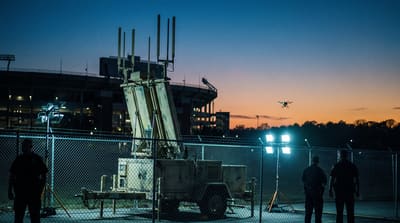
For legal operators, the takeaway is not about defense budgets. It is about airspace density. Over the next several quarters, more locally operated sensors and mitigation systems are going to appear near stadiums, prisons, critical infrastructure, and major public events. That is exactly the airspace where commercial mapping, inspection, and public-safety crews already work. Your job now is to make sure your lawful flight is legible to those systems before force logic ever gets applied to it.
Follow the money, not the press release
The program was established under the One Big Beautiful Bill Act, 2025 (Pub. L. No. 119-21, Sec. 90005(a)) and is administered through FEMA. The structure tells you where the density will build first.
FY2026's $250 million went to Tier 1 jurisdictions tied to megaevent security. The published state allocations are not small: California received roughly $34.6 million, Texas about $30.3 million, the National Capital Region (District of Columbia on behalf of DC, Maryland, and Virginia) about $28.3 million, Florida about $23.6 million, and New Jersey about $21.8 million. FY2027 adds another $250 million and opens eligibility to all 56 State Administrative Agencies, shifting the emphasis from event-specific security toward standing, nationwide detection and response.
One eligibility detail matters for any operator or program manager who wants situational awareness: only State Administrative Agencies can apply directly to FEMA. Cities, counties, and law enforcement agencies participate as subgrantees through their state. If you want to know what is being fielded in your operating area, the trail runs through your state's homeland security or emergency management office, not through a hundred separate municipal budgets. That single point of contact is how you find out what is going live near your routes.
Why this is a density problem, not a market story
We have written before about the market consolidation angle, most directly when Motorola paid $1.5 billion for D-Fend and pulled counter-UAS into the public-safety technology stack. That was a signal about who owns the market. This is different. This is about how many systems get deployed, and where.
Detection is the part that expands fastest, because detection is the least legally constrained tier and the easiest to justify on a grant application. Passive RF sensors, radar, and acoustic arrays do not require the higher certification threshold that mitigation does. So the near-term reality is a growing web of systems that see your aircraft, log it, and feed a threat-assessment workflow run by people who have never met you and cannot read your intent from a radar track.
The problem is that detection does not read a waiver. It reads a signature. A properly authorized, TFR-compliant, Remote ID-broadcasting survey flight and an unauthorized incursion can look similar on a first-pass sensor return. The rule that governs what happens next, the SAFER SKIES interim final rule, authorizes mitigation of a drone assessed as a credible threat. It does not build a clean mechanism to distinguish your lawful flight before that assessment hardens. If you have not read the operator breakdown of what that rule actually authorizes local police to do, start there, because the money we are describing is what turns that authority into deployed capability.
The spectrum layer makes mitigation cheaper to field
Buying a jammer is one thing. Being allowed to turn it on is another. The FCC moved on that in the same July window, clarifying the anti-interference provisions of Section 333, issuing blanket temporary spectrum authority, waiving certain equipment authorization requirements, and opening experimental testing paths. In plain terms, the agency deliberately reduced the friction that used to keep local RF mitigation rare.
That is efficient for an agency standing up a program on grant money. It is a shared-spectrum risk for everyone else operating in the same bands. RF mitigation works by attacking the command-and-control link, and a signal aimed at a threat drone does not respect a tidy boundary. A collateral hit on your C2 or your GPS during a legal BVLOS or public-safety mission is a safety event, not a paperwork problem. We covered the licensing mechanics in the FCC DA 26-314 spectrum reform breakdown; the point here is that the grant money and the spectrum relief arrived together, by design, to accelerate fielding.
What a working operator should actually do
You cannot stop the buildout, and you would not want to. Most of it is aimed at genuine threats. What you can do is make your own operations impossible to mistake for one.
Broadcast Remote ID cleanly, every flight, and verify it. Remote ID is increasingly the input a detection system uses to sort cooperative traffic from suspicious traffic. A dropped or misconfigured broadcast turns you into an anonymous track. Treat a confirmed, correct Remote ID broadcast as a safety-critical preflight item near any protected category site.
Pre-coordinate near protected sites. If your work puts you near a stadium, a correctional facility, an airport, or a National Special Security Event footprint, get ahead of it. Notify the controlling authority, carry your authorization on the aircraft crew, and know who runs the local C-UAS program. In a World Cup host state or the National Capital Region, assume a program exists and is funded.
Document your compliance posture as evidence, not paperwork. Keep your waiver, your TFR checks, your Remote ID configuration, and your flight logs in a form you can produce quickly. If a mitigation event ever touches your aircraft, your contemporaneous record of lawful operation is the difference between an incident report and a liability.
Track the money through your state. Ask your State Administrative Agency what C-UAS capability is being fielded under the FEMA grant in your operating area. It is public-interest information, and it tells you where sensor density is about to rise before you find out the hard way.
The operator takeaway
The counter-drone debate has moved past whether the authority should exist. Congress settled that in the FY2026 NDAA, the rule is live, and as of December the money is awarded and flowing. The summit happening in National Harbor today is where that money turns into fielded systems. For the legal operator, the practical consequence is simple and near-term: the airspace you fly in is getting more instrumented, more of the sensors belong to agencies with new mitigation authority, and your protection increasingly depends on how legible and well-documented your operations are.
This is a good moment to pressure-test your own posture. If your operations put you anywhere near an event, a prison, an airport, or critical infrastructure in a funded state, the question is not whether local counter-UAS capability is coming. It is whether your flights are set up to be recognized as lawful before anyone has to decide. If you want help translating your operating profile into a compliance-and-coordination posture for the newly funded C-UAS environment, that regulatory-to-operational translation is exactly the work we do. Reach out through the site.
Sources
- FEMA, "Counter Unmanned Aircraft Systems Grant Program" (FY2026 $250M, awards announced December 30, 2025; state allocations): https://www.fema.gov/grants/preparedness/counter-unmanned-aircraft-systems-grant-program
- Counter-UAS Grant Program Notice of Funding Opportunity (established under Pub. L. No. 119-21, Sec. 90005(a); $500M over FY2026-2027; FY2026 prioritized for FIFA World Cup host states and the National Capital Region): https://www.caloes.ca.gov/wp-content/uploads/Grants/Documents/2.-C-UAS-Grant-Program-NOFO.pdf
- IDGA Counter-UAS Summit, August 25-26, 2026, MGM National Harbor, MD (official agenda): https://www.idga.org/events-counteruas-usa/agenda-mc
- Federal Register, "Counter-UAS Authority for State, Local, Tribal, and Territorial Law Enforcement and Correctional Agencies," document 2026-13609 (interim final rule, effective July 1, 2026, docket FBI-2026-0001): https://www.federalregister.gov/documents/2026/07/06/2026-13609/counter-uas-authority-for-state-local-tribal-and-territorial-law-enforcement-and-correctional
- Holland & Knight, "Latest FCC, DOJ, DHS Actions on Drones Indicate Increased National Security Focus" (FCC Section 333 clarification, blanket temporary spectrum authority, equipment authorization waivers): https://www.hklaw.com/en/insights/publications/2026/07/latest-fcc-doj-dhs-actions-on-drones-increased-national-security
- Morgan Lewis, "Preparing for the Next Megaevent: New Federal Counter-UAS Rules Will Reshape Aviation Security" (700+ drones seized near 2026 World Cup match sites): https://www.morganlewis.com/pubs/2026/07/preparing-for-the-next-megaevent-new-federal-counter-uas-rules-will-reshape-aviation-security-in-the-united-states