

By Wesley Alexander • May 7, 2026 • 10 min read
The drone industry's next bottleneck is not airframes. It is people.
That is the uncomfortable read-through from the current wave of BVLOS rulemaking, hiring commentary, and operator behavior. The FAA's proposed Part 108 framework is aimed at normalizing beyond visual line of sight operations across package delivery, agriculture, aerial surveying, public safety, recreation, and flight testing. Aircraft manufacturers are ready to sell vehicles. Software teams are ready to sell autonomy stacks. Investors are ready to sell the story.
But a scalable BVLOS operation still needs trained humans who understand airspace, automation supervision, command-and-control failure modes, maintenance control, cybersecurity, safety management, data quality, and regulatory accountability. Those people are in shorter supply than the industry likes to admit.
AIN's FutureFlight recently framed the issue directly: the drone industry is facing a talent crunch as BVLOS rules approach the finish line. Their headline example is telling. A cargo aircraft such as MightyFly's Cento may not carry a pilot onboard, but it does not operate without people. It shifts the human role from stick-and-rudder control to systems supervision, contingency management, maintenance readiness, dispatch discipline, and operational governance.
That is not a smaller workforce problem. It is a different workforce problem.
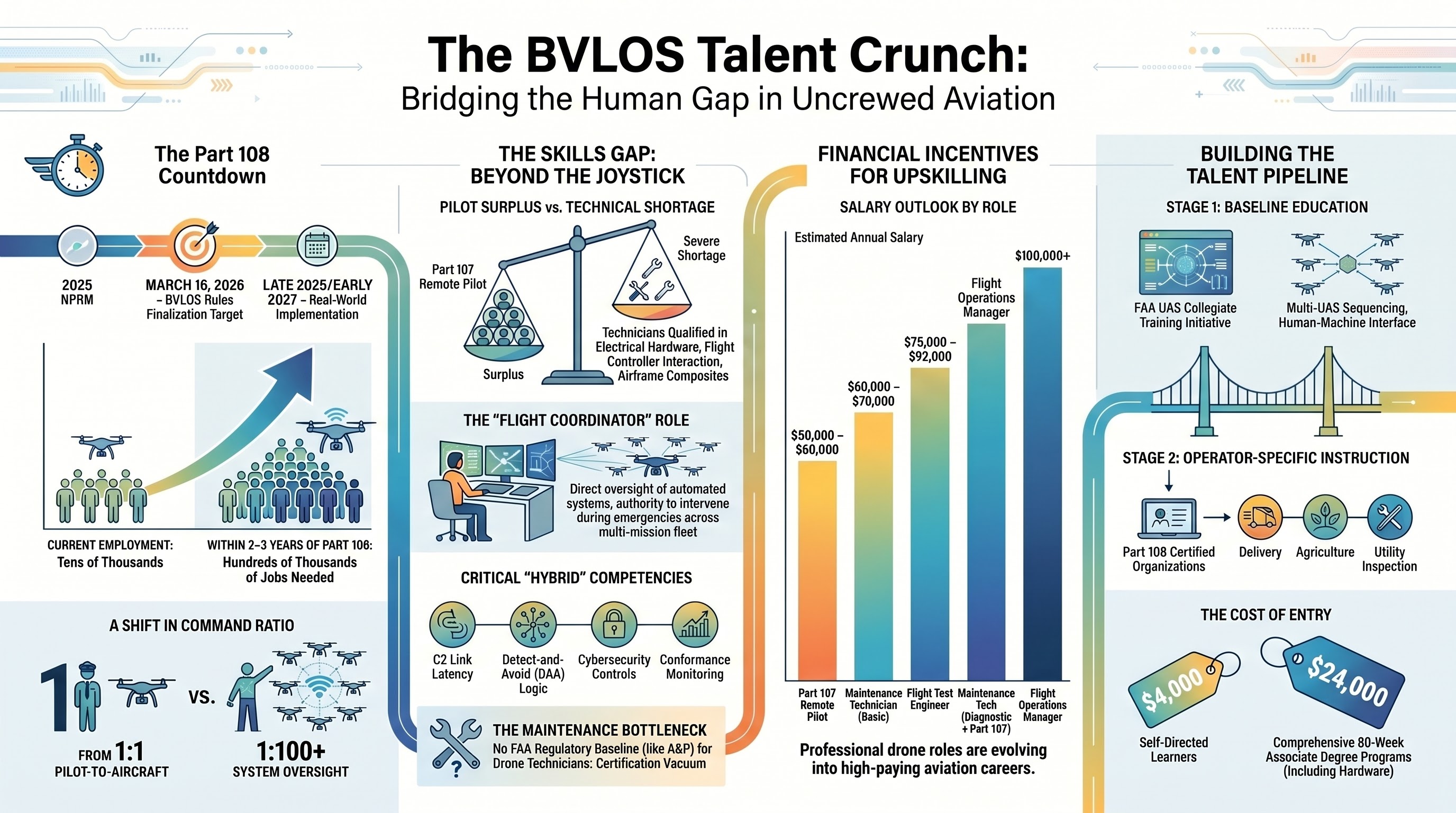
BVLOS Changes the Job Description
Part 107 created a large population of certificated remote pilots. That was necessary, but it was never sufficient for routine BVLOS at scale. A visual-line-of-sight inspection crew can often be organized around one aircraft, one pilot, one observer, one customer site, and a tightly bounded mission. BVLOS operations are closer to an aviation system: approved areas, defined routes, operating limitations, crew qualification, records, reporting, maintenance tracking, communications coverage, and contingency procedures.
The FAA's BVLOS fact sheet makes the personnel shift explicit. For certificated operators, the proposed framework identifies two required operational roles: an operations supervisor responsible for overall safety, security, compliance, and training, and a flight coordinator providing direct oversight of aircraft operations with authority to intervene. Neither role is described as a traditional onboard pilot job. Both are aviation accountability jobs.
That distinction matters. The industry has spent years telling the public that autonomy reduces the need for pilots. It may reduce the need for one person to manually command one aircraft. It does not reduce the need for disciplined operational control. If anything, it raises the bar because the human is now supervising a system whose failure modes are distributed across software, network coverage, detect-and-avoid behavior, battery health, ground infrastructure, and airspace assumptions. The same pressure shows up in the electronic conspicuity fight: the technology argument is inseparable from the question of who is trained to monitor it.
The Scarce Roles Are Not Just Remote Pilots
The most useful hiring analysis right now is not the usual "drone pilot jobs are growing" headline. It is the more precise observation that drone companies need hybrid people.
Christian & Timbers' 2026 drone hiring guide identifies several constrained categories: UAV systems engineers, BVLOS operations specialists, drone software developers, aerial data and geospatial specialists, regulatory and compliance experts, and program managers who can translate between engineering, customers, and FAA timelines. UAVJobs' 2026 hiring analysis reaches a similar conclusion from the operator side: the market is moving away from simple pilot gigs toward full UAS operations and data roles.
That matches what serious programs already know. A utility inspection customer does not buy "flight hours." They buy validated asset data delivered safely inside a constrained operating environment. A public safety agency does not need a pilot who can merely launch a quadcopter. It needs someone who can build a response procedure, manage batteries and payloads, brief incident command, preserve chain of custody when necessary, and keep crews inside policy when the radio traffic gets ugly.
BVLOS adds another layer. The operator now needs people who understand:
- C2 link coverage, latency, lost-link logic, and degraded command paths
- Detect-and-avoid assumptions, including cooperative and noncooperative traffic
- Conformance monitoring and when to stop trusting the automation
- Maintenance release discipline for aircraft that may fly many cycles per day
- Cybersecurity controls for ground stations, networks, and data paths
- Remote ID, recordkeeping, incident reporting, and operational data retention
- Human factors in multi-aircraft or high-tempo supervision environments
That is a different profile from a recreational pilot who turned professional after passing the Part 107 knowledge test. The industry should stop pretending those are the same labor pools.
The FAA Proposal Makes Training a Business Requirement
The proposed BVLOS framework does not just permit operations. It creates a compliance architecture around them.
The FAA says operators would need approval for the areas where they intend to fly, including boundaries, approximate daily operation counts, takeoff and landing areas, communications coverage, and lost-link procedures. Certificated operations would require a safety management system and a training program. Operators would maintain records for flights, assigned personnel, mechanical issues, maintenance and alteration inspections, personnel training, and operations manuals. Security requirements would include physical security and cybersecurity policies, with TSA threat assessments for covered personnel.
That is not a side project for the most enthusiastic pilot on staff. It is an aviation department.
Small companies will feel this first. A startup can buy an aircraft, contract a software stack, and hire a clever Part 107 pilot. It cannot fake an operations supervisor who understands how to defend a safety case after an off-nominal event. It cannot fake a maintenance control process when a fleet starts cycling every day. It cannot fake a cybersecurity program when the control station becomes part of the operational risk picture. The lesson is similar to the one in UAVHQ's BVLOS compliance checklist: the paperwork is only useful if it reflects a real operating system.
Defense and Commercial Operators Are Competing for the Same People
The commercial market is not hiring in a vacuum. Defense demand for uncrewed systems, counter-UAS, autonomy, ISR, and expeditionary operations is pulling on the same engineers, operators, test personnel, software developers, and program managers. Clearance requirements narrow the candidate pool further. Hardware-centric roles remain geographically constrained, and operations roles often cannot be solved with remote work.
That matters because many commercial drone companies are not the highest bidder in the room. A BVLOS operations specialist with real waiver experience, safety case experience, and flight-test scars can work for a delivery company, a defense contractor, a public safety integrator, a counter-UAS firm, an aircraft manufacturer, or a regulator-facing consultancy. The labor market will not wait for a six-round interview process and a vague job description that says "drone ninja."
The companies that win talent will be the ones that define the mission clearly: what airspace, what aircraft, what operational risk, what customer, what authority, and what success looks like. Serious operators are attracted to serious problems. They are less attracted to slide decks pretending that autonomy eliminated the hard parts.
Training Pipelines Need to Look More Like Aviation
The obvious answer is to train more people, but the details matter. The drone industry does not need a larger population of basic stick operators as much as it needs structured progression:
- Foundational remote pilot competence. Airspace, weather, Part 107, crew resource management, radio discipline, and conservative decision-making.
- Domain specialization. Utility inspection, mapping, public safety, agriculture, delivery, construction, or defense support.
- Systems qualification. Aircraft, payloads, ground control station, C2 architecture, emergency modes, batteries, maintenance limitations, and software release behavior.
- Operational control. Dispatch, risk assessment, NOTAM review, mission release, contingency planning, recordkeeping, and post-flight review.
- BVLOS supervision. Conformance monitoring, DAA assumptions, lost-link response, multi-aircraft tempo, and intervention criteria.
- Leadership and accountability. Operations supervisor, chief remote pilot, safety manager, maintenance controller, or program manager roles.
That progression cannot be replaced by a weekend course. The better model is industry apprenticeship backed by standards: formal coursework for baseline knowledge, simulator and scenario training for abnormal procedures, supervised line experience for judgment, and recurrent evaluation that actually fails people who are not ready.
Aviation learned this the expensive way. Uncrewed aviation does not get to skip the lesson because the cockpit moved to the ground.
Operator Bottom Line
The BVLOS talent crunch is not a human-resources inconvenience. It is a safety and scalability constraint.
The operators who will move fastest under Part 108 are not necessarily the ones with the slickest aircraft or the biggest autonomy claim. They will be the ones that can show a regulator, an insurer, a customer, and their own crews that they have qualified people in the loop at the right points: supervising operations, maintaining aircraft, monitoring automation, protecting networks, managing records, and making conservative calls when the system drifts toward the edge of the envelope.
For founders and program managers, the advice is blunt: start building the bench before the rule is final. Identify which roles are truly safety-critical. Write job descriptions around operational problems rather than buzzwords. Create internal qualification standards. Capture lessons from every waiver, test flight, maintenance discrepancy, and customer mission. Promote the people who can explain risk clearly, not just the ones who can fly prettiest.
For pilots trying to move up, the same message applies in reverse. Do not market yourself as someone who flies drones. Market yourself as someone who can run a mission safely, produce usable data, understand the machine, brief the risk, and keep the operation legal when the plan changes.
BVLOS will not eliminate the need for aviation professionals. It will expose who has been building them and who has merely been counting aircraft.
Sources
- FAA: Beyond Visual Line of Sight proposed rule overview
- FAA: Beyond Visual Line of Sight fact sheet
- AIN FutureFlight: Drone Industry Faces Talent Crunch Ahead of BVLOS Launch
- Christian & Timbers: 2026 Drone Industry Hiring Trends & Talent Strategy in the US
- UAVJobs: UAV & Drone Hiring Trends 2026
- AUVSI: Defining BVLOS and the future of flight