
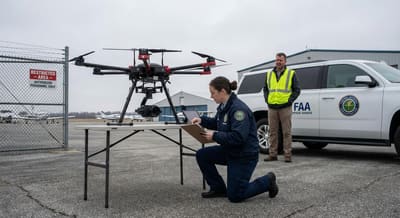
Record-Breaking Penalties Set New Precedent
The numbers tell a stark story: 18 enforcement actions resulting in fines ranging from $1,771 to $36,770, plus eight pilot license suspensions or revocations in 2025 alone. This represents the most aggressive enforcement stance the FAA has ever taken against civilian drone operators, signaling a fundamental shift in how the agency approaches airspace violations.
The largest penalty—$36,770—was levied against an operator who flew near emergency response aircraft during a wildfire in April 2023. This incident underscores one of the FAA's primary concerns: drones interfering with critical emergency operations. When a drone enters wildfire zones, it can force firefighting aircraft to pause operations, potentially costing lives and property.
"These aren't just regulatory violations anymore," explains aviation attorney Jennifer Martinez, who specializes in drone law. "The FAA is treating serious airspace breaches as public safety emergencies, and the penalties reflect that reality."
High-Profile Violations Draw Maximum Penalties
The enforcement actions reveal a pattern of violations at high-security locations and major public events. A $20,371 fine was issued for unauthorized flight near Mar-a-Lago in January 2025, where Temporary Flight Restrictions are frequently in effect. Another operator received a $20,370 penalty for flying over crowds at Florida's Sunfest Music Festival, where the drone ultimately crashed into a tree.
Perhaps most concerning for professional operators, the FAA fined one pilot $14,790 for operating near State Farm Stadium during the 2023 Super Bowl—one of the most heavily secured sporting events in the country. These cases demonstrate that major events and VIP locations carry the highest enforcement risk.
The agency didn't limit action to financial penalties. In what may be the most serious consequence yet, the FAA completely revoked a remote pilot's license for operating in restricted airspace near Mar-a-Lago in September 2025. Other suspensions included a pilot whose drone became entangled with a paraglider, forcing an emergency landing, and violations during a drone light show in Orlando.
2026 Policy Update: Zero Tolerance for Public Endangerment
The enforcement surge isn't coincidental. In 2026, the FAA updated its enforcement policy to mandate legal action when drone operations endanger the public, violate airspace restrictions, or are conducted in furtherance of another crime. For a detailed breakdown of the new zero-tolerance policy, see our coverage of the FAA's enforcement crackdown and what it means for operators. The policy change formalizes what many in the industry have observed: a shift from education-first to enforcement-first approach.
"The FAA will take decisive action against drone operators who ignore safety rules or operate without authorization," stated FAA Chief Counsel Liam McKenna. "These unsafe operations create serious risks, and the FAA will hold operators fully accountable for any violations."
Under federal law, the maximum penalty per violation now stands at $75,000, and the agency has shown increasing willingness to approach these limits for serious violations.
The El Paso Crisis: When Counter-Drone Measures Backfire
The enforcement crackdown comes amid growing concerns about how to safely deploy counter-drone technologies, highlighted dramatically by the El Paso airspace shutdown last week. What was initially described as a response to potential Mexican cartel drone incursions turned out to be an FAA reaction to Customs and Border Protection's use of a Pentagon-provided anti-drone laser weapon near civilian airspace.
The incident reveals the complex challenges facing authorities as they attempt to balance drone defense capabilities with aviation safety. CBP reportedly used the LOCUST (a 20-kilowatt laser system made by AeroVironment) to shoot down what ultimately turned out to be a party balloon. The FAA's decision to immediately close El Paso airspace for what was initially planned as 10 days demonstrates the agency's acute concern about deploying military-grade counter-drone systems near civilian aircraft.
"The FAA likely did a very intelligent thing by issuing the Temporary Flight Restriction," noted Tarah Wheeler, chief security officer of cybersecurity consultancy TPO Group. "The initial 10-day length of the TFR makes it seem like the FAA wasn't provided with information on how long the laser would be in use."
Industry Implications: A New Operating Reality
For commercial drone operators, these developments create a significantly more complex operational environment. The message from regulators is clear: the era of warnings and educational enforcement is ending, replaced by substantial financial penalties and career-ending license actions.
Professional operators now face a dual challenge. Not only must they navigate increasingly strict enforcement, but they must also operate in an environment where military-grade counter-drone systems are being deployed with limited coordination between agencies. The El Paso incident shows that even legitimate operations could be affected by counter-drone measures deployed without proper air traffic control coordination.
"We're seeing the collision of two trends," explains Dr. Sarah Chen, director of the Autonomous Systems Policy Institute. "Regulators are getting tougher on violations while simultaneously deploying defensive systems that can affect all drone operations in an area. It's creating operational uncertainty even for compliant operators."
What Professional Operators Need to Know
The enforcement data reveals specific risk factors that professional operators should prioritize:
- Emergency Response Zones: Any operation near wildfire, law enforcement, or medical emergency scenes carries extreme enforcement risk. The $36,770 wildfire fine represents the highest penalty to date.
- Major Events: Sports stadiums, music festivals, and large gatherings remain high-risk areas, with multiple operators facing five-figure penalties.
- VIP Locations: Areas subject to frequent TFRs, particularly those involving high-profile individuals, carry severe penalties including potential license revocation.
- Populated Areas: Operations over people without proper authorization continue to result in significant fines, especially when incidents occur.
The Broader Counter-Drone Challenge
The El Paso incident exposes a fundamental problem that extends beyond individual operator compliance: how to safely integrate defensive drone technologies into civilian airspace. As drone threats evolve, from recreational violations to potential security risks, authorities are deploying increasingly sophisticated countermeasures.
However, tools like directed energy weapons, signal jammers, and kinetic interceptors all carry risks to legitimate aviation operations. The Army's Multi-Purpose High Energy Laser (AMP-HEL) program has deployed systems like LOCUST specifically for drone defense, but their safe integration with civilian air traffic remains an unsolved challenge.
Congressional representatives from Texas and New Mexico have requested classified briefings on the El Paso incident, seeking to understand "where the failed communication occurred" between agencies. This suggests that coordination protocols for counter-drone operations remain inadequate.
Looking Ahead: Industry Adaptation Required
The combination of aggressive enforcement and expanding counter-drone operations signals a maturation of drone regulation that requires industry adaptation. Professional operators must now factor enforcement risk into every flight decision, while also preparing for an environment where counter-drone systems may be active without warning.
Several trends are likely to emerge:
- Enhanced Pre-Flight Planning: Operators will need more sophisticated tools to identify not just restricted airspace, but areas where counter-drone systems might be active.
- Insurance Implications: With penalties reaching nearly $37,000, commercial drone insurance policies may need to expand coverage for regulatory violations.
- Training Evolution: Part 107 training programs will likely emphasize enforcement risk assessment and penalty avoidance strategies.
- Technology Response: Drone manufacturers may integrate more sophisticated geofencing and compliance tools to help operators avoid high-risk areas.
For the broader industry, the 2026 enforcement surge represents both a challenge and an opportunity. While the penalties create new operational risks, consistent enforcement may help establish clearer operational boundaries and reduce the regulatory uncertainty that has plagued the industry.
The Path Forward
The FAA's enforcement escalation and the El Paso counter-drone crisis together illustrate the growing pains of an industry and regulatory environment still finding their balance. As drones become more ubiquitous and threats more sophisticated, both operators and regulators are grappling with complex questions about safety, security, and operational freedom.
The agency's updated enforcement policy suggests this aggressive stance will continue throughout 2026. For professional operators, success will require not just technical compliance, but strategic risk management that accounts for both enforcement probability and potential counter-drone operations.
As one commercial pilot who requested anonymity told WIRED regarding the El Paso situation: "I do not want to be stuck anywhere for 10 days or get hit by a laser. There is currently no procedure for that."
That sentiment captures the uncertainty facing the industry in 2026. Professional drone operations are no longer just about following FAA regulations -- they're about navigating an increasingly complex environment where enforcement is swift, penalties are severe, and new counter-drone technologies can affect operations without warning. The upcoming Part 108 BVLOS framework may eventually bring more clarity to advanced operations, but until then operators must exercise extreme caution.
The industry that emerges from this period of intense regulatory evolution will likely be more professional, more cautious, and more technically sophisticated. But it will also operate under significantly higher stakes, where a single violation can result in career-ending penalties and where technological countermeasures add new layers of operational complexity.
For drone operators, the message is clear: the regulatory environment has fundamentally changed, and adaptation isn't optional -- it's survival. If you need help developing a compliance strategy for this new enforcement era, UAVHQ's consulting services provide expert guidance on regulatory risk management.
📺 Watch the Video Briefing
Get expert video analysis on this topic and more on the UAVHQ YouTube channel.
🚁 Stay Ahead of the Drone Industry
Expert analysis on FAA regulations, commercial operations, and emerging technology — delivered to your inbox.
Subscribe
Consulting Intake Paused
UAVHQ is not currently accepting new consulting clients. Existing commitments remain supported; select time-sensitive safety or regulatory inquiries may be reviewed as availability allows.
Sponsored by
Your Brand Here
Reach drone professionals, commercial operators, and aviation decision-makers.
Sources
- DroneDJ: FAA steps up enforcement against reckless drone pilots
- WIRED: The El Paso No-Fly Debacle Is Just the Beginning of a Drone Defense Mess
- FAA: Updated Enforcement Policy (2026)
FAA Enforcement Drone Regulations Counter-Drone Aviation Safety Commercial Drones
📺 Watch the Video Briefing
Get expert video analysis on this topic and more on the UAVHQ YouTube channel.
🚁 Stay Ahead of the Drone Industry
Expert analysis on FAA regulations, commercial operations, and emerging technology — delivered to your inbox.
Subscribe
Sponsored by
Your Brand Here
Reach drone professionals, commercial operators, and aviation decision-makers.
UAVHQ
Drone industry intelligence and professional UAV consulting from Wesley Alexander — Senior Test Pilot with 25+ years of aviation leadership.
Explore
Connect
© 2026 UAVHQ. All rights reserved. · Privacy Policy