
By Wesley Alexander • July 6, 2026 • 7 min read
Tactical Summary
On July 2, 2026, the FAA published a Draft Environmental Assessment for Wing Aviation, LLC's proposed expansion of commercial drone package delivery across the Atlanta metro area, and opened a 30-day public comment period that closes August 1, 2026 at 5:00 p.m. Central Time. Comments go to 9-FAA-Drone-Environmental@faa.gov. The document was signed by Derek W. Hufty, Manager of the General Aviation and Commercial Operations Branch in the FAA's Emerging Technologies Division, Office of Safety Standards.
The framing that matters for operators is buried in the notice language. Wing is not asking to start flying in Atlanta. It already flies there through its Walmart and DoorDash partnerships. What Wing is seeking is to amend its air carrier Operations Specifications and other FAA approvals to scale that service, and the FAA has determined that approving the amended OpSpecs is a major federal action requiring a NEPA review. That is the whole story. The EA is the environmental gate between a Part 135 drone carrier and the expanded footprint it wants, and this comment window is the only formal point where anyone outside Wing and the FAA gets to shape the record.
What the EA Actually Proposes
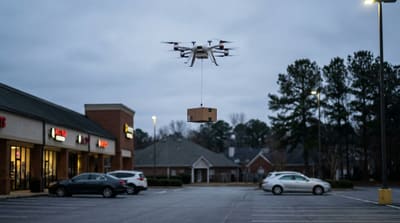
The Draft EA covers Wing's proposed package delivery operations across a large slice of metro Atlanta, and Appendix J is the part every local operator should open first. It lists roughly 40 proposed nest sites, the fixed launch and recovery pads Wing uses, scattered from Woodstock and Acworth in the northwest to McDonough and Hampton in the south, and from Douglasville in the west out to Loganville and Covington in the east. A large share of them sit at named Walmart and retail addresses in Conyers, Lithonia, Alpharetta, Roswell, Marietta, Duluth, Stone Mountain, Decatur, Snellville, and Peachtree Corners.
For anyone flying commercially in the Atlanta basin, that map is not abstract. Each nest is a point source of repeated low-altitude autonomous traffic, launching and recovering on a schedule, running out-and-back delivery legs into surrounding neighborhoods. If your survey, inspection, real-estate, or public-safety work overlaps any of those corridors, the operating environment you plan around is about to get denser, and the EA is where the assumptions behind that density are written down.
The review is being conducted under FAA Order 1050.1G, with the companion analyses NEPA triggers: Section 4(f) of the DOT Act, Section 7 of the Endangered Species Act, and Section 106 of the National Historic Preservation Act. In plain terms, the FAA is documenting noise, wildlife, and community effects so it can defend the OpSpecs approval. Noise is the category that has drawn the sharpest outside scrutiny on drone delivery generally, and it is the one where a specific, local comment carries the most weight.
Why Approval Does Not Equal Launch Readiness
This is the recurring trap in delivery expansion coverage, and it is worth stating directly. An EA that results in a Finding of No Significant Impact does not flip a switch. It clears one federal hurdle, the NEPA hurdle, on the path to amended OpSpecs. Wing still has to hold the operational approvals, airspace authorizations, and per-site arrangements that let it fly each route. A favorable EA removes the environmental objection to expansion. It does not certify that the airspace deconfliction, community notification, or ground-risk mitigation for every new nest is solved.
That distinction is exactly what we drew out when Flytrex and Wing flew 8,000 overlapping deliveries with zero conflicts. As we argued in what UTM actually solved, and what it did not, shared low-altitude airspace works today because a small number of cooperative operators coordinate deliberately. Scaling one carrier's nest count in a single metro raises the coordination burden for everyone else flying there, including the Part 107 operator who never signed up for a UTM handshake. The EA quantifies environmental impact. It does not resolve who yields to whom at 200 feet over a Gwinnett County subdivision.
The Noise and Community Record Is the Contested Ground
The most substantive public criticism of drone delivery environmental review has centered on methodology, not on whether the drones are loud in an absolute sense. In the national Draft Programmatic Environmental Assessment for drone package delivery, whose comment period the FAA extended into January 2026, community groups formally argued that the agency's reliance on day-night average sound level, the DNL metric, understates how people actually experience repeated, intermittent drone passes. A metric built for continuous airport noise can average away the specific annoyance of a delivery drone crossing the same backyard fifteen times a day.
That critique is portable, and it is the single most useful thing an Atlanta commenter can engage with. If the Wing Atlanta EA leans on the same averaging approach, a comment that names a specific neighborhood, a specific nest from Appendix J, and the realistic daily overflight count does more than a general objection. It puts a concrete, local data point into a record the FAA has to respond to in the Final EA. The agency aggregates and discounts generic complaints. It has to address substantive, specific ones.
What Metro Atlanta Operators Should Do Before August 1
The window is short and the mechanics are simple, so the discipline is in being specific.
-
Open Appendix J and cross-check it against your operating areas. Identify every proposed Wing nest within a few miles of where you fly. Those are your future traffic sources. Map them now, before the routes go live, not after.
-
File a specific, operational comment. Email 9-FAA-Drone-Environmental@faa.gov before 5:00 p.m. Central on August 1. Name the corridor or airspace you share, describe the deconfliction or noise concern in operational terms, and, if relevant, ask how transit and right-of-way expectations are documented between an air carrier's autonomous fleet and independent Part 107 traffic. Note that comments become part of the public record, so leave sensitive client detail out.
-
Audit your own Remote ID and detect-and-avoid posture. A denser autonomous delivery environment is exactly the case where receive-side traffic awareness stops being optional. Confirm your fleet broadcasts standard Remote ID and that you have a practical way to know when another operator is active near you. This is the same procedure-as-compliance discipline we laid out in the BVLOS compliance checklist and the Part 108 complete guide.
-
Watch the Final EA, not the press release. The launch announcement will come after the environmental finding, and it will read like a done deal. The document that tells you how the FAA weighed the objections, and what conditions ride on the approval, is the Final EA. That is the one to read when it posts.
The UAVHQ Read
Drone delivery expansion stories usually get written as growth headlines. This one is a regulatory gate with a calendar attached. Wing's Atlanta footprint grows only after the FAA clears a NEPA review, and that review is open for public comment for exactly 30 days, closing August 1. For the operators who already share Atlanta's low-altitude airspace, the EA is not a Wing story. It is a notice that the traffic environment is being formally reshaped, with roughly 40 new fixed traffic sources named in an appendix, and a narrow window to put an operator's perspective on the record.
Read Appendix J. Find your corridors. If a nest sits over your routes, file the specific comment before the clock runs out. The record the FAA builds this month is the airspace you will be flying in next year.
Sources
- FAA: Draft Environmental Assessment for Wing Aviation, LLC Proposed Drone Package Delivery Operations in Atlanta, Georgia (July 2026)
- FAA: NEPA and Drones (Draft EA review page)
- Federal Register: Extension of Public Comment Period, Draft Programmatic Environmental Assessment for Drone Package Delivery Operations (extended to Jan 23, 2026)
- DoorDash: DoorDash and Wing Expand Drone Delivery Partnership to Metro Atlanta
- DRONELIFE: Wing and Walmart Add Seven New Drone Delivery Markets
Wing Aviation Atlanta Draft Environmental Assessment NEPA FAA Order 1050.1G Part 135 OpSpecs Amendment Drone Delivery Comment Period August 1 2026 Nest Sites Remote ID Low-Altitude Airspace Deconfliction DNL Noise Part 107 Metro Atlanta
Consulting Intake Paused
UAVHQ is not currently accepting new consulting clients. Existing commitments remain supported; select time-sensitive safety or regulatory inquiries may be reviewed as availability allows.