
By Wesley Alexander • August 14, 2026 • 9 min read
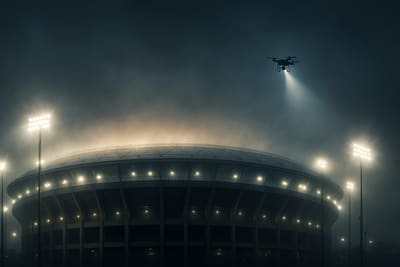
The number is out, it is official, and it is the one every operator planning to fly near a major event for the next two years needs to internalize. In its formal after-action announcement, the U.S. Department of Transportation says federal, state, and local partners seized more than 700 unauthorized drones during FIFA World Cup 2026, across all 11 U.S. host cities. The FAA is not treating that as a one-off. Secretary Sean Duffy, DHS Secretary Markwayne Mullin, and FBI Director Kash Patel each framed the operation as a new standard, and the release names the target explicitly: the 2028 Olympic and Paralympic Games in Los Angeles. If you thought stadium counter-UAS was a summer story that ended with the final, read this again.
What the Official Number Actually Says
Back in June we covered the interim enforcement figures while the tournament was still running, in the first World Cup drone enforcement numbers. Those were dozens of seizures and a handful of criminal citations, mid-event, incomplete. This is different. This is the closed-book total, published by the FAA press office, and the scale changed the conversation.
Here is what the government put on the record:
- The FAA established no-drone zones through nearly 250 temporary flight restrictions covering match venues, fan festivals, team hotels, and training sites.
- The FBI and DHS seized more than 700 drones operating in restricted airspace across all 11 host cities over the course of the tournament.
- Ground Intercept Teams, blending federal and local personnel, were positioned at venues for rapid detection, mitigation, and enforcement.
- Every unauthorized drone was treated as a potential threat until its operator and purpose could be assessed.
That last point is the operational heart of the whole thing, and I will come back to it. But first, sit with the count. More than 700 seizures across roughly two hundred fifty distinct restricted zones is not a story about a few bad actors. It is a story about the volume of drone traffic that now shows up, uninvited, over any large public gathering. The Homeland Security and Defense Forum's read on this is blunt: control of low-altitude airspace has become a central homeland-security requirement for major events. The perimeter now goes up, not just around.
The Detection Net Does Not Read Intent
The FAA and DHS were careful about one thing, and operators should be too. The available record does not establish that all 700-plus drones were deliberate threats. Many were almost certainly hobbyists chasing footage, tourists who did not check a TFR, and people who genuinely did not know a stadium had become restricted airspace for the week. The government said as much: each drone was treated as a potential threat until its operator and intent could be assessed.
That is exactly why this matters to legitimate operators. A counter-UAS detection and intercept system does not read your Part 107 certificate off the airframe. It reads position, altitude, and behavior. When you fly a legal commercial mission near the edge of a large event footprint, you enter the same sensor picture as the reckless hobbyist a mile away. The system flags you first and sorts intent second. In an environment with 250 TFRs and Ground Intercept Teams standing by, the burden is on you to prove you belong there before someone decides you do not.
This is the same enforcement escalation we have tracked all year. The FAA has moved from an education-first posture toward automatic legal referral for airspace violations, a shift we broke down in the 2026 FAA enforcement crackdown. The World Cup was that policy at industrial scale, and the detection technology is what turned a paper threat into 700 seizures.
Why This Is a Legal-Authority Story, Not Just a Tech Story
The reason state and local task forces could seize drones at all is the legal plumbing that got built in 2025 and 2026. The FAA's own release lays out the chain, and operators should understand it because it is now permanent infrastructure, not a World Cup rental.
Congress passed the Safer Skies Act in December 2025, extending counter-drone mitigation authority to state, local, tribal, and territorial law enforcement agencies that meet federal training requirements. We covered what that means for legal pilots in the SAFER SKIES state and local counter-UAS rule. Separately, the One Big Beautiful Bill Act of 2025 carried a $500 million counter-drone grant, and the first $250 million went to host cities and states specifically for the tournament. The FBI's National Counter-UAS Training Center trained the local agencies who did the actual field work.
Put those pieces together and you get the real lesson: the World Cup was not a temporary bubble of federal capability that has now deflated. It was the moment a distributed, locally-operated, federally-funded counter-UAS capability went live across 11 major metro areas, staffed by police departments and sheriffs' offices that still have the equipment, the training, and the authority. That capability does not pack up and go home. It looks for its next assignment.
The 2028 Olympics Are the Next Assignment
The FAA said it plainly. Lessons from the World Cup will strengthen protections for future high-profile gatherings and critical infrastructure, including the 2028 Olympic and Paralympic Games in Los Angeles. The DHS assessment folded the counter-drone result into its broader tournament security account. This is the government telling you where the capability points next.
For operators, that reframes the World Cup number as a planning baseline rather than a headline. If 700-plus incursions showed up across a month-long tournament spread over 11 cities, a concentrated, weeks-long Olympics in a single dense urban airspace is going to generate its own volume, and the response posture will be at least as aggressive. Los Angeles airspace is already among the most complex in the country. Layer Olympic TFRs, VIP movements, and venue no-drone zones onto that, and the margin for a sloppy pre-flight disappears entirely.
If your business plans to operate anywhere in the LA basin in the run-up to and during summer 2028, the time to build your airspace-compliance discipline is not the week before opening ceremonies. It is now, while you can still develop the habits and the paperwork trail that keep you out of the intercept picture.
What Operators Should Actually Do
The practical discipline here is not complicated, but it has to be reflexive. The operators who got seized were not, for the most part, people who read a TFR and decided to gamble. They were people who never checked. Do not be a data point.
- Treat TFR status as a launch-time input, not a planning-time checkbox. Event TFRs and their footprints can shift. Pull the active TFR list and B4UFLY within minutes of takeoff, and re-check on any multi-sortie day. A morning briefing does not cover an afternoon airspace change.
- Know that LAANC does not clear you into a TFR. Authorization for controlled airspace is not authorization inside a temporary flight restriction. We laid out that exact trap in why LAANC does not override a World Cup TFR, and it will be identical over Olympic venues.
- Log the geometry. Event TFRs are defined by a center point, radius, and ceiling. Record the coordinates and ceiling in your flight log so you can prove you planned around them, not through them.
- If you have a legitimate reason to be inside the perimeter, get authorized through the event's aviation management. There is a coordinated path for public-safety, broadcast, and sanctioned commercial work. It runs through the incident or event airspace authority, not around it. For the broadcast and stadium-BVLOS side of this, see our breakdown of Part 108 stadium and event operations.
- Document your deconfliction decisions. In an enforcement proceeding, your NOTAM checks, recorded coordinates, and your decision not to launch are the evidence that separates a professional from the 700.
The Bigger Signal for the Industry
Step back and the trajectory is unmistakable. Two years ago, counter-UAS was concentrated around airports, military installations, and a handful of VIP movements. The World Cup pushed it to distributed, event-driven deployment across an entire country, operated in large part by local law enforcement. Wildfire TFRs are now getting the same treatment, as we documented over the Spokane Complex fires. The 2028 Olympics will push it further still.
For the drone industry this cuts two ways, and both are real. It is a genuine deterrent against the reckless minority whose stadium footage flights create a collision hazard over crowds of tens of thousands, and that is a legitimacy problem the whole sector has needed solved. But it also permanently raises the compliance floor for legitimate operators, who now work in an environment where their position near any major event is actively logged and assessed by federal and state teams. The operators who treat airspace compliance as live risk management will keep flying. The ones who treat it as paperwork are going to meet the intercept team.
The World Cup set the baseline. The FAA told you the next test is in Los Angeles in 2028. The professionals will spend the intervening two years building the discipline to fly clean inside it. The 700 who did not check will spend it explaining themselves to the FAA.
UAVHQ Analysis: The official World Cup after-action turns a summer enforcement story into a two-year planning problem. The capability that produced 700-plus seizures is federally funded, locally operated, and now pointed at the 2028 Los Angeles Olympics. Operators who fly near major events should rebuild TFR checks into a launch-time, re-verified step, document deconfliction on every sortie, and start developing that discipline now rather than in summer 2028. We will track the Olympic airspace-security posture as LA 2028 planning develops.
Sources
- Successful Counter-Drone Efforts Helped Keep Millions of Fans Safe During FIFA World Cup 2026, With More Than 700 Drones Seized, FAA Newsroom (July 22, 2026)
- DHS Celebrates Record-Breaking Success at FIFA World Cup 2026, U.S. Department of Homeland Security (July 23, 2026)
- More Than 700 Unauthorized Drones Reveal a New Major-Event Security Challenge, Homeland Security & Defense Forum (August 2026)
- More than 700 unauthorised drones seized across 11 FIFA World Cup host cities, Unmanned Airspace (August 2026)
📺 Watch the Video Briefing
Get expert video analysis on this topic and more on the UAVHQ YouTube channel.
🚁 Stay Ahead of the Drone Industry
Expert analysis on FAA regulations, commercial operations, and emerging technology — delivered to your inbox.
Subscribe
Consulting Intake Paused
UAVHQ is not currently accepting new consulting clients. Existing commitments remain supported; select time-sensitive safety or regulatory inquiries may be reviewed as availability allows.