
By Wesley Alexander • August 24, 2026 • 8 min read
The phrase that should stop every commercial and public-safety drone operator this week is "military-grade." On August 3, 2026, the Federal Communications Commission published a Public Notice in the Federal Register (91 FR 48870, PS Docket No. 26-189) proposing to prohibit the continued importation and marketing of foreign-produced drones and drone components the agency classifies as military-grade. Comments are due on or before September 2, 2026. That is roughly nine days from now.
Here is why this one is different from the supply-chain actions we covered in July, and why the label is misleading in a way that can catch operators flat-footed. The FCC is not defining "military-grade" by who built the aircraft or what it was marketed for. It is defining the term by capability. And several of the capabilities on its list are the exact features that make a drone useful for inspection, mapping, agriculture, and public safety.
The label says military. The definition says your fleet.
This proceeding, released as Public Notice DA 26-758, is a separate docket from both the nine-company import notice (PS Docket 26-184) and the July 22 component-loophole order we broke down in the FCC supply-chain read. Unlike the nine-company notice, DA 26-758 names no manufacturers and lists no FCC IDs. Instead it proposes seven capability-based categories, each drawn from existing federal regulation. A foreign-produced Covered List drone or critical component is reachable if it falls into any one of them:
- Heavy platforms. Any UAS with a maximum takeoff weight of 55 pounds or more, meaning anything that is not a "small unmanned aircraft" under 14 CFR 107.3.
- Aerosol dispensers. Systems capable of dispensing an "economic poison" as defined for agricultural aircraft operations under 14 CFR 137.3. In plain terms, spray drones.
- Thermal imagers. Any UAS integrating sensors that capture temperature differences and heat signatures.
- LiDAR. Any UAS integrating laser-based ranging and remote-sensing sensors.
- Docking stations. Multipurpose systems that let a drone land, recharge or swap batteries, and transfer data or payload autonomously.
- Munitions-list designs. UAS "specially designed to incorporate a defense article" under the U.S. Munitions List, 22 CFR 121.1, Category VIII.
- Swarming systems. Ground control stations or vehicle-management systems built to coordinate autonomous multi-drone operations, explicitly including light-show fleets.
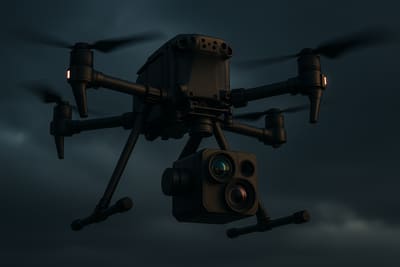
Read categories two through five again with your own operation in mind. A thermal payload for roof and solar inspection. A LiDAR pod for corridor mapping. A spray system for aerial application. A charging dock for a remote drone-in-a-box deployment. None of those is what a reasonable person pictures when they hear "military-grade," yet each one is a named trigger. The scope hook is that the capability, not the mission, is what pulls a device into the proposed prohibition.
What the rule does, and just as important, what it does not do
The mechanism here is the same one the FCC built in its October 2025 equipment-authorization security order: the 47 CFR 2.939(e) procedure that lets the Public Safety and Homeland Security Bureau place a limitation on an existing authorization without revoking the underlying grant. That distinction is the reason continued use stays legal.
If adopted as proposed, the rule would prohibit importation and marketing, which the FCC defines to include advertising, sale, lease, and distribution, of covered military-grade foreign-produced UAS and components. It would not make it illegal to operate a drone already in your hangar. The Notice is explicit that the prohibition "would not affect continued use or operation of already-purchased covered equipment."
Several carve-outs also survive. The proposal would not reach non-military-grade UAS, domestically produced drones, Blue UAS Cleared List equipment, Buy American "domestic end products," equipment holding a Conditional Approval, or import and marketing for U.S. government use or for commercial testing and development. The Blue UAS and Buy American exceptions were recently extended to January 1, 2028, and Conditional Approvals were made permanent, so those pathways are more stable than they were a year ago.
One timing detail matters for planning. Where the nine-company notice contemplated a 30-day cutoff, DA 26-758 proposes a longer 180-day transition after any final rule, which from the August 3 publication would land on or about January 30, 2027. The FCC justifies the longer runway by the larger expected scope of affected equipment. That is a tell: the agency itself expects this capability net to catch a lot of gear.
The operator read: this is a fleet-replacement clock, not a flight ban
The easy misread is "another import rule, my existing drones are fine, move on." The accurate read is that if your program depends on foreign-produced thermal, LiDAR, spray, or docking hardware, your resupply and expansion path for that hardware is what is on the table. You can keep flying what you own. You may not be able to buy the next one, or the replacement when one goes down.
For a public-safety drone-as-first-responder program running docked, remotely deployed aircraft, that is a direct operational planning question. For an inspection or mapping shop built on thermal and LiDAR payloads, it is a capital-equipment question. For an aerial-application operator, the spray-dispenser trigger sits right on top of the certification burden we covered in the $289,215 ag-drone enforcement case. The compliance surface is stacking.
What to actually do before September 2
A rulemaking with an open comment window is one of the few moments an operator's field experience is on the record before the rule hardens. The FCC is specifically asking whether its seven-category list captures the right equipment, whether any listed category is not truly military-grade, and whether any unlisted category should be added. That is a direct invitation for operational evidence.
- Map your exposure by capability, not by brand. Walk your fleet and flag every foreign-produced airframe or critical component that carries a 55-pound-plus takeoff weight, a thermal sensor, a LiDAR unit, a spray system, an autonomous dock, or swarm coordination. Those are the assets in scope.
- Confirm your exemption pathway. If a platform rides on a Blue UAS listing, a Buy American qualification, or a Conditional Approval, document which one and its expiration. That is the difference between an asset that stays procurable and one that does not.
- File a comment if a category hits your operation. A specific, operationally grounded filing beats a generic objection. If treating a routine thermal-inspection drone as "military-grade" would strand a public-safety or commercial program, the FCC asked to hear exactly that, with evidence. File in PS Docket No. 26-189 through the FCC Electronic Comment Filing System before September 2.
- Calendar the 180-day clock now. If the rule is adopted, the import-and-marketing cutoff runs about six months out. Operators who plan replacement procurement around a trusted-supplier stack today are the ones who will not be scrambling in Q1 2027.
The UAVHQ Read
The FCC is doing something subtle and consequential: it is redrawing the boundary of "covered" drone equipment around what a device can do rather than who made it or what badge it wears. "Military-grade" is a headline word, but the operative language reaches thermal imagers, LiDAR, spray systems, docking stations, and heavy-lift platforms that fill ordinary commercial and public-safety roles. The nine-day comment window is the point of leverage. After it closes, the definition gets written with or without operator input.
If your program runs on foreign-produced sensing or delivery hardware and you need to understand which capabilities are exposed, whether an exemption pathway protects you, or how to file a comment that puts real operational stakes on the record, that is the regulatory and operational work UAVHQ does with operators. The clock closes September 2.
Sources
- Federal Register: Seeking Comment on Prohibiting Importation and Marketing of Certain Foreign-Produced Military-Grade UAS (91 FR 48870, PS Docket 26-189)
- FCC Public Notice DA 26-758 (released July 21, 2026)
- FCC Fact Sheet: FCC Takes Action to Secure the Drone Supply Chain (July 21, 2026)
- FCC Electronic Comment Filing System
- Jonathan Rupprecht: FCC Drone Import and Marketing Ban analysis
- 14 CFR 107.3 (small unmanned aircraft definition)
- 14 CFR 137.3 (economic poison definition)
FCC Military-Grade UAS PS Docket 26-189 DA 26-758 Covered List Foreign Drone Import Marketing Ban Thermal LiDAR Spray Drone Docking Station Swarming Comment Deadline September 2 Commercial Drone Operator Public Safety Compliance