
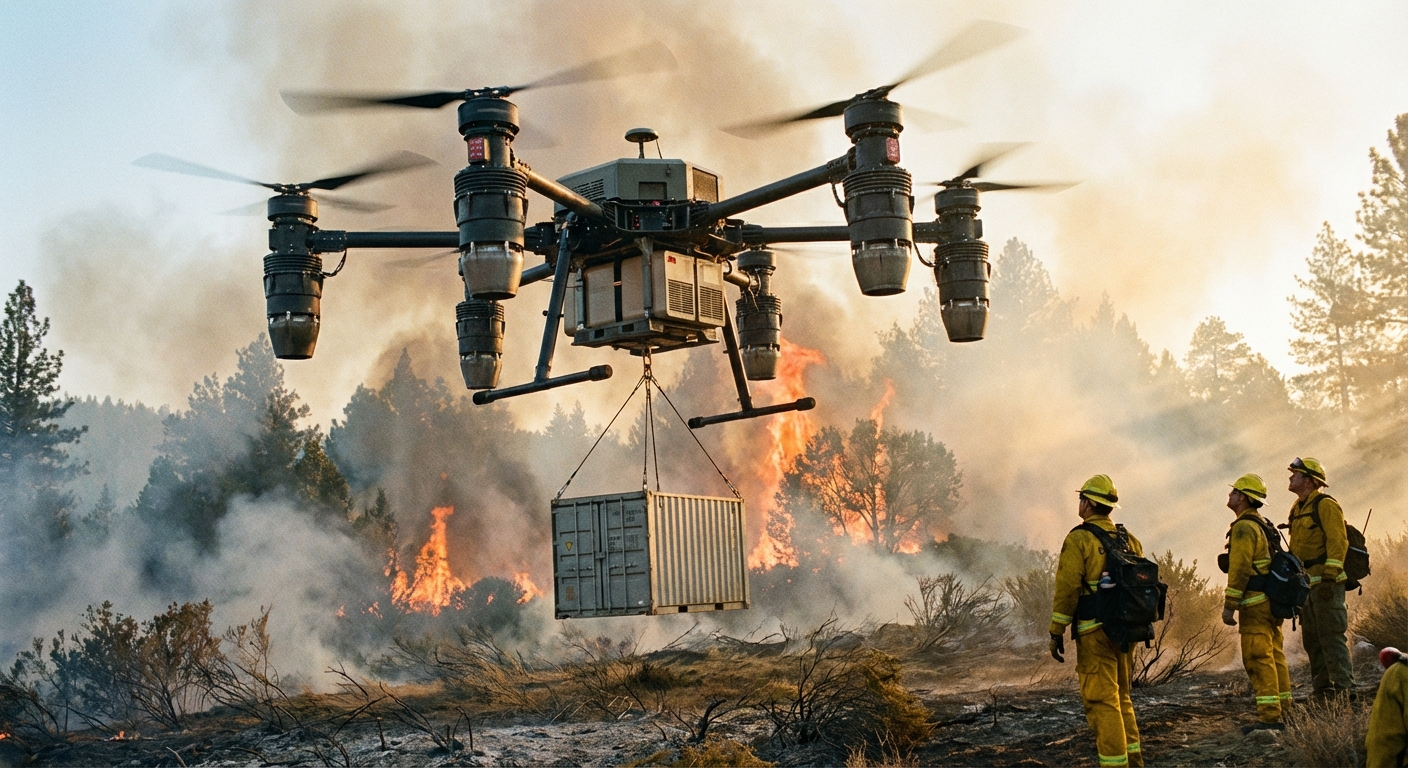
California-based Parallel Flight Technologies has received a coveted 49 U.S.C. §44807 exemption from the Federal Aviation Administration, clearing the path for commercial operations of its Firefly heavy-lift drone platform. The decision represents a major regulatory milestone for the hybrid-powered aircraft and signals growing FAA confidence in advanced UAS platforms for industrial applications.
Breaking Through the 55-Pound Barrier
The §44807 exemption is particularly significant because it allows Parallel Flight to operate the Firefly beyond the strict 55-pound weight limit that governs standard Part 107 commercial drone operations. For companies developing heavy-lift platforms, this exemption pathway represents the only viable route to commercial operations under current FAA regulations.
Parallel Flight CEO Craig Stevens emphasized the validation this approval provides: "This is an important step for our team and our customers. The 44807 exemption validates the safety architecture, system design, and maturity of our platform."
The timing couldn't be better for industrial operators. With the commercial drone services market projected to reach $35 billion by 2030, demand for heavy-lift capabilities is accelerating across multiple verticals, from wildfire suppression to infrastructure inspection and emergency cargo delivery. This development comes as operators navigate the complex landscape of FAA regulatory applications.
Hybrid Power: The Game-Changing Advantage
What sets the Firefly apart from conventional commercial drones is its patented Parallel Hybrid Electric Multirotor (PHEM) propulsion system. This innovative approach combines fuel and electric power to deliver up to 10 times longer flight duration than pure battery-powered platforms—a critical advantage for missions requiring extended operational time or heavy payload capacity.
The specifications are impressive for a platform that still maintains field portability:
- Payload capacity: Up to 100 pounds
- Flight endurance: 10x longer than equivalent electric platforms
- Speed: 60-100 mph operational range
- Power generation: Up to 2 kilowatts continuous in-flight power
- Transport: Fits in pickup truck, deployable by two people
That continuous power capability is particularly valuable for sensor-intensive missions. Unlike battery-powered drones that must carefully manage power budgets between propulsion and payload systems, the Firefly can run demanding equipment like LiDAR sensors, thermal imaging arrays, or communications relay gear without compromising flight time.
Industrial Applications: From Firefighting to Infrastructure
The FAA exemption opens several high-demand commercial applications that have been difficult to address with smaller platforms. Parallel Flight has identified three primary market segments:
Wildfire Response and Management
With wildfire seasons growing more severe and extended, the Firefly's combination of heavy payload capacity and extended flight time makes it ideal for fire suppression support, real-time monitoring, and emergency supply delivery to ground crews. The platform can carry significant water payloads or deploy specialized fire-retardant systems while maintaining operational awareness through extended flight operations.
Critical Infrastructure Inspection
Power lines, bridges, cell towers, and oil & gas facilities require increasingly sophisticated sensor packages for comprehensive inspection. The Firefly's ability to carry large sensor arrays while generating substantial in-flight power enables more thorough data collection in single missions, reducing operational costs and improving inspection quality.
Emergency Logistics and Disaster Response
In disaster scenarios where traditional aircraft cannot operate safely or ground access is compromised, the Firefly's cargo capacity and rapid deployment profile make it valuable for medical supply delivery, communications equipment deployment, and situational awareness missions.
"The aircraft is designed as a heavy-lift workhorse while still remaining surprisingly portable. The quadcopter can be transported by just two people and fits in the back of a pickup truck — a feature that could make it particularly useful in disaster zones, remote infrastructure sites, or wildfire response missions." — DroneDJ Industry Analysis
Understanding the §44807 Exemption Process
For drone operators wondering about the significance of this approval, the §44807 exemption process represents one of the most rigorous pathways in commercial aviation. Unlike standard Part 107 waivers, which address specific operational restrictions, §44807 exemptions require comprehensive safety cases covering:
- Concept of Operations: Detailed mission profiles and use cases
- Safety Risk Analysis: Comprehensive hazard identification and mitigation
- Operations Manual: Detailed procedures and limitations
- Emergency Procedures: Contingency planning and response protocols
- Training Program: Pilot and crew qualification requirements
- Maintenance Manual: Airworthiness and inspection procedures
- Flight History: Demonstrated safety record and operational experience
According to FAA guidance, the agency uses "a risk-based approach to determine if certain unmanned aircraft systems may operate safely in the national airspace system on a case-by-case basis." Each exemption is highly specific to the aircraft design, operational parameters, and mission requirements.
What This Means for Other Heavy-Lift Operators
Parallel Flight's success with the §44807 process provides a valuable precedent for other companies developing heavy-lift platforms. The approval demonstrates that the FAA is willing to work with manufacturers who invest in comprehensive safety analysis and operational planning.
However, operators should note that exemptions are not transferable. Each platform and operator combination requires its own approval process, and the FAA evaluates applications based on specific design characteristics, intended use cases, and operational safety measures.
Government Backing and Market Validation
The Firefly platform has already attracted significant attention from major government agencies and research organizations, lending credibility to its commercial prospects. Current supporters include:
- Defense Innovation Unit (DIU): Military application development
- NASA: Research and development programs
- USDA: Agricultural and environmental monitoring
- National Science Foundation: Research mission support
- Office of Naval Research: Maritime operations development
Notably, the Office of Naval Research awarded Parallel Flight a $3.7 million contract in fall 2025 to modify the Firefly platform for maritime operations, indicating strong military interest in the hybrid propulsion approach.
Industry Implications: The Heavy-Lift Revolution
Parallel Flight's regulatory success comes at a crucial time for the commercial drone industry. While the consumer and light commercial markets have matured significantly, industrial applications requiring substantial payload capacity have remained underserved due to regulatory and technological barriers.
The approval signals several important trends:
Regulatory Maturation
The FAA's willingness to approve complex hybrid-powered platforms demonstrates growing regulatory confidence in advanced UAS technologies. This could accelerate approval timelines for other innovative designs that previously faced uncertain regulatory pathways.
Market Expansion
Heavy-lift capabilities open entirely new market segments that were previously inaccessible to commercial drones. This expansion could drive significant growth in sectors like construction, energy, telecommunications, and public safety.
Technology Evolution
The success of hybrid propulsion validates alternative power approaches beyond traditional battery-electric systems. This could spur innovation in other propulsion technologies, including hydrogen fuel cells and advanced hybrid systems.
What Drone Operators Need to Know
For commercial operators considering heavy-lift applications, the Firefly approval offers several practical insights:
Operational Planning is Critical
The §44807 exemption process requires extensive operational planning and safety analysis. Operators should begin this process early and invest in comprehensive documentation if they're considering heavy-lift operations. UAVHQ's consulting team can assist with exemption applications and operational planning.
Mission-Specific Approvals
Even with an exemption, operators must still obtain Certificates of Waiver or Authorization (COAs) for specific operational airspace. The FAA provides "blanket" COAs for flights at or below 400 feet in Class G airspace, but more complex operations require individual approval.
Training and Certification
Heavy-lift operations require enhanced pilot training and operational procedures. Operators should expect more stringent training requirements compared to standard Part 107 operations.
Looking Ahead: Commercial Deployment
With FAA authorization secured, Parallel Flight plans to begin shipping customer units this summer. The company is also working to expand its approved flight envelope and scale up manufacturing to meet anticipated demand.
The near-term focus will likely be on proving operational concepts in the three core application areas: wildfire response, infrastructure inspection, and emergency logistics. Many of these use cases will require BVLOS operational capability to reach their full potential. Success in these initial deployments could drive broader market adoption and validate the business case for heavy-lift commercial operations.
For the broader drone industry, the Firefly approval represents more than just one company's regulatory success—it's a proof point that advanced UAS platforms can navigate complex approval processes and achieve commercial viability. As the industry moves toward more sophisticated applications, regulatory precedents like this become increasingly valuable for all participants.
The Competitive Landscape
Parallel Flight isn't alone in pursuing heavy-lift commercial markets. Several other companies are developing platforms that would require similar §44807 exemptions, including established aerospace firms and innovative startups. The success of the Firefly approval process could accelerate competitive development and regulatory submissions across the sector.
However, Parallel Flight's head start with both regulatory approval and government contracts provides significant competitive advantages. The combination of proven technology, regulatory clearance, and established customer relationships positions the company well for the emerging heavy-lift market.
Conclusion: A New Chapter for Commercial Drones
The FAA's approval of Parallel Flight Technologies' Firefly platform represents a significant milestone in commercial drone development. By successfully navigating the complex §44807 exemption process, the company has not only cleared the path for its own commercial operations but also demonstrated a viable regulatory approach for other advanced UAS platforms.
As the commercial drone industry matures beyond basic inspection and photography applications, heavy-lift capabilities will become increasingly important for industrial customers. The Firefly's hybrid propulsion system and substantial payload capacity address real operational needs that existing platforms cannot meet effectively.
For drone operators and industry observers, this approval signals the beginning of a new phase in commercial aviation—one where unmanned systems can handle increasingly complex and demanding missions. The regulatory precedent established by this approval will likely benefit the entire industry as more companies pursue advanced operational capabilities.
The real test now comes with operational deployment. As the Firefly platform enters commercial service this summer, its performance in real-world applications will determine whether heavy-lift drones can deliver on their substantial promise—and potentially reshape expectations for what commercial drones can accomplish.