
By Wesley Alexander • June 29, 2026 • 8 min read
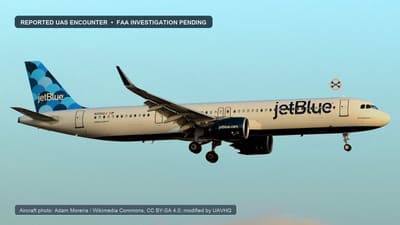
A JetBlue crew approaching New York's John F. Kennedy International Airport reported that the aircraft may have struck a drone at roughly 3,000 feet on Monday morning. The flight landed safely. JetBlue said passengers deplaned normally, and a post-flight inspection found no damage or evidence of a collision. The FAA is investigating.
That last sentence matters. This is still a reported event, not a final investigative finding.
But even with that caveat, this is not just another drone-sighting headline. It came only days after a United Airlines crew on approach to Newark reported a near miss with a drone roughly 100 feet below the aircraft. Together, the two New York-area events put a bright light on a problem the drone industry keeps treating as background noise: unauthorized UAS activity near major airports is not rare enough, not easy enough to investigate, and not politically harmless.
For serious Part 107 operators, this is an opportunity. Not a marketing opportunity in the cheap sense. A credibility opportunity.
What We Know So Far
CBS New York reported that the JetBlue event involved Flight 948 from Las Vegas to JFK at around 7:15 a.m. Monday. The pilot reported a possible drone strike at about 3,000 feet while on final approach. The aircraft landed safely, passengers exited normally, and JetBlue said it would assist the FAA investigation.
BBC News reported the same basic FAA timeline and added that the crew described the strike as occurring above the cockpit. JetBlue told the BBC that the flight landed without incident and that the aircraft inspection found no damage or evidence of a collision.
That distinction is important. A pilot report is operationally serious. A confirmed collision is an evidentiary conclusion. Right now, the responsible phrasing is that the crew reported a possible drone strike, the FAA is investigating, and the aircraft inspection did not find damage or evidence of impact.
The Newark event, reported by CNN days earlier, involved a United Boeing 737 arriving from Key West. The pilot said the aircraft nearly hit a drone, describing it as circular, about three feet wide, and approximately 100 feet below the airplane. A second United Express/GoJet crew also reported seeing a drone around 2,000 feet in the area, according to ATC audio cited by CNN.
Two events do not make a trend by themselves. But two reported drone encounters on final approach into the New York metro airport system in a matter of days are enough to shape the week’s aviation narrative.
The Rule That Gets Lost in the Headline
The FAA’s airport guidance is not subtle: drone operators near airports in controlled airspace need authorization before flight, and drone operators are responsible for avoiding manned aircraft and any safety hazard they create in the airport environment.
That is the floor. Not the aspiration. The floor.
For Part 107 operators and recreational flyers, LAANC and FAA DroneZone exist for a reason. The airspace around JFK and Newark is not an informal operating environment where a pilot can “just stay low” and hope the app icons are green. Arrival corridors change with wind, runway configuration, and traffic flow. Helicopters, medevac aircraft, news aircraft, law enforcement aircraft, and airline traffic can all appear at altitudes a casual drone pilot may not expect.
And 3,000 feet near a major airport is not a Part 107 gray area. It is the wrong altitude, in the wrong place, at the wrong phase of someone else’s flight.
Why This Is Bigger Than One JetBlue Report
The FAA says reports of UAS sightings from pilots, citizens, and law enforcement remain high, and that it receives more than 100 reports near airports each month. The agency also says unauthorized drone operations around airplanes, helicopters, and airports are dangerous and illegal, and that operators may face stiff fines, criminal charges, and possible jail time.
Those statements are not new. What changes this week is the public context.
A drone reported at 3,000 feet on final approach to JFK is not an obscure local enforcement problem. It is a national-airspace confidence problem. It lands in the same policy environment as Remote ID compliance, airport counter-UAS authority, Part 108 BVLOS normalization, and the broader question of whether the drone industry can separate professional operators from irresponsible ones in a way regulators, insurers, and airport stakeholders can actually verify.
That separation is where the opportunity sits.
The Professional Operator Advantage
Most commercial drone operators do not fly anywhere near airline final approach paths. Most Part 107 pilots are not the problem in stories like this. But the public does not sort the industry that carefully. A drone headline near JFK is a drone headline near JFK.
Professional operators need to answer with evidence, not indignation.
That means being able to show:
- Airspace authorization records. LAANC approvals, FAA DroneZone authorizations, waiver conditions, and internal no-go decisions when authorization was unavailable.
- Preflight airspace review. Not just “checked the app,” but a repeatable record of controlled airspace, TFRs, NOTAMs when relevant, nearby airports, heliports, approach corridors, and client-site constraints.
- Remote ID compliance. Hardware capability, serial/broadcast records where available, and a maintenance process that keeps Remote ID from becoming a forgotten checkbox.
- Crew briefing discipline. Who is PIC, who is visual observer, what altitude limit applies, what lost-link behavior is expected, and what triggers an immediate termination.
- Post-flight logs. Time, location, max altitude, authorization reference, abnormalities, and corrective action if something did not go as planned.
That file is not bureaucracy. It is the difference between a professional aviation operation and a consumer-electronics outing that happens to have propellers.
Remote ID and Airport Detection Just Got More Politically Valuable
If the JFK report ultimately traces to a drone operator, the first question will be whether that operator was broadcasting Remote ID and whether anyone captured it. If the answer is yes, the FAA and law enforcement have an enforcement path. If the answer is no, expect the policy pressure to move toward stronger detection, stronger airport authority, and stronger penalties.
That is uncomfortable for parts of the industry, but it is predictable.
Airport operators do not want to wait for a damaged aircraft before building detection capability. Airlines do not want the safety case to depend on a hobbyist understanding Class B airspace. Crewed-aviation organizations do not want drone integration to shift residual risk onto their pilots. And regulators do not want to explain why “more than 100 reports a month” is an acceptable background rate near airports.
The operators who win in that environment will be the ones who can prove they are visible, authorized, trained, and documented.
The Part 108 Connection
This week’s events are not about BVLOS directly. A rogue or misoperated drone near JFK is not the same thing as a certificated Part 108 operator flying a documented route with detect-and-avoid, command-and-control, crew training, and operating limitations.
But politically, the stories collide.
Part 108 asks the FAA, crewed aviation, and the public to trust that routine BVLOS can scale safely. That trust is easier to build when the industry can show a sharp line between compliant operators and unauthorized airport incursions. It is harder when every news cycle reminds the public that a small drone can appear near an airliner on final approach.
For Part 108 applicants, the lesson is simple: your safety case needs to be legible to people outside your company. DAA assumptions, electronic conspicuity, operating volumes, emergency procedures, lost-link behavior, and coordination with affected stakeholders cannot live as vague slideware. They need to be documented in a way a regulator, insurer, airport operator, or customer can understand.
What Operators Should Do This Week
If you operate commercially, use the JFK and Newark reports as a compliance drill.
- Pull three recent missions and verify that the airspace record is complete.
- Confirm every aircraft that requires Remote ID is configured, broadcasting, and documented.
- Review your airport/heliport standoff procedure. If the answer is “the pilot checks an app,” that is not a procedure.
- Add a specific “approach/departure corridor” prompt to your preflight checklist for work near controlled airspace.
- Make sure your client proposal language distinguishes authorized Part 107 work from casual drone use.
The goal is not to overreact. The goal is to be the operator who can walk into a client meeting the day after a JFK drone headline and say, calmly, “Here is how our process prevents that.”
Bottom Line
The JetBlue report may or may not become a confirmed drone strike after the FAA investigation. The Newark event may remain a close-call report. We should not pretend the facts are more settled than they are.
But the business implication is already clear.
Airport drone encounters are becoming a reputational tax on the entire UAS sector. Serious operators can either complain about being lumped in with irresponsible flyers, or they can use the moment to show the paperwork, discipline, and aviation culture that separates professional operations from noise.
Show the paperwork.
Sources
- BBC News: JetBlue pilot reports striking a drone while landing at JFK airport
- CBS News New York: JetBlue pilot reports plane possibly struck drone while landing at JFK
- CNN: Drone nearly hits United plane landing in Newark, pilot says
- FAA: Drone Sightings Near Airports
- FAA: Flying Near Airports
- Hero aircraft photo: Adam Moreira / Wikimedia Commons, CC BY-SA 4.0, modified by UAVHQ.

Wesley Alexander is a former Insitu/Boeing ScanEagle Commercial Chief Test Pilot and former UAS DPE for Insitu ScanEagle pilots and instructors. UAVHQ provides operator-focused intelligence on regulatory and safety developments in the commercial UAV industry.