
By Wesley Alexander • June 4, 2026 • 9 min read
Most of the Part 108 conversation lives in the comment-letter ecosystem: AOPA, EAA, ALPA, NBAA, the drone trade associations, the BVLOS service providers. That fight matters, and we covered it yesterday in our Part 108 residual-risk analysis. But there is a second front opening, and it is much closer to a lot of working drone operators than the airspace policy debate suggests.
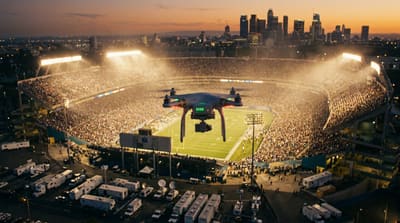
Stadiums. Broadcast compounds. Large outdoor venues. Marathons, festivals, motorsports, college football, MLS, NFL, MLB, World Cup 2026, the Olympics buildup. The places where commercial drones already operate every weekend under a stack of Part 107 waivers, stadium TFRs, and event-by-event coordination. Part 108 reshapes that environment in ways that affect contracting, equipage, and compliance burden well before the rule is finalized.
If you fly broadcast, security, crowd analytics, betting integrity, light shows, or first-responder drones in or near large venues, this is the part of the NPRM that lands on you specifically.
The Five-Category Framework
Part 108 abandons the binary VLOS-versus-waiver world for a tiered structure built around population density. The NPRM defines five risk categories that scale equipage, certification, and oversight as the people on the ground get denser and the operational risk gets harder to mitigate.
The categories matter because they decide three things at once: whether you can fly a given operation at all under a permit, whether you need an operating certificate with a safety management system, and whether onboard detect-and-avoid is mandatory rather than optional. The Herrick Feinstein analysis published this week walks through the structure with stadium use cases in mind, and the picture is consistent with the broader NPRM text: suburban districts, entertainment corridors, and sold-out outdoor stadiums sit in the higher categories, and the higher categories are where the equipage and oversight burden climbs sharply.
For a commercial operator, the practical effect is that any meaningful event-side BVLOS operation, anything over an open-air crowd, anything that involves broadcast or security at a real venue, is going to slot into Category 4 or Category 5. That means certificate-tier oversight, strategic deconfliction through approved service providers, conformance monitoring, and onboard DAA. The light-touch permit path is not the path event operators are going to live on.
What Changes for Event Operators
Three changes deserve to be on the whiteboard now.
Detect-and-avoid stops being a sales pitch. Today, DAA at events is largely a competitive differentiator and a path to a stadium TFR waiver. Under Part 108, in the highest categories, it is mandatory equipage. Radar, electro-optic and infrared sensors, acoustic systems, cooperative ADS-B In, or a combination defined by the operator's safety case. If your fleet does not have a credible DAA pathway, your roadmap to Part 108 venue work runs through the equipage budget first, then the safety case, then the certificate.
Operating certificates replace event-by-event waivers for repeat venue operators. A broadcaster flying every Sunday during a season, a stadium running its own security program, a league deploying drones across multiple cities, all of these look more like operating certificate territory than permit territory under the proposed structure. That is a different regulatory relationship than a Part 107 operator with a stack of 107.41 waivers. It comes with an SMS obligation, maintenance program documentation, training records, recurrent oversight by an FAA Principal Operations Inspector, and a different liability shape.
TSA security vetting becomes a routine compliance task. Part 108 incorporates TSA vetting for BVLOS operators in higher categories, which means background-check and security-program elements that Part 107 operators have not had to manage at this depth. Event operators flying near critical infrastructure, near federally protected sites, or in support of mass-gathering events should expect this layer to be a real schedule item, not a checkbox.
The Standing Stadium Restriction Is Not Going Away
Worth saying clearly because the question comes up every time we brief a broadcast or event client: the standing stadium restriction is its own animal and is not displaced by Part 108. Drones remain prohibited within 3 nautical miles of qualifying stadiums and motor speedways, up to 3,000 feet AGL, from one hour before to one hour after a covered event. Waivers exist, and event-side broadcast and security operators have built workflows around them, but the underlying prohibition is statutory in flavor and not a function of the BVLOS rule.
What Part 108 does is change the architecture of the waiver. Today a stadium waiver is essentially a permission slip granting an exception to the standing restriction. Under Part 108 the same operation has to clear two doors: the standing-restriction door, and the Part 108 category-appropriate authorization door. Operators with mature event programs are already running both checks in parallel. Operators who treat event work as a special case of normal Part 107 flying are going to find the new structure more painful than they expect.
C2 Link, Remote ID, and the Field Reality
Stadium environments are the worst-case scenario for command-and-control link health and for Remote ID broadcast reception. Steel structures, packed crowds, broadcast RF, scoreboard and lighting electronics, cellular network congestion at full capacity. Operators who have flown a sold-out NFL stadium know what the C2 trace looks like when 75,000 phones are competing for the same bands the drone is depending on.
Part 108's performance-based DAA and conformance-monitoring requirements assume a C2 environment that does not actually exist at a sold-out outdoor venue without deliberate engineering. The operators who succeed under the new rule will be the ones who pre-survey the RF environment, plan link redundancy, document Remote ID broadcast reception inside and around the venue, and pre-coordinate with the venue's own RF coordinator. This is real work and it is the work the FAA will expect to see in the operating certificate package.
The closer cousin to this conversation is the counter-UAS buildout around major events. We covered the DHS counter-UAS procurement guide and the World Cup 2026 framing in our counter-UAS purchasing analysis, and the lesson there is the same lesson here. Venue-side drone work and venue-side counter-UAS work are converging into a single coordination problem. The federal USS structure laid out in Project ULTRA is the architecture that will eventually carry both.
What Event-Side Operators Should Document Now
If you operate at large venues or expect to under Part 108, build the file now. Specifically:
A current inventory of every venue you fly at, with its airspace class, controlling ATC facility, standing-restriction status, and any existing LAANC or waiver authorizations. A DAA roadmap that names the sensor stack, the safety case, and the failure-mode coverage rather than naming a vendor. A C2 link survey for each venue, including measured RF performance at capacity, not just empty-stadium baselines. A draft SMS appropriate to Category 4 or Category 5 operations, even if you are not yet certificate-required, because the certificate will arrive faster than the buildable SMS will. A Remote ID broadcast reception map of each venue and its perimeter. A contracting review of your media-rights, sponsorship, and venue-access agreements, because the liability and indemnity shape changes when the operator entity carries certificate-level responsibility.
The operators who have this file together when the rule finalizes will spend the implementation period executing. The operators who do not will spend the implementation period scrambling.
Comment-Window Reality Check
The Part 108 comment window remains an active operator opportunity. Crewed-aviation organizations are filing detailed letters, BVLOS service providers are filing letters, and the event-and-venue side of the industry is, so far, under-represented in the comment stream. If you operate at venues, your operational reality is exactly what the rule needs to hear: the C2 environment of a packed stadium, the RF reality of a broadcast compound, the coordination cost of a stadium TFR overlay, the practical gap between a paper DAA standard and a working DAA system in a steel-and-crowd venue. Filed comments from working event operators carry weight precisely because they are scarce.
Our Part 108 comment-reopening analysis walks through how to structure an operator comment that lands. The shorter version is this: name the operation, name the gap, name the fix you would accept. Vague concern does not move a rule. Specific, technically grounded operator testimony does.
The Working Operator's Read
Part 108 is not a stadium rule, but stadiums are where Part 108 hits a lot of working drone operators first. The five-category structure pushes serious event operations into certificate territory, the DAA mandate becomes equipage rather than marketing, and the standing stadium restriction stays in force as a separate authorization gate.
The honest read for an event-side operator is that Part 108 is good for the operators who have already built mature programs and harder for the operators who have not. The serious operator with documented C2 performance, a DAA roadmap, an SMS in draft, and a contracting review in hand is going to be ahead of competitors who treated venue work as a stack of one-off waivers. The rule, in other words, professionalizes the segment.
The window to file comments, build documentation, and pressure-test your category fit is the window we are in right now. The final rule will reflect who filed and what they said. Event-side operators who show up will help shape a workable rule. Event-side operators who do not will live with the one that gets written without them.
Sources
- FAA, BVLOS NPRM (Part 108) public docket version
- Herrick, Feinstein LLP, Part 108 and Pro Sports: How the FAA's BVLOS Proposal Could Impact Stadium Operations, Broadcasting, and Event Partnerships
- Vertical Aviation International, Solving the BVLOS Challenge
- UAVHQ, Part 108's Hidden Fight: Who Carries the Residual Risk When BVLOS Scales
- UAVHQ, FAA Reopened Part 108 Comments: The Real Fight Is Who Must Be Seen
- UAVHQ, DHS Built a Counter-Drone Buying Guide for World Cup Cities
Building a Part 108 application or pressure-testing whether your venue operations sit in Category 4 or Category 5? UAVHQ's consulting practice works with commercial operators, broadcasters, and public-safety programs on Part 108 readiness reviews. Reach out through the contact page.