
Wesley Alexander • June 9, 2026 • 9 min read
Tactical Summary
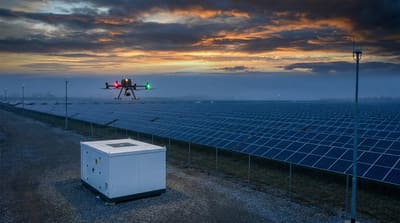
On June 8, 2026, DRONELIFE and several trade outlets reported that High Lander, an Israeli drone fleet management and UTM software provider, signed an agreement with Israel's Ministry of Energy to support autonomous aerial security at the Ta'anakh solar project, a 150 megawatt site in the southern Jezreel Valley that generates roughly 310 gigawatt-hours per year. Cando Drones is the operational supplier, and G1 Group leads the overall security program. The system pairs a drone-in-a-box that can launch within 15 seconds of an alert with High Lander's Orion fleet platform and its Vega UTM layer, the latter approved by the Civil Aviation Authority of Israel for certified BVLOS operators working from a manned flight center.
It is a foreign deployment under a foreign regulator. So why does it matter to a U.S. operator or a domestic infrastructure security director? Because the architecture, autonomous patrols, sensor-triggered launch, centralized fleet management, and an airspace layer that carries the safety case, is exactly the model U.S. critical infrastructure is moving toward. The hard part is that the parts which make it legal in Israel do not port to the United States without significant regulatory work. Knowing which pieces transfer and which do not is the difference between a fundable program and an expensive grounding letter.
What Was Actually Deployed
Strip the press language down and the Ta'anakh build is a layered physical security system with drones as the rapid-response tier:
- A drone-in-a-box housed on site, launchable within 15 seconds of a sensor trigger.
- Integration with smart fencing, ground sensors, and triggered response mechanisms, so the drone is dispatched by the alarm rather than by a human typing a mission.
- High Lander's Orion DFM platform for mission dispatch, automated patrols, hot swaps for continuous coverage, live video sharing, and ground-team coordination.
- High Lander's Vega UTM platform providing the airspace management layer, operated by a manned flight center staffed with operators authorized for beyond visual line of sight flight.
The CEO quote cites more than 100,000 hours of operational flight experience and a cyber and privacy protection layer the company calls High Shield. Discount the marketing, and the engineering claim that matters is this: the safety case for routine BVLOS over a fixed, complex site lives in the software and the manned flight center, not in a one-off waiver for a single mission. That is the architecture U.S. operators keep asking for and rarely get to fly.
Why Solar Farms Are the Natural First Customer
Utility-scale solar is close to an ideal autonomous-security use case, which is why you will see more of these announcements, not fewer:
- The sites are large, flat, and sparsely populated, which simplifies the ground-risk picture that drives any BVLOS safety argument.
- The perimeter is long and expensive to patrol with humans, so the labor math favors automation quickly.
- The threat profile, copper and equipment theft, vandalism, trespass, and increasingly reconnaissance of strategic energy assets, rewards fast eyes-on rather than a guard driving a fence line.
- The asset owner is often a regulated utility or a government energy ministry, which means there is a budget line for resilience and a procurement process that can absorb a software subscription.
The same logic extends to substations, transmission corridors, water treatment, ports, rail yards, and correctional facilities. Anywhere the perimeter is long, the threat is intermittent, and the response-time requirement is measured in seconds, a drone-in-a-box beats a patrol vehicle. The Ta'anakh deal is a clean example of the pattern that critical infrastructure security is shifting from manpower-heavy patrols toward software-driven systems that scale.
What Transfers to U.S. Operations
If you are pitching or building this domestically, several elements carry over directly:
- The layered concept is sound. Drones as a sensor-cued rapid-response tier on top of fencing, fixed cameras, and ground sensors is good security design regardless of jurisdiction.
- The fleet-management and dispatch software model is jurisdiction-neutral. Centralized mission control, automated patrol scheduling, and hot-swap coverage are engineering, not regulation.
- The economic argument holds. The labor-replacement and response-time case that justifies the system in Israel justifies it at a Texas solar farm or a Midwest substation.
- The integration discipline transfers. Tying launch to a verified alarm, deconflicting the drone with any other site sensors, and maintaining a clean video and audit trail are the same disciplines that show up in serious BVLOS programs, where the command-and-control link, surveillance picture, and traffic awareness are engineered together rather than bolted on.
What Does Not Transfer, and Why It Matters
This is where domestic operators get into trouble if they assume an Israeli or European deployment maps onto FAA airspace.
The BVLOS authority is different. Ta'anakh runs under CAAI approval with a manned flight center. In the United States, routine BVLOS over a fixed site today still runs on Part 107 waivers and exemptions, with the durable framework, Part 108, still working its way toward usable rules. An automated drone-in-a-box that launches on an alarm is precisely the kind of operation that needs either a robust BVLOS waiver with a tested detect-and-avoid solution or a future Part 108 authorization. You cannot point at an Israeli precedent and expect a U.S. Flight Standards office to be impressed. Build the safety case the FAA actually asks for, and read our Part 108 explainer before you assume the timeline favors you.
The counter-UAS half does not exist for private operators. The most important nuance the press coverage glosses over: this is a security drone system, not a counter-drone system. Detecting and especially mitigating a hostile drone over your solar farm is a separate legal universe in the United States. Federal C-UAS mitigation authority is narrowly scoped under 6 U.S.C. § 124n and related statutes, primarily to DHS, DOJ, DOD, DOE, and specific designated events. A private energy company in the U.S. generally cannot legally jam, spoof, or take down an intruding drone. It can detect, document, and call law enforcement. We walked through how thin that authority really is in the Project ULTRA brief and the DHS counter-UAS procurement piece. If your security pitch quietly implies you will neutralize intruding drones, you are selling something most U.S. customers cannot lawfully operate.
Remote ID and airspace deconfliction are mandatory, not optional. A standing autonomous patrol over a fixed site has to broadcast Remote ID and has to coexist with crop dusters, news helicopters, and the occasional recreational flyer. The Vega-style UTM layer in Israel is doing real work that a U.S. operator has to replicate through approved means. Plan for it as a first-class engineering requirement, not a paperwork afterthought.
The Operator and Program-Manager Checklist
If you are evaluating an autonomous drone-security system for a U.S. critical infrastructure site this year, work the following before you sign anything:
- Separate the security mission from any counter-UAS implication, and confirm in writing what the system is authorized to do versus what it can technically do. Detection is legal. Mitigation by a private operator is almost certainly not.
- Pin down the BVLOS authority path explicitly. Is the vendor flying under your existing Part 107 waiver, their own exemption, a shielded-operations argument, or a future Part 108 authorization? Get the operative document, not a slide.
- Require a detect-and-avoid solution and a defined lost-link and lost-C2 behavior. An alarm-triggered launch with no answer for a degraded link is a hazard, not a feature.
- Demand Remote ID compliance on every airframe, verified with an independent receiver, plus a written airspace coordination plan for your specific site and its surrounding traffic.
- Confirm data handling and retention. Persistent aerial video over a site raises privacy, cybersecurity, and evidentiary questions. Know where the footage lives and who can pull it.
- Run an RF and coverage survey before installation. A drone-in-a-box that scores well in a vendor demo is not the same as one that performs against your terrain, your structures, and your local RF environment.
The UAVHQ Read
The Ta'anakh deployment is a useful signal, not a template. It shows the autonomous-security architecture maturing into routine operations on critical energy infrastructure, and it confirms that the safety case is migrating into software and a manned flight center rather than living in a stack of single-mission waivers. That is genuinely where the U.S. market is heading.
The trap is assuming the regulatory environment has caught up with the technology. It has not. In the United States the BVLOS authority is still hard to get, the counter-UAS authority is reserved for a short list of federal agencies, and Remote ID plus airspace deconfliction are non-negotiable. The operators who win the domestic version of this market will be the ones who build the FAA-grade safety case, keep the security mission cleanly separated from any mitigation fantasy, and treat airspace integration as core engineering. The ones who copy the press release and skip the authority work will get a very expensive lesson from their regional Flight Standards office instead.
If you are scoping an autonomous site-security or infrastructure-protection program and need the BVLOS authorization path and the counter-UAS authority boundaries mapped before you commit budget, that is exactly the kind of work UAVHQ does.
Sources
- DRONELIFE: Autonomous Drone Security Takes Flight at 150 MW Ta'anakh Solar Project
- Global Airspace Radar: High Lander to Power Autonomous Aerial Security for Critical Solar Infrastructure
- UASweekly: High Lander Brings Autonomous Drone Security to Solar Farms and Critical Energy Infrastructure
- High Lander | Cando Drones
High Lander Cando Drones Ta'anakh Solar Drone-in-a-Box BVLOS UTM Critical Infrastructure Counter-UAS Remote ID Part 108 Site Security
Consulting Intake Paused
UAVHQ is not currently accepting new consulting clients. Existing commitments remain supported; select time-sensitive safety or regulatory inquiries may be reviewed as availability allows.