FAA Section 2209: Invisible Airspace Traps for Drone Operators
The proposed UAFR framework could finally give sensitive fixed sites a formal drone restriction process — but operators need digital publication, workable transit rules, and clear counter-UAS boundaries.
May 6, 2026 Part 107, Part 108, BVLOS, public safety, infrastructure inspection Author: Wesley Alexander — Former Insitu/Boeing ScanEagle Commercial Chief Test Pilot
01 — Video Briefing
Full Video Analysis
02 — What You Need to Know
5 Key Takeaways
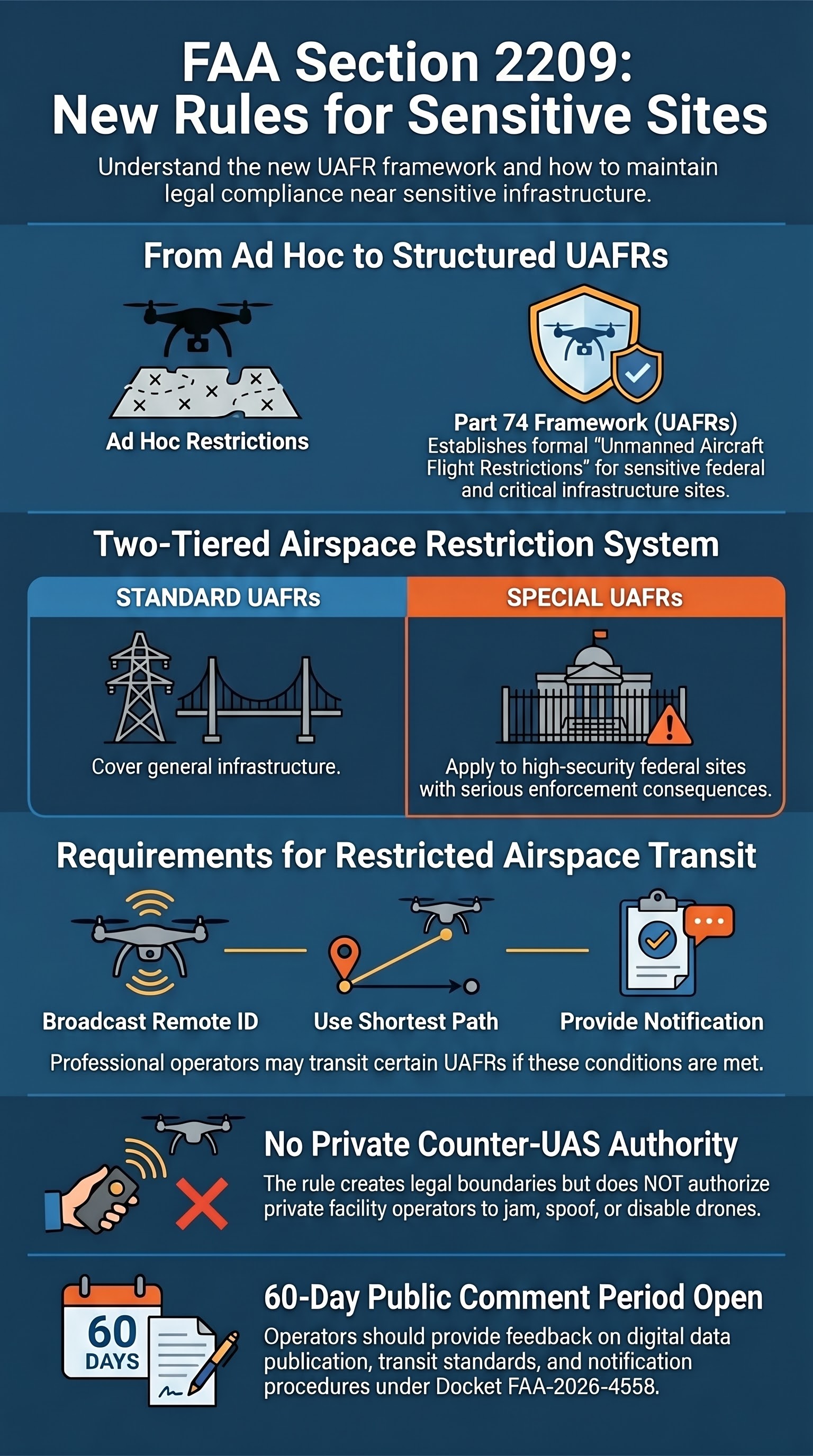
New Part 74 Framework
The NPRM would create Unmanned Aircraft Flight Restrictions, or UAFRs, as a formal petition pathway for sensitive fixed sites.
Two Restriction Tiers
Standard UAFRs cover qualifying infrastructure. Special UAFRs carry heavier federal security treatment and stronger enforcement consequences.
Transit Access Matters
Part 107, Part 108, Part 135, and Part 137 operations need workable transit rules, shortest-practicable routing, notification, and Remote ID clarity.
No Private Mitigation Authority
A UAFR is not permission for private facilities to jam, spoof, capture, or disable drones. Detection and mitigation remain separate legal worlds.
Operators Should Comment
Digital publication, machine-readable boundaries, emergency exceptions, and practical notification standards should be shaped before the rule hardens.
03 — Visual Explainer
FAA Section 2209: New Rules for Sensitive Sites
Click to open full-size infographic · FAA Section 2209: New Rules for Sensitive Sites
04 — Operational Briefing PDF
Section 2209 Operational Briefing
Twelve-page operator briefing covering the proposed UAFR structure, route-planning impacts, notification workflow, Remote ID, counter-UAS boundaries, and comment-period action items.
📄
FAA Section 2209 Operational Briefing
Open the PDF in your browser or download it for offline field reference.