
By Wesley Alexander • August 4, 2026 • 8 min read
Tactical Summary
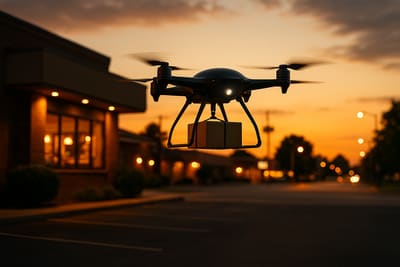
On July 29, 2026, DoorDash announced that DoorDash Labs, its in-house robotics and autonomy team, had earned Part 135 air carrier certification from the Federal Aviation Administration and was launching DoorDash Air. The company says this makes it the eighth drone operator in the United States to hold the certificate. According to Reuters and DoorDash's own newsroom, the aircraft is being designed and built in-house, and commercial service is expected to begin in fall 2026, initially limited to approved service areas and suitable orders.
Read as a press release, this is one more delivery company adding drones. Read as an operator, it is a deliberate bet on vertical integration that runs directly against the market structure taking shape elsewhere. Matternet is licensing a Type-Certified aircraft to a bench of Part 135 partners. DoorDash is doing the opposite: building its own airframe and standing up its own air carrier. Both approaches point at the same conclusion, which is that the durable advantage in this business is no longer the drone. It is the certificate and the compliance backbone behind it. If you fly commercially, that shift changes who your competition is and where the barriers to entry actually live.
What Part 135 Actually Buys, and What It Does Not
The single most misread fact in drone delivery is that "FAA approved" is one approval. It is not. DoorDash's certificate is an operational authorization, not a blanket key to the national airspace.
A Part 135 air carrier certificate says a specific operator has the manuals, training program, maintenance program, operational control structure, and management personnel to conduct commercial carriage for compensation. DoorDash's newsroom describes passing the FAA's five-stage certification process covering aircraft airworthiness, maintenance, and safety procedures. That is the same rigor the agency applies to a crewed charter operator, and it is why only eight drone companies hold it. Before DoorDash, the list was Wing, UPS Flight Forward, Amazon Prime Air, Zipline, Causey Aviation Unmanned, DroneUp, and Drone Express.
Here is the part the mainstream coverage buries. Part 135 does not grant unrestricted airspace access, and by itself it does not authorize the scaled Beyond Visual Line of Sight operations that make drone delivery economically interesting. As TechCrunch and TechRepublic both noted, when DoorDash wants to expand its coverage footprint, it will have to pursue additional approval for the drone's BVLOS operations. The air carrier certificate is the entry ticket. It is necessary and hard-won. It is not sufficient on its own to fly the dense, repeating, over-people corridors that turn a pilot program into a business. That gap is exactly what the coming Part 108 framework is meant to close, and it is why operators should read this launch as a beginning, not a finish line. The full landscape is in our Part 108 complete guide.
The Vertical Integration Bet
The genuinely interesting decision here is not that DoorDash got certified. It is that DoorDash chose to own the entire stack.
Most of the delivery market is fragmenting into specialists. Aircraft makers build airframes. Operators hold certificates and run the flying. Platforms connect merchants and customers. DoorDash is collapsing those layers into one company. It designed the aircraft inside DoorDash Labs, it holds the air carrier certificate itself, and it already owns the merchant network, the order management, the dispatch, and the customer relationship. As DroneLife framed it, the certificate is important but the decision to build and operate the system in-house may matter more.
This is the same structural fork we covered when Amazon Prime Air exited the Commercial Drone Alliance over a Part 108 safety split. Amazon also built its own aircraft, earned Part 135, and folded drones into a logistics network it controls end to end. DoorDash is running a comparable playbook, with one important difference: Amazon controls warehouses and inventory, while DoorDash connects independent restaurants and retailers it does not own. That makes DoorDash's integration a harder operational problem, because the loading point moves to a third-party merchant's curb rather than a company fulfillment center.
Contrast that with the Matternet operator-network model, where one company holds the Type Certificate and licenses the aircraft to Part 135 partners like Beeline and Ameriflight. The market is running a live experiment on two theories of the case. One says the winner assembles a certified network. The other says the winner owns everything and keeps a single safety case in-house. DoorDash just placed a very large bet on the second.
Why This Matters If You Fly Commercially
If you run survey, inspection, real estate, public-safety, or ENG operations, a new Part 135 delivery carrier in your metro is a change to your operating environment, not just an industry headline. Delivery networks are built to fly the same corridors on a schedule, every day. Your exposure is not one drone on one afternoon. It is a persistent, repeating low-altitude traffic pattern layered onto airspace you already work.
Three concrete moves:
-
Treat Remote ID as an operational necessity, not a checkbox. A denser autonomous delivery environment is precisely where broadcasting standard Remote ID and having a practical way to detect nearby traffic stops being paperwork and starts being how you stay clear of a scheduled delivery leg. This is the posture we laid out in the BVLOS compliance checklist: compliance is a procedure you run, not a document you file once.
-
Assume shared low-altitude airspace still runs on cooperation. DoorDash Air will begin in approved service areas, which means it will fly repeatable routes near real merchants in real neighborhoods. If those areas overlap your work, know that right-of-way at 200 feet over a residential street is still largely a human coordination problem. A new air carrier flying near you is one more party that may not have a deconfliction handshake with the independent Part 107 operator who never joined a shared-airspace arrangement.
-
Watch the footprint before it goes live. Delivery companies announce first and publish operating areas later. DoorDash has signaled more detail at its September product event. Watch for the launch markets, the merchant partners, and any airspace authorizations that surface near you, the same way operators are reading Appendix J in the Wing Atlanta environmental assessment. The corridors get set before you get consulted.
The Barrier to Entry Just Moved
For years the implicit assumption in drone delivery was that whoever built the best aircraft would win. DoorDash Air, like the Matternet network and Amazon Prime Air before it, says the aircraft is table stakes. The durable advantages sit elsewhere: the certificate that lets you legally fly for hire, the operational control structure the FAA signs off on, and the merchant and logistics network that gives the drones something profitable to carry.
That has a direct read for anyone deciding where to invest compliance energy. Building a delivery drone is a crowded, capital-intensive race with a long list of casualties. Holding a Part 135 certificate and knowing how to run compliant, scalable operations is a smaller, quieter field. Under Part 108, the operational bar is exactly where the FAA is putting its weight. Operators who understand that early, and who invest in the certificate and the compliance backbone rather than chasing hardware, are aligning with where the barrier to entry actually sits.
The UAVHQ Read
DoorDash Air is easy to file under "food-delivery company adds drones" and forget. The more useful read is structural. The eighth Part 135 holder in the country did not license someone else's aircraft or contract out its flying. It built the airframe, earned the air carrier certificate, and plugged both into a merchant network it already runs. That is a full-stack integration bet, and it is the mirror image of the licensing model Matternet is scaling.
For operators, the takeaway is twofold. Short term, if DoorDash's approved service areas land in a metro you work, expect a persistent new traffic layer on a schedule, so tighten your Remote ID and traffic-awareness posture now. Long term, remember that the certificate is doing the heavy lifting here, not the drone, and that Part 135 alone does not unlock scaled BVLOS. The advantage in this market is migrating to the operational authorizations that are genuinely hard to earn.
If your team is weighing a Part 135 path, a BVLOS operational build-out, or how a new delivery carrier changes the airspace you already fly, that is exactly the kind of operational and regulatory question UAVHQ works through with operators. The certificate is the moat. Build it deliberately.
Sources
- DoorDash Newsroom: DoorDash Is Cleared for Takeoff, Launches DoorDash Air (July 29, 2026)
- Reuters: DoorDash launches in-house drone delivery program after FAA certification (July 29, 2026)
- DroneLife: DoorDash Is Building More Than a Drone Delivery Service (July 29, 2026)
- Commercial UAV News: DoorDash Earns FAA Part 135 Certification, Launches In-House Drone Delivery Program (August 3, 2026)
- TechRepublic: DoorDash Gets FAA Approval for In-House Drone Delivery
DoorDash Air Part 135 Air Carrier Certificate FAA Drone Delivery DoorDash Labs Vertical Integration BVLOS Part 108 Remote ID Commercial Drone Operator Compliance Amazon Prime Air Matternet Wing Zipline Merchant Network Autonomous Delivery