
CRITICAL ANALYSIS COUNTER-UAS COMMERCIAL OPS
UAVHQ Staff | February 15, 2026 8 min read
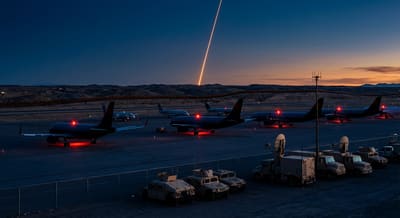
The chaotic deployment of laser counter-drone systems near El Paso International Airport this week exposed dangerous coordination failures between federal agencies—and created new risks for every commercial drone operator in America.
Watch: El Paso Counter-Drone Crisis: What Commercial Operators Must Learn More videos →
The seven-hour closure of El Paso International Airport on Wednesday wasn't just another routine security incident. It was a preview of what happens when America's rapidly expanding counter-drone infrastructure collides with the realities of commercial aviation—and commercial drone operations.
When U.S. Customs and Border Protection deployed high-powered laser systems against suspected cartel drones without coordinating with the FAA, they didn't just ground a dozen commercial flights. They exposed a fundamental problem that every commercial drone operator needs to understand: we're now flying in an increasingly militarized airspace where the rules are evolving faster than the coordination protocols.
The New Reality: More Agencies, More Authority
Two months ago, Congress quietly expanded counter-drone authorities to a broader range of law enforcement agencies. Previously, only select federal agencies could legally take down rogue drones. Now, with proper training, local law enforcement and additional federal agencies have that same power.
This expansion was driven by legitimate security concerns. Officials reported more than 27,000 drone detections within 1,600 feet of the southern border in just the last six months of 2024. The upcoming World Cup and America's 250th birthday celebrations have prompted $500 million in federal counter-drone grants.
But Wednesday's incident in El Paso revealed the downside of this expansion: more agencies with counter-drone capability means more potential for coordination failures, especially when those systems pose risks to manned aviation.
What Went Wrong: A Coordination Nightmare
According to sources familiar with the situation, CBP deployed laser counter-drone systems without coordinating with the FAA. When the aviation authority became aware of the high-powered lasers operating near commercial flight paths, they ordered an immediate airspace closure that was initially planned to last 10 days.
Only intervention at the highest levels—including from Homeland Security Secretary Kristi Noem—resolved the standoff within hours. But the damage was done: more than a dozen flights canceled, thousands of passengers disrupted, and a clear demonstration that our counter-drone expansion has outpaced our coordination capabilities.
"We need to simplify the authorities for who is really in charge and get these egos out of the way from these different agencies before an American gets hurt," said Brett Velicovich, a drone warfare expert who founded Power.us and consults on counter-drone operations.
Commercial Implications: Beyond NOTAMS
For commercial drone operators, the El Paso incident should be a wake-up call. The traditional approach of checking NOTAMs and coordinating with local control towers is no longer sufficient when multiple agencies might deploy counter-drone systems with little advance notice.
Risk Assessment Challenges
Commercial operators now face several new risk categories:
- Collateral targeting: Counter-drone systems don't always discriminate between malicious and legitimate aircraft
- Coordination failures: Agencies may deploy systems without notifying aviation authorities
- Equipment interference: RF jammers and directed energy weapons can affect legitimate drone operations in unexpected ways
- Airspace closures: Emergency restrictions can ground operations with no advance warning
Border and Security Zone Operations
The El Paso incident specifically impacts operators working near international borders, military installations, and critical infrastructure. These areas were already complex from a regulatory standpoint, but now they represent active counter-drone environments where commercial operations face new hazards.
Operations within 1,600 feet of the southern border—where 27,000 drone detections occurred last year—should be considered high-risk zones for potential counter-drone deployment.
Industry Perspective: "Two Pieces of Metal in the Sky"
Allied Pilots Association spokesman Captain Dennis Tajer captured the fundamental challenge: "You don't have to be a pilot, an engineer or a defense expert to understand that two pieces of metal in the sky that one doesn't know the other is there and is uncontrolled is dangerous."
This principle applies equally to drone-aircraft collisions and counter-drone-aircraft conflicts. The expansion of counter-drone capabilities creates a three-way collision risk that the industry is still learning to navigate.
Technology Assessment: Current Counter-Drone Arsenal
Understanding the counter-drone technologies now in broader circulation helps commercial operators assess their risk exposure:
RF-Based Systems
- Jammers: Disrupt control signals, potentially affecting nearby legitimate operations
- Spoofers: Take control of GPS and flight control systems
- Detectors: Passive systems that identify drone signatures
Kinetic Systems
- Interceptor drones: Physical collision systems
- Nets and tethers: Capture mechanisms
- Projectile systems: Traditional ballistic approaches
Directed Energy
- High-powered microwaves: Disable electronics
- Laser systems: The technology used in El Paso, capable of physically damaging aircraft
The laser systems that caused the El Paso crisis represent the most concerning category for aviation safety, as they can affect aircraft well beyond their intended target zone. The recent Pentagon-FAA joint anti-drone laser tests at White Sands are a direct attempt to establish safety protocols for these directed energy systems.
Regulatory Response: What's Coming
The El Paso incident will likely accelerate regulatory development in several areas:
Coordination Protocols
Expect new requirements for inter-agency coordination before counter-drone deployment, especially near airports and flight corridors.
Remote ID Integration
The incident underscores the importance of Remote ID systems in helping authorities distinguish between legitimate and malicious aircraft. Operators should expect accelerated enforcement of Remote ID requirements.
Geofencing Expansion
Areas with active counter-drone systems may see expanded geofencing requirements and real-time airspace restrictions.
Risk Mitigation for Commercial Operators
Enhanced Flight Planning
- Monitor security-related TFRs more closely
- Coordinate with multiple agencies in sensitive areas, not just FAA
- Maintain situational awareness of local law enforcement exercises
- Consider secondary communication methods in case of RF interference
Equipment Considerations
- Ensure Remote ID compliance is bulletproof
- Consider backup navigation systems for GPS-denied environments
- Implement fail-safe modes that don't rely on ground control signals
Insurance and Liability
Review insurance policies to ensure coverage for counter-drone related incidents. The intersection of security operations and commercial aviation creates new liability categories that traditional policies may not address. Our drone consulting services can help operators navigate these evolving risk frameworks.
Looking Ahead: An Industry in Transition
Michael Robbins, president and CEO of the Association for Uncrewed Vehicle Systems International, emphasized that counter-drone technology "when responsibly used with proper oversight and intensive training will help to mitigate unsafe or malicious drones in the very rare instances where that needs to occur."
The challenge is defining "responsibly used" and "proper oversight" in real-world scenarios where agencies operate under pressure and with incomplete information.
The drone industry has spent years building trust with regulators and the public. Events like El Paso threaten to undermine that progress by associating all drone operations—legitimate and illegitimate—with security threats.
Conclusion: Adaptation Required
The El Paso incident represents a inflection point for commercial drone operations. The days of operating in a purely civilian regulatory environment are ending. Commercial operators must now factor military and law enforcement counter-drone capabilities into their risk assessments and operational planning.
The industry's response to this challenge will determine whether commercial drone operations can coexist with enhanced security measures, or whether the expanding counter-drone infrastructure will create insurmountable barriers to routine commercial flight.
As Velicovich warned, we need better coordination "before an American gets hurt." For commercial operators, that coordination starts with understanding the new environment we're flying in.
📺 Watch the Video Briefing
Get expert video analysis on this topic and more on the UAVHQ YouTube channel.
🚁 Stay Ahead of the Drone Industry
Expert analysis on FAA regulations, commercial operations, and emerging technology — delivered to your inbox.
Subscribe
Consulting Intake Paused
UAVHQ is not currently accepting new consulting clients. Existing commitments remain supported; select time-sensitive safety or regulatory inquiries may be reviewed as availability allows.
Sponsored by
Your Brand Here
Reach drone professionals, commercial operators, and aviation decision-makers.
Sources
- Fortune: Congress let more law enforcement agencies to down rogue drones
- ABC News: What to know about the counter drone technology that triggered the closure of the El Paso airspace
- DHS: Counter-Unmanned Aircraft Systems
- FAA: Remote ID
📺 Watch the Video Briefing
Get expert video analysis on this topic and more on the UAVHQ YouTube channel.
🚁 Stay Ahead of the Drone Industry
Expert analysis on FAA regulations, commercial operations, and emerging technology — delivered to your inbox.
Subscribe
Sponsored by
Your Brand Here
Reach drone professionals, commercial operators, and aviation decision-makers.
UAVHQ
Drone industry intelligence and professional UAV consulting from Wesley Alexander — Senior Test Pilot with 25+ years of aviation leadership.
Explore
Connect
© 2026 UAVHQ. All rights reserved. · Privacy Policy