
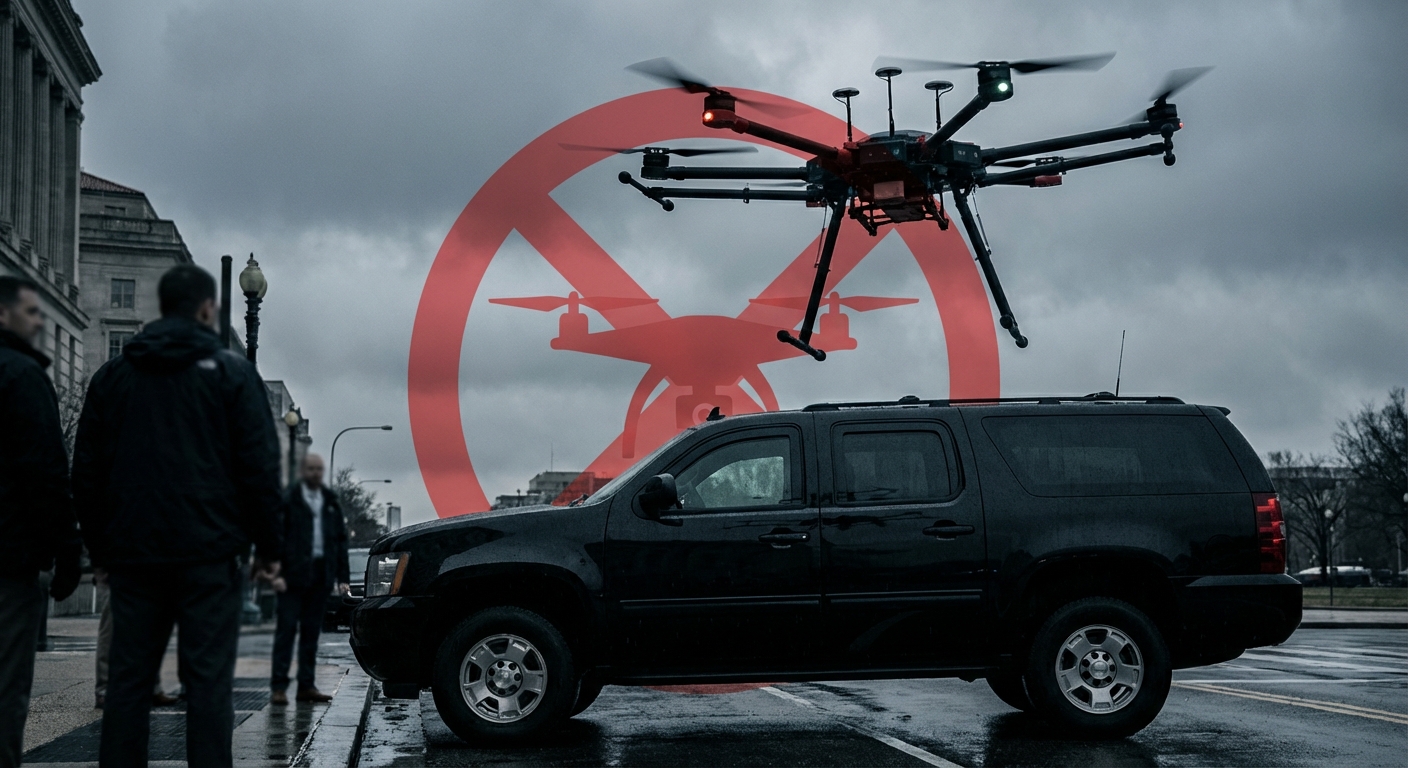
Every Part 107 operator knows the drill before a flight: check NOTAM data, verify controlled airspace, confirm no TFRs in the area. That checklist assumes airspace restrictions have one defining characteristic — they stay in one place. NOTAM FDC 6/4375, issued on January 16, 2026, breaks that assumption entirely.
This NOTAM creates a moving 3,000-foot lateral bubble around the "facilities and mobile assets" of the Departments of Defense, Energy, Justice, and Homeland Security. That explicitly includes "ground vehicle convoys and their associated escorts." In plain terms: any ICE or CBP vehicle on any street in America carries its own no-fly zone with it, and you are required to stay outside it at all times.
The restriction runs until October 29, 2027 — 21 months from its effective date. It covers all 50 states. There is no geographic boundary, no start time, no end time, and no map you can pull up to check compliance before launch. That is not a minor regulatory footnote. It is a fundamental change to how airspace works in this country, and every drone operator needs to understand it.
What the NOTAM Actually Says
The text of FDC 6/4375 prohibits unmanned aircraft operations within 3,000 feet horizontally and 1,000 feet vertically of any facility or mobile asset belonging to DoD, DOE, DoJ, or DHS — including convoys and their escorts. The restriction applies to all UAS, including recreational flyers and Part 107 certificate holders operating under valid waivers.
The FAA characterizes this under its authority to create National Defense Airspace (NDA), the same authority it uses to protect restricted zones around Washington, D.C., nuclear facilities, and major sporting events. In those contexts, the authority is uncontroversial — the protected zones are fixed and mappable. Applied to moving vehicles, the same authority produces restrictions that are practically impossible for operators to verify before or during flight.
Kerry Fleming, who spent nearly four decades at the FAA including as Airspace Manager of the System Operations Support Center, described the NOTAM bluntly: "This administration is determined to put all UAS operators on notice that they face severe penalties if they violate restricted or prohibited airspace, whether purposely or accidentally." Fleming was among the first FAA veterans to publicly flag the operational impossibility of the restriction's compliance requirements.
The Enforcement Problem Is Not Theoretical
Under normal circumstances, a TFR violation is treated as an administrative matter under the FAA's "compliance philosophy" — operators receive education and warnings before formal enforcement. That framework no longer applies in 2026.
In February 2026, the FAA published Compliance and Enforcement Bulletin No. 2026-1, which mandates automatic legal enforcement for any operation that violates an airspace restriction. The bulletin explicitly removes investigator discretion in these cases: violations go directly to the Chief Counsel for legal action. Compliance conversations are prohibited without approval from both the program office director and Chief Counsel.
The practical result is that accidentally flying within half a mile of an unmarked federal SUV — something a competent, licensed operator genuinely cannot prevent with current tools — now triggers formal FAA enforcement proceedings. Penalties under the bulletin range up to $75,000 per incident, with certificate suspension or revocation also on the table. For operators who hold both a Part 107 certificate and a traditional pilot certificate, the Bulletin makes clear that drone violations can result in revocation of all airman certificates held.
That combination — an unverifiable airspace restriction paired with zero-tolerance enforcement — creates genuine legal exposure for operators doing nothing more than standard commercial work in any urban environment.
The Unmarked Vehicle Problem
The compliance challenge is compounded by how federal immigration enforcement actually operates. ICE and CBP routinely use unmarked rental cars. Agents swap license plates between vehicles. Convoys offer no advance warning of their route or timing. A drone operator in a city conducting a routine inspection or mapping job cannot know whether a DHS mobile asset is within 3,000 feet of their aircraft — and there is no real-time API, app, or data feed that tells them.
Compare this to every other TFR in the FAA system. The Super Bowl TFR around Levi's Stadium earlier this year had precise GPS coordinates, hard start and end times, and was published weeks in advance. Stadium TFRs, wildfire TFRs, disaster TFRs — all of them give operators the information they need to plan around the restriction. FDC 6/4375 provides none of that. The zone is wherever the vehicles are, and you find out you violated it after the fact.
The Electronic Frontier Foundation, the National Press Photographers Association, and the Freedom of the Press Foundation have all filed formal challenges, arguing the NOTAM violates the First, Fifth, and Fourteenth Amendments and the FAA's own regulatory requirements for specifying the hazard requiring a TFR. As of April 2026, the FAA has not responded to letters demanding the restriction be lifted or substantially revised.
How This Compares to Existing Airspace Restrictions
Experienced operators are already navigating a complex landscape of fixed airspace restrictions. Class B, C, D, and E airspace around airports requires LAANC authorization. The Washington, D.C. Flight Restricted Zone (FRZ) and its surrounding Special Flight Rules Area (SFRA) require specific certificates and briefings. Fixed security NOTAMs around power plants and military facilities are published with coordinates. Operators have tools to work within all of these frameworks because the restrictions are defined, verifiable, and stable.
FDC 6/4375 fits none of those categories. It is national defense airspace by definition, which means it carries the full penalty weight of restricted military airspace. But unlike any military restricted area, it has no coordinates. It cannot be loaded into flight planning software. It cannot be cross-referenced against your planned route. It is, in effect, a restriction that exists everywhere and nowhere simultaneously.
This is why aviation attorneys and former FAA officials have been unusually vocal in their criticism. Dawn Zoldi, an attorney and longtime drone regulatory expert, noted that the bulletin fundamentally shifts who bears the burden of proof: "The system has to justify mercy, rather than justify escalation." Apply that posture to a restriction operators cannot reasonably verify, and the math gets uncomfortable fast.
What the First Amendment Challenge Actually Means for Operators
The constitutional challenges are important context, but they should not be mistaken for operational guidance. Unless and until a federal court issues a preliminary injunction against FDC 6/4375, the restriction is legally in force. Operators who fly in violation of it — regardless of their views on its legality — face real enforcement consequences under current FAA policy.
The First Amendment argument centers on aerial documentation of law enforcement. Drone journalism and citizen documentation of public safety events are legitimate and protected activities. Several federal circuit courts have affirmed a right to record law enforcement officers in public. But that legal framework has not yet been tested against FAA airspace authority at this scale, and until a court rules, operators should treat FDC 6/4375 as enforceable.
For commercial operators, the First Amendment dimensions are largely beside the point anyway. A construction inspector, infrastructure mapper, or real estate photographer has no obvious First Amendment stake in flying near a CBP vehicle. But they face the same legal exposure from accidental proximity as a journalist does from intentional documentation.
Practical Guidance for Part 107 Operators
Given the current regulatory environment, here is what I recommend for commercial and recreational operators working in urban areas:
Increase Your Pre-Flight Documentation
There is no tool that definitively clears you from FDC 6/4375, but documentation of your pre-flight compliance efforts matters significantly in enforcement proceedings. Record that you checked NOTAM data through official FAA sources. Log your flight planning steps. If you are operating near a federal facility, courthouse, or known enforcement activity area, document your risk assessment explicitly.
Maintain Conservative Separation in Urban Environments
Operating in areas with known or probable federal law enforcement activity adds regulatory risk to what might otherwise be a routine job. That does not mean refusing urban work — it means building in deliberate conservatism on altitude, lateral distance from major roadways, and operational timing when possible. Awareness is your primary mitigation tool when you cannot verify the restriction directly.
Know Your Certificate Exposure
If you hold both a Part 107 remote pilot certificate and a traditional airman certificate (private, commercial, ATP), understand that a drone violation under the new enforcement bulletin can put all of them at risk. This is not a hypothetical. The bulletin specifically addresses "all airman certificates held by the violator." If your livelihood depends on your pilot certificate, your drone operations now carry cross-certificate liability you may not have fully accounted for.
Consider Whether BVLOS Waivers Address This
BVLOS waivers and Part 108 authorizations for routine operations include specific airspace conditions. They do not provide blanket authorization to operate in national defense airspace, including FDC 6/4375 zones. Operators pursuing advanced authorizations should verify with their legal counsel whether their authorization documentation addresses this NOTAM specifically, particularly for operations in urban corridors where federal vehicle traffic is common. Our analysis of Part 108 and its airspace requirements covers the authorization framework in detail.
Monitor the Legal Challenge
The EFF, NPPA, and Freedom of the Press Foundation challenges are active. A successful First Amendment challenge or a court-ordered revision to FDC 6/4375 could substantially change the operational picture. Follow developments through those organizations and through FAA NOTAM updates. If the restriction is revised or enjoined, update your operational procedures accordingly. For the broader context of how the FAA has been escalating its enforcement posture in 2026, see our earlier analysis of Compliance and Enforcement Bulletin 2026-1.
The Industry Implications
FDC 6/4375 represents something genuinely new in U.S. airspace management: a security restriction defined not by geography but by the movements of government personnel. If it survives legal challenge and becomes an accepted regulatory tool, it creates a precedent with significant implications for drone operations at scale.
Consider what BVLOS normalization looks like in this environment. Part 108, the pending BVLOS rulemaking, envisions routine drone operations across extended corridors in urban and suburban areas — package delivery, infrastructure inspection, public safety support. All of those operations will regularly transit airspace near roadways and urban environments where federal vehicles operate. If a permanent, nationwide mobile TFR remains in force, every operator planning extended corridor operations needs to account for it explicitly in their safety case.
The same concern applies to drone-as-first-responder (DFR) programs. Public safety agencies operating DFR fleets are themselves DHS-adjacent, but their contracted operators and partner agencies may not have clear guidance on how FDC 6/4375 applies to their specific operations. That ambiguity creates liability exposure for programs that otherwise operate with solid regulatory foundations.
The broader industry trend is toward increasing complexity in airspace access. Remote ID requirements, the LAANC authorization system, evolving BVLOS rules, and now a permanent mobile TFR all layer on top of each other. Operators who treat compliance as a checkbox exercise rather than an active risk management discipline are going to find themselves exposed in ways they did not anticipate. If your enterprise drone program needs a comprehensive regulatory review, our consulting services cover Part 107/108 compliance, waiver applications, and operational risk assessment.
What Comes Next
Several possible developments bear watching over the next 60 to 90 days:
The EFF and press freedom organizations have explicitly demanded that the FAA either rescind FDC 6/4375 or substantially revise its terms to provide operators with workable compliance criteria. If the FAA does not respond, formal litigation is the likely next step, and a federal court could issue preliminary relief that changes the operational picture before any final ruling.
Congressional attention is also possible. Several members of the House Transportation Committee have expressed interest in FAA airspace security policy, and the intersection of drone restrictions with press freedom is the kind of issue that generates bipartisan concern. A legislative fix is unlikely in the near term but not out of the question over the 21-month life of the NOTAM.
The FAA itself may choose to revise the restriction in response to the volume of criticism from aviation professionals, attorneys, and civil liberties organizations. The agency has tools to add geographic clarity, operator notification requirements, or news media exemptions to the NOTAM without revoking it entirely. Whether political pressure from the administration that ordered expanded enforcement makes that path viable is a separate question.
What is clear right now: NOTAM FDC 6/4375 is active, enforceable, and paired with the toughest enforcement posture the FAA has ever implemented for drone operations. Every professional operator needs to understand what it means for their risk profile. And every operator who finds themselves in an enforcement proceeding over an inadvertent proximity event should consult legal counsel immediately.
The airspace has gotten more complicated. The consequences of getting it wrong have gotten larger. Act accordingly.
UAVHQ Analysis: FDC 6/4375 is the most operationally ambiguous airspace restriction in FAA history. Its combination of geographic indeterminacy and maximum enforcement penalties creates a risk landscape that existing compliance tools were not designed to address. Operators should treat urban commercial work with elevated caution until either a legal challenge succeeds or the FAA provides workable compliance guidance. We will update this analysis as the situation develops. For related reading, see our coverage of the ACLU's analysis of regulatory asymmetry in U.S. drone policy and the Safer Skies Act and venue-based counter-drone authority.
Sources
- The FAA's "Temporary" Flight Restriction for Drones is a Blatant Attempt to Criminalize Filming ICE — EFF (April 2026)
- FAA No-Fly Zones Around ICE Vehicles Are A First Amendment Problem, Press Groups Say — DroneXL (February 2026)
- Hammer and Nails: The FAA's UAS Enforcement Order Just Made "Legal Action" the Default — Autonomy Global (February 2026)
- NOTAM FDC 6/4375 — FAA TFR System
- FAA Steps Up Enforcement Against Unsafe Drone Operations — FAA Newsroom