
Wesley Alexander | April 2, 2026
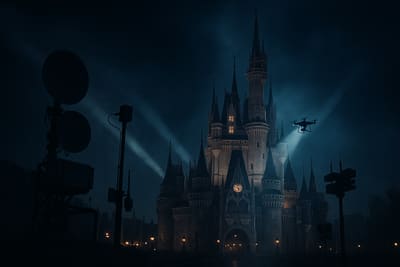
For years, theme parks operated under a maddening legal paradox. The FAA classified consumer drones as regulated aircraft, which meant that Disney World — hosting 58 million visitors annually — couldn't legally touch a drone hovering over Cinderella Castle without risking federal charges. The parks could ask nicely. They could call the FAA hotline. They could not act.
That's over. The Safer Skies Act, embedded as Sections 8601–8607 of the FY2026 National Defense Authorization Act and signed into law on December 18, 2025, fundamentally rewrites the counter-drone authority structure in the United States. For the first time, trained state and local law enforcement officers can legally detect, track, and disable unauthorized drones at covered venues — and amusement parks are explicitly named beneficiaries.
This isn't just a Disney story. It's a structural shift in how drone operations intersect with venue security, and every commercial operator in the country needs to understand the new rules of engagement.
Key Facts
- Law: Safer Skies Act (Sections 8601–8607, FY2026 NDAA), signed December 18, 2025
- Authority: Trained state/local law enforcement can detect, track, and disable drones at covered venues
- Covered venues: Amusement parks (Disney, Sea World, Universal Studios), stadiums, and other fixed-site facilities
- Authorization: Individual officers approved by DOJ — not entire agencies
- Reporting: Every mitigation action requires 48-hour incident reporting
- Technology: Only DOJ/DHS/DoD/DOT/FCC/NTIA-approved counter-UAS systems permitted
- Scale of threat: NFL reported 2,845 unauthorized drone incursions over stadiums in 2023 alone
- Pending rulemaking: FAA Section 2209 (permanent airspace restrictions via petition) still in progress since 2016
- Follow-on legislation: H.R. 7525 (Rep. Burlison, Feb 2026) would make SLTT counter-drone authority permanent
Situation Report: The Legal Gap That Took a Decade to Close
To understand why the Safer Skies Act matters, you need to understand the absurd legal framework it replaces. Under existing federal aviation law, a consumer drone — even one flown illegally over a packed theme park — is a "civil aircraft" under 49 U.S.C. The same protections that prevent someone from shooting at a Cessna applied equally to a $300 DJI Mini buzzing Space Mountain at 200 feet.
Theme parks weren't passive about this. Disney has operated its own drone detection systems for years, tracking incursions with radio frequency sensors and radar. But detection without the authority to act is just an expensive way to watch a threat you can't stop. The parks could detect drones. They could notify law enforcement. They could not legally jam, intercept, or bring down the aircraft.
The numbers tell the urgency story. The NFL documented 2,845 unauthorized drone incursions over stadiums during the 2023 season alone. That's nearly nine illegal drone flights per game day across the league. Theme parks, with their longer operating hours and year-round schedules, face exposure on a different order of magnitude entirely.
Before the Safer Skies Act, the only entities authorized to counter drones were four federal agencies: DOJ, DHS, DoD, and DOE. A local police officer watching a drone fly directly over 50,000 people had exactly as much legal authority to intervene as a random bystander.
Operational Impact: How the Safer Skies Act Actually Works
The law is more nuanced than the headlines suggest, and the details matter enormously for operators. Here's what actually changed:
Individual Officer Authorization — Not Agency-Wide
This is the critical distinction most coverage misses. The Safer Skies Act does not grant counter-drone authority to entire police departments. It authorizes individual officers who have completed DOJ-approved training programs. An untrained officer at the same venue has no more authority to disable a drone than before the law passed.
The training requirement creates a deliberate bottleneck. Counter-UAS operations require specific knowledge: understanding airspace classifications, identifying drone types, operating approved mitigation technology, and — critically — assessing collateral risk before engaging. A jammed drone doesn't disappear; it falls. Where it falls matters enormously when 50,000 people are below it.
Approved Technology Only
Officers can't freelance their mitigation approach. The law establishes an authorized technology list maintained jointly by DOJ, DHS, DoD, DOT, FCC, and NTIA. Only systems on this list can be deployed at covered venues. This addresses one of the most serious coordination failures in recent counter-drone history — the El Paso incident where uncoordinated Pentagon laser deployment shut down an international airport for seven hours.
The multi-agency technology approval process isn't bureaucratic overhead. RF jammers can interfere with airport communications. GPS spoofers can affect navigation systems for miles. Kinetic interceptors create falling debris. Each mitigation technology carries its own risk profile, and the approval list ensures that only systems with understood, bounded risk characteristics are deployed near civilian populations.
48-Hour Reporting Requirement
Every single mitigation action — whether it's a detection, tracking event, or active interdiction — triggers a mandatory 48-hour reporting requirement. This creates an accountability framework that didn't exist for federal counter-drone operations, where interagency coordination gaps have been a persistent problem.
The reporting requirement serves a dual purpose: it creates a national dataset on drone threat patterns at covered venues, and it prevents scope creep. When every action requires documentation, the incentive structure favors measured response over aggressive overreach.
Regulatory Analysis: The Three-Layer Airspace Protection Framework
The Safer Skies Act doesn't exist in isolation. It's the enforcement layer in what's becoming a three-tier drone restriction framework around major venues:
Layer 1: FAA Temporary Flight Restrictions (TFRs)
Existing mechanism for event-based airspace restrictions. TFRs over Disney theme parks and major venues already prohibit drone operations. Compliance depends on pilot awareness and voluntary adherence.
Layer 2: Section 2209 Permanent Restrictions (Pending)
FAA rulemaking authority from 2016 that would allow venue operators to petition for permanent drone-free airspace. Still pending after nearly a decade. IAAPA advocates risk-based criteria rather than attendance-threshold triggers for petition eligibility.
Layer 3: Safer Skies Act Active Enforcement (New)
The enforcement mechanism that was always missing. Trained officers can now actively detect, track, and neutralize unauthorized drones — backing the existing restrictions with actual teeth.
The missing piece — and the source of significant industry tension — is Layer 2. FAA Section 2209 rulemaking has been pending since 2016. A decade. The International Association of Amusement Parks and Attractions (IAAPA) has pushed for a risk-based criteria approach to the petition process, arguing that fixed attendance thresholds would leave smaller but equally vulnerable venues unprotected.
Until Section 2209 produces permanent airspace restrictions, the framework relies on TFRs (temporary) and the Safer Skies Act (reactive). That's enforcement without prevention — the security equivalent of locks without walls.
The Paradox: Parks Want to Fly Drones Too
Here's where it gets interesting. The same theme parks lobbying for counter-drone authority are simultaneously pushing to operate their own drone programs. Disney's drone light shows are already legendary — the company holds multiple patents for entertainment drone swarm technology. Universal Studios uses drones for aerial media production. Parks across the industry see drones as essential tools for maintenance inspection, structural monitoring, and immersive entertainment.
This creates a regulatory challenge that the Safer Skies Act doesn't fully resolve. How do you create an enforcement framework that can distinguish between an unauthorized incursion and an authorized park-operated drone? The answer lies in the technology approval process and operational coordination, but the practical implementation is still evolving.
For commercial operators, this dual-use reality is significant. Theme parks aren't anti-drone — they're anti-unauthorized -drone. The regulatory framework they're advocating for would, if properly designed, create clear operational lanes for authorized commercial operations while providing enforcement tools against threats. That's actually a healthy model for the broader industry.
H.R. 7525: Making Counter-Drone Authority Permanent
The Safer Skies Act provisions have a sunset problem — they're embedded in an annual defense authorization bill. Representative Eric Burlison introduced H.R. 7525 in February 2026 to make state, local, tribal, and territorial (SLTT) counter-drone authority permanent rather than subject to annual reauthorization.
The bill's introduction signals bipartisan recognition that counter-drone authority at the local level isn't a temporary experiment. It's infrastructure. The coordination challenges between federal and local agencies during recent incidents demonstrated that federal-only counter-drone response doesn't scale to the number of venues requiring protection.
What This Means for Operators
If you fly drones commercially, the Safer Skies Act changes your operational calculus in several concrete ways:
UAVHQ Analysis: Operator Action Items
1. Know Your Covered Venues
The Act explicitly covers amusement parks, stadiums, and other fixed-site facilities. If you operate anywhere near Disney World, Universal Studios, Sea World, or any major theme park or stadium, you are now operating in airspace where trained officers have active interdiction authority. TFR awareness was always important. Now, the consequences of a TFR violation include having your aircraft physically disabled.
2. Authorized ≠ Immune
Even operators with proper FAA authorization (Part 107 waivers, COAs, etc.) need to understand the coordination requirements. An officer authorized under the Safer Skies Act may not immediately distinguish between your authorized survey flight and an unauthorized incursion. Clear communication with venue security and local law enforcement isn't optional — it's operational survival. File NOTAMs. Coordinate with venue security offices directly. Carry your authorization documentation.
3. The Technology Implications
Approved counter-UAS technologies include RF jamming, GPS disruption, and kinetic interdiction. If you're operating near (not at) a covered venue, your aircraft may be affected by RF interference or GPS anomalies from counter-drone systems protecting the venue. Build contingency procedures for signal loss scenarios near protected sites. The El Paso incident proved that counter-drone effects don't respect operational boundaries.
4. Commercial Opportunity
The approved technology list creates a defined market for counter-UAS system providers. For drone service companies, there's an emerging market in helping venues establish detection networks, train staff, and integrate drone operations (both defensive and operational) into their security infrastructure. If your company does drone consulting, counter-UAS integration is now a legitimate service line.
5. Watch Section 2209
The pending FAA rulemaking on permanent airspace restrictions will have far larger operational impact than the Safer Skies Act itself. Permanent no-drone zones around theme parks, stadiums, and similar venues would fundamentally reshape the airspace map for commercial operations. IAAPA's push for risk-based criteria over attendance thresholds will determine how broadly these restrictions apply. Part 108 operators should be tracking this rulemaking with the same intensity as BVLOS regulations.
The Bigger Picture: Counter-Drone Authority Is Expanding
The Safer Skies Act is part of a broader trend of counter-drone authority expanding beyond federal agencies. The European Commission's Counter-Drone Action Plan and DHS counter-drone preparations for the 2026 FIFA World Cup reflect the same global recognition: drone threats at major venues require local enforcement capability, not just federal response.
For the U.S. drone industry, this means the operating environment is getting more complex, not less. The airspace around major venues will increasingly feature active counter-drone systems. The FAA's enforcement posture is already tightening with record fines and license actions. Layer active interdiction authority on top, and the margin for operational error near protected sites drops to zero.
This isn't necessarily bad for the commercial drone industry. Clear enforcement creates clear boundaries. Operators who understand the rules and coordinate properly will find their operations are more respected and less likely to face blanket restrictions born from security panic. It's the unauthorized, uncoordinated flights that created the political pressure for laws like the Safer Skies Act in the first place.
The Bottom Line
The Safer Skies Act closes a decade-old enforcement gap that left some of America's most visited venues legally defenseless against drone threats. For theme parks, stadiums, and similar facilities, it provides the active interdiction capability they've been requesting since consumer drones first appeared over their properties.
For commercial drone operators, it means a harder enforcement environment near covered venues — but also a more structured one. The individual officer authorization model, approved technology list, and 48-hour reporting requirements create accountability guardrails that protect legitimate operators from overreach while giving law enforcement real tools to address genuine threats.
The unfinished business is Section 2209. Permanent airspace restrictions will have more lasting impact on commercial operations than active interdiction authority. Operators, industry associations, and trade groups should be engaging with the FAA rulemaking process now, before the petition criteria are finalized.
The Happiest Place on Earth just got the authority to knock your drone out of the sky. Make sure you're not giving them a reason to use it.
Counter-Drone Safer Skies Act NDAA 2026 Disney World Theme Park Security FAA Enforcement Counter-UAS Section 2209 IAAPA No-Fly Zone Public Safety H.R. 7525
Sources
DroneXL — Disney World Drone No-Fly Zone Enforcement H.R. 7525 — SLTT Counter-Drone Authority Act (Rep. Burlison) FAA — UAS Airspace Analysis and Restrictions IAAPA — International Association of Amusement Parks and Attractions
📺 Watch the Video Briefing
Get expert video analysis on this topic and more on the UAVHQ YouTube channel.
🚁 Stay Ahead of the Drone Industry
Expert analysis on FAA regulations, commercial operations, and emerging technology — delivered to your inbox.
Subscribe
Need Expert Drone Consulting?
UAVHQ offers professional consulting for counter-drone assessments, venue airspace protection, Part 107/108 compliance, and regulatory strategy. 25+ years of aviation expertise at your service.
Sponsored by
Your Brand Here
Reach drone professionals, commercial operators, and aviation decision-makers.