
Wesley Alexander • June 10, 2026 • 8 min read
Tactical Summary
On June 4, 2026, the Fort Worth Police Department announced a Drone as First Responder program built with Flock Safety, demonstrated live at the Bob Bolen Public Safety Complex. Per the Fort Worth Report and the Fort Worth Star-Telegram, the initiative is a one-year, no-cost pilot starting with two drones and a team of roughly ten, with Police Chief Eddie García saying the long-term goal is coverage for all six of the department's patrol divisions. The timing is not accidental: North Texas is hosting matches for the world's largest soccer tournament this summer, and Fort Worth wants real-time aerial response in place before the visitors arrive.
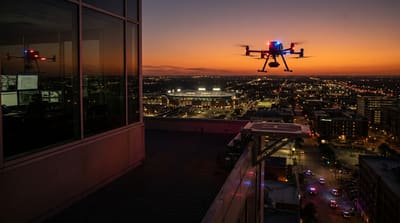
The public-safety value proposition is straightforward. When a qualifying 911 call comes in, a drone launches from its dock, reaches nearby scenes within minutes, and streams a live aerial view to officers in the field, dispatch, and the real-time crime center. First eyes on scene before the first cruiser arrives. That is a genuine officer-safety and outcome improvement, and it is why public safety and DFR remain the fastest-growing application in U.S. commercial drone work.
But a DFR program is not a gadget purchase. The press conference is the visible 10 percent. The other 90 percent is FAA authorization, airspace deconfliction, lost-link behavior, and an accountability record that survives a city council meeting and a public-records request. Here is what is actually holding this program up, and what every other agency watching Fort Worth should document before they copy it.
What Fort Worth Actually Bought
Strip away the vendor language and the FWPD build is a layered, alarm-cued response system with drones as the rapid tier:
- Drone-in-a-box docks that launch on a qualifying incident, with each dock providing coverage within roughly a four-mile radius.
- Integration with the department's existing Flock license plate reader network and an expanding real-time crime center that is being built into a regional resource for partner agencies.
- Trigger-only launches tied to specific events such as a 911 call, an LPR alert, or gunshot detection, explicitly not roaming patrol.
- An accountability layer: automatic flight logging of where, when, and why; a camera that points to the horizon in transit and tilts toward a scene only on arrival; and a community dashboard publishing redacted flight logs and high-level metrics.
That accountability scaffolding is not marketing fluff. It is the part that determines whether a DFR program survives its second year. Agencies that launch without it spend the back half of year one fighting privacy lawsuits and open-records fights instead of running calls.
The Legal Authority That Makes It Possible
Here is what a press release will never spell out: a citywide DFR program that launches autonomously from a dock and flies to a scene the pilot cannot see is, by definition, a beyond visual line of sight operation. Today, in the United States, that runs on an FAA waiver package, not on a purchase order.
Most mature DFR programs operate under a Part 107 BVLOS waiver, frequently paired with a shielded-operations or "DFR-specific" framework the FAA has been refining, and increasingly with a tactical BVLOS approach that leans on a combination of visual observers, an approved detect-and-avoid solution, and altitude and geographic limits. The durable nationwide framework, Part 108, is still working toward usable rules, so for now every one of these programs lives on case-by-case authority. If you want the full picture of where the rulemaking sits, our Part 108 explainer lays out the timeline and the two-tier structure.
The operator lesson: when you evaluate a DFR vendor, the first question is not "how fast does the drone launch," it is "what is the operative FAA authorization, who holds it, and what are its limits." Get the waiver document and its special provisions, not a slide. A program that cannot show you the authority it flies under is selling you a liability, not a capability.
Airspace, Deconfliction, and the Class B Problem
Fort Worth sits inside one of the busiest pieces of controlled airspace in the country. DFW International and the surrounding Class B shelves, plus heavy helicopter traffic from news, medical, and police aviation, mean a DFR drone cannot simply pop up to 300 feet on every call and trust that the sky is clear.
A serious DFR program engineers airspace integration as a first-class requirement. That means Remote ID broadcast on every airframe, a written airspace coordination plan with the controlling facility, programmed no-fly geofences around airports and sensitive sites, and a defined deconfliction procedure for manned traffic. The Fort Worth demonstration specifically highlighted programmed no-fly zones and automatic return-to-dock on low battery, which is the right instinct. The agencies that get into trouble are the ones that treat airspace as a paperwork afterthought rather than as the engineering constraint that shapes the entire concept of operations. We walked through how invisible those airspace restrictions can be in our Section 2209 sensitive-sites brief.
There is also an event-airspace wrinkle here. With the World Cup driving temporary flight restrictions over venues this summer, a DFR program operating near a stadium has to know that LAANC authorization does not override a security TFR. We covered exactly that trap in our World Cup TFR brief, and it applies directly to any North Texas agency flying near a match venue.
Failure States Nobody Demos
A live demonstration shows the happy path. The work is in the failure states:
- Lost C2 link. What does the aircraft do when the command-and-control link degrades or drops mid-response? The answer has to be a defined, tested behavior, not an improvisation.
- Lost GPS or a contested RF environment. Dense urban canyons and large events both stress positioning and datalink. A drone that performs in a parking-lot demo is not the same as one that performs over downtown during a packed event.
- Detect-and-avoid coverage. Sensor-cued autonomous launch with no answer for converging manned traffic is a hazard, not a feature. Confirm the DAA solution and its limits.
- Privacy and evidentiary handling. Persistent aerial video raises retention, chain-of-custody, and discovery questions. Know where the footage lives, how long it is kept, and who can pull it before the first subpoena arrives.
These are the same disciplines that separate a fundable public-safety program from a grounded one, and they are why agencies increasingly bring in outside regulatory help before they sign rather than after. Our Vanderbilt campus DFR analysis and the Warren, Michigan first-responder program write-up both show how the documentation burden scales with the airspace complexity.
The UAVHQ Read
Fort Worth's DFR launch is a real public-safety win and a clean example of where municipal drone operations are heading: alarm-cued, dock-launched, integrated with existing camera and LPR infrastructure, and wrapped in a transparency layer that earns public trust. The no-cost, one-year pilot structure is also smart procurement, because it lets the department prove the concept against its own call data before committing to a citywide buildout.
The trap, for the dozens of agencies that will now ask their chiefs for the same thing, is assuming the hard part is the hardware. It is not. The hard part is the FAA authorization path that makes BVLOS legal, the airspace deconfliction that keeps the drone clear of manned traffic in complex airspace, the tested failure-state behavior, and the accountability record that survives public scrutiny. Get those four right and a DFR program is a durable capability. Skip them and it is an expensive grounding letter waiting to happen.
If your agency is scoping a DFR program and needs the BVLOS waiver path, airspace coordination plan, and accountability framework mapped before you commit budget, that is exactly the kind of work UAVHQ does.
Sources
- Fort Worth Report: Fort Worth police crime-fighting drone program takes off in partnership with Flock Safety
- Fort Worth Star-Telegram: Fort Worth Police Department launches new drone program
- GovTech: Drone Program Gives Fort Worth Police 'Eyes in the Sky'
- Flock Safety: Fort Worth Police Launch Flock Drone as First Responder Program
Fort Worth DFR Drone as First Responder Flock Safety BVLOS Part 108 Remote ID Public Safety World Cup TFR Real-Time Crime Center Detect-and-Avoid
Consulting Intake Paused
UAVHQ is not currently accepting new consulting clients. Existing commitments remain supported; select time-sensitive safety or regulatory inquiries may be reviewed as availability allows.