
Wesley Alexander • June 8, 2026 • 9 min read
Tactical Summary
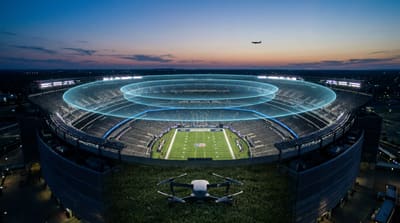
FIFA World Cup 2026 begins June 11. The FAA's official venue list, published May 29, establishes Temporary Flight Restrictions over 11 host stadiums (3 nautical-mile radius, surface to 3,000 feet AGL on match days) and 12 fan-event venues (1 NM radius, surface to 1,000 feet AGL across multi-week windows). Additional TFRs will cover team hotels, base camps, and training facilities in cities that are not even hosting matches. Penalties include fines up to $100,000, drone confiscation, and federal criminal charges. The FAA's new DETER program is the enforcement layer.
The single most important operator point: LAANC authorization, Part 107 certification, and recreational privileges grant zero exemption inside an active TFR. If your normal flight area touches one of these rings, your operating posture has to change before kickoff, not during the first violation conversation with a federal agent.
What the FAA Actually Published
The May 29 announcement is the first time the agency has put concrete dimensions, dates, and venue addresses on the public record for the tournament. Two ring sizes:
Stadium (match-day) TFRs. 3 NM radius, surface to 3,000 feet AGL, active on each match day. Eleven stadiums: SoFi (Los Angeles), Levi's (Santa Clara), Lumen Field (Seattle), AT&T Stadium (Arlington), NRG (Houston), Mercedes-Benz (Atlanta), Gillette (Foxborough), Hard Rock (Miami), Arrowhead (Kansas City), MetLife (East Rutherford), Lincoln Financial Field (Philadelphia). Match dates run June 12 through July 19, with most stadiums hosting between six and nine matches.
Fan-event TFRs. 1 NM radius, surface to 1,000 feet AGL. Twelve venues, several of them active continuously for weeks. Dallas Fair Park and Houston's East Downtown District are restricted essentially the entire tournament window. Lemon Hill Park in Philadelphia covers June 11 through July 19 without a break. Rockefeller Center in New York activates July 4 to 19. Centennial Olympic Park in Atlanta runs a non-contiguous schedule tied to the local match calendar.
Implicit third ring. The FAA's release flags "additional restrictions" at team hotels, base camps, and training facilities, with a supplementary PDF for venues not listed in the headline announcement. Cities that are not hosting matches, but that are hosting a training base or team hotel, get a 1 NM ring too. That detail catches a lot of operators who assume only host cities matter.
All restrictions are subject to change, and NOTAMs are the controlling document. The published table is the planning artifact; the active TFR text is the legal one.
Why LAANC Will Not Help You
This is the part the published FAA release does not spell out in plain English, so it is worth spelling out here.
LAANC (Low Altitude Authorization and Notification Capability) is the automated authorization layer for controlled airspace under 400 feet. It lets Part 107 and recreational operators get near-instant authorization inside Class B, C, D, and the surface portions of Class E around airports, up to the published UAS Facility Map ceilings.
A TFR is a separate legal instrument. It sits on top of the underlying airspace class. When a stadium TFR activates, the LAANC grid for that 3 NM circle goes irrelevant. Your earlier authorization does not roll forward. A new LAANC request inside that ring during the TFR will not produce a valid authorization, because LAANC does not adjudicate TFR access. The only paths through an active sporting-event TFR are explicit FAA waivers issued in advance to specific operators (broadcast, public safety, federal partners), or ATC-coordinated airspace access for cooperating aircraft.
For practical purposes, every commercial and recreational operator should treat the published rings as hard exclusion zones on the listed dates, and treat the surrounding airspace as significantly more scrutinized than usual.
The DETER Enforcement Layer
The FAA launched the Drone Expedited and Targeted Enforcement Response program specifically to compress the timeline between detection and consequence. Historically, FAA enforcement against rogue drone operators took months and frequently stalled because identifying the pilot was hard. Remote ID changed the identification problem. DETER is the procedural response that turns identification into an enforcement action quickly.
For World Cup venues, DETER pairs with federal counter-UAS authority. As covered in the DHS C-UAS purchasing tool brief, detection is largely a state and local sensor problem, but mitigation authority sits with federal agencies under 6 U.S.C. § 124n. The federal teams on site for the tournament are authorized to use "specialized mitigation tools" to move an unauthorized aircraft out of the airspace while preserving the aircraft for evidentiary purposes.
If your Remote ID broadcast is clean and your aircraft is correlated with a tail number, registration, and operator address inside an active TFR, the federal process to identify, locate, and cite the operator now runs in minutes, not months. The $100,000 maximum civil penalty is paired with possible criminal referral, and the agencies have published unusually direct enforcement language for a planned event.
Operator Pre-Flight Changes, by Mission Type
This is where the abstract regulatory picture becomes a checklist. Different operator types should make different changes this week.
Commercial Part 107 operators in host metros. Pull the published venue list. Overlay the 3 NM stadium rings and 1 NM fan-event rings against your typical jobsites. Identify any recurring client locations (real estate, inspection, mapping, cinematography) that fall inside a ring on any active date. For affected jobs, either reschedule outside the active window or relocate. Do not assume LAANC will accommodate. Update your client communication template now so the conversation happens before the booking, not the morning of the flight.
Public safety drone programs in host cities. Your aircraft are the cooperative traffic the federal counter-UAS picture needs to recognize without alarm. Pre-coordinate every routine flight pattern with your local FBI field office and the FAA's regional System Operations Support Center before the tournament window. Confirm your Remote ID broadcast independently using a separate receiver app, not just the manufacturer's compliance attestation. For Drone as First Responder programs, document your standard launch sites and altitude bands so the federal coordination cell has a baseline to deconflict against.
Recreational operators near venues. The same rules apply to you. There is no Section 44809 exemption for active TFRs. The FAA's "No Drone Zone" framing is aimed primarily at this audience, because the historical pattern at major sporting events is that the violators are recreational pilots, not commercial ones. If you fly in or near any of the listed metros, the safest posture is to fly elsewhere on match days and during continuous fan-event windows.
Operators contracted for sanctioned broadcast or security work. You should already have a waiver process in motion. If you do not, the window is closing. Direct coordination with the FAA's Air Traffic Organization and the relevant federal security lead is the only legitimate path. There is no last-minute LAANC equivalent for sporting-event TFR access.
What This Sets Up for the Rest of 2026
The World Cup TFR pattern is a preview, not an exception. The same playbook (federal coordination, dense counter-UAS sensor coverage, DETER-accelerated enforcement, hardened public messaging) will appear again at the 2028 Olympics, at NFL playoffs, and at any future federally designated National Special Security Event. The procurement money has flowed. The federal coordination cells have been stood up. The legal instruments are tested.
The longer-term operational message for commercial drone operators is simple: cooperative behavior, clean Remote ID, and pre-coordination are now the cost of doing business in any city that hosts a major event. The operators who internalize that this summer will find the rest of the decade easier. The operators who learn it through a DETER citation will find it expensive.
Get the pre-flight checklist before June 11.
Download the UAVHQ World Cup 2026 Operator Briefing: venue-by-venue ring geometry, active-date calendar, LAANC and waiver decision tree, Remote ID verification steps, DETER exposure checklist, and client communication template.
Get the checklist →The UAVHQ Read
The interesting story is not the venue list, although the venue list is the artifact every operator needs. The interesting story is that the FAA, DHS, and DOJ have built a coordinated enforcement model that will define how the airspace around major events works for the next several years. LAANC will not help you. Pre-coordination will. Clean Remote ID broadcasts will. Predictable, documented operating patterns will. Showing up to a routine job inside a 3 NM stadium ring on a match day, with no plan, will not.
If you operate commercially in any of the 11 host metros, the next 72 hours are the time to update your scheduling, brief your pilots, and pull the active dates into your dispatch process. The tournament window is six weeks. The enforcement environment is new. Treat the rings as real.
Sources
- FAA: FAA Establishes 'No Drone Zones' for FIFA World Cup 2026 Stadiums, Fan Events, and Base Camps
- FAA: Safety Plan for FIFA World Cup 2026 (No Drone Zone)
- FBI Dallas: Warning to Drone Operators on World Cup TFRs
- DroneLife: FAA Creates World Cup No-Drone Zones Across U.S. Host Cities (May 29, 2026)
LAANC Part 107 TFR FIFA World Cup 2026 DETER FAA Remote ID Counter-UAS Commercial Drone Operations Public Safety Drones
Consulting Intake Paused
UAVHQ is not currently accepting new consulting clients. Existing commitments remain supported; select time-sensitive safety or regulatory inquiries may be reviewed as availability allows.