
Reality Check: Oregon Study Reveals $2 Billion FCC Ban Impact as FAA Data Confirms DJI's 96% Market Stranglehold
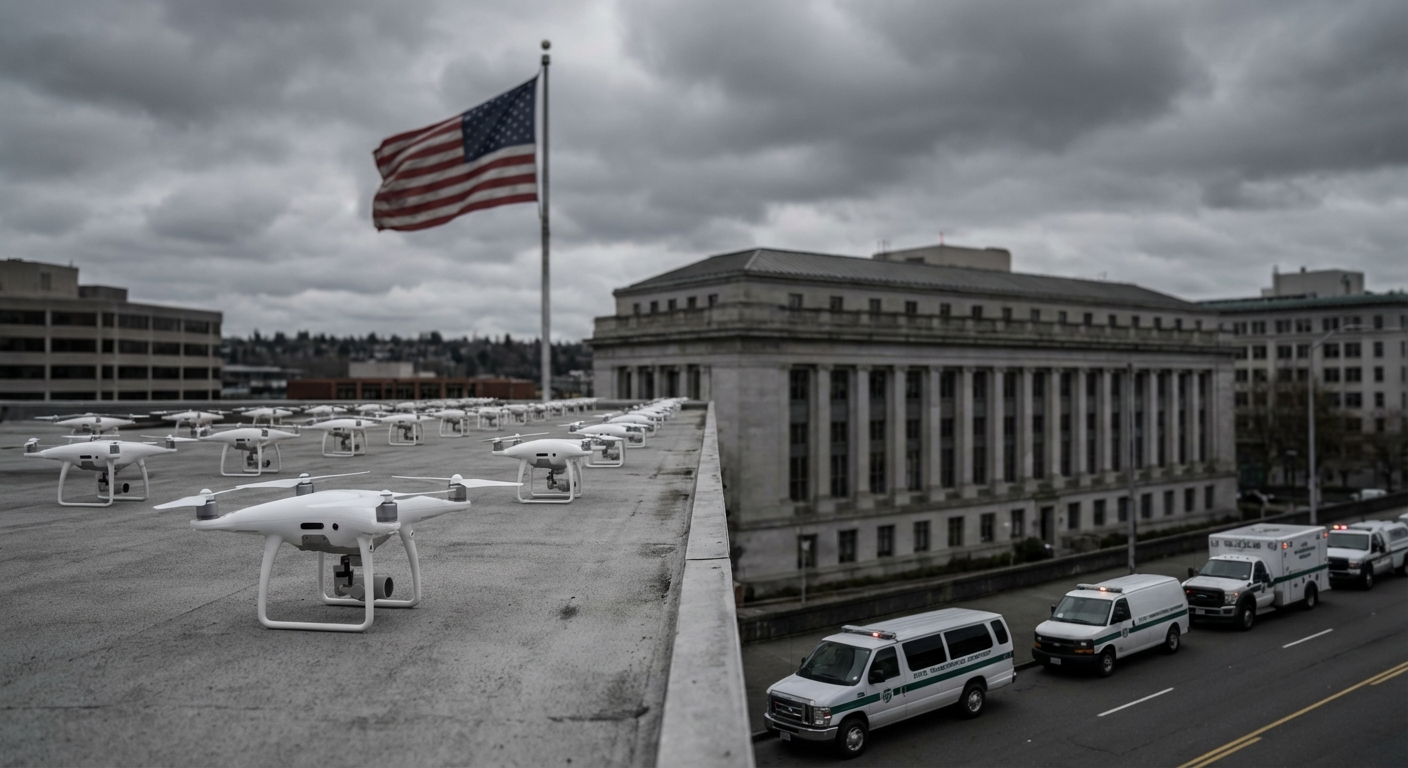
The numbers are in, and they paint a stark picture of the FCC's drone restrictions' real-world impact. A new white paper from the Oregon Department of Aviation reveals that state transportation departments alone face up to $2 billion in losses nationwide, while fresh FAA data confirms that Chinese manufacturer DJI controls over 96% of detected drone activity in US airspace—creating what industry observers are calling a regulatory nightmare with no clear exit strategy.
The $2 Billion Reckoning
Oregon's comprehensive survey of 25 state transportation departments exposes the brutal arithmetic of the FCC's security-driven restrictions on Chinese-manufactured drones. The findings are nothing short of devastating for state-level operations:
- Wisconsin: 100% of fleet grounded
- Colorado: 90% loss of operational capabilities
- Oregon: Down to just 1 compliant drone out of 22
- Total impact: At least 467 drones grounded or restricted across 25 states
But the numbers tell only part of the story. Idaho reported that a drone previously purchased for $15,000 now requires a $42,000 investment to replace with a compliant alternative—a 180% cost increase that most agencies simply cannot absorb.
"The financial impact is enormous, but the operational disruption is what's really killing us," noted one state DOT official who spoke on condition of anonymity. "We've got bridge inspections delayed, emergency response capabilities compromised, and project timelines blown apart."
DJI's Unassailable Market Position
Simultaneously, the FAA's Assure A83 2025 Annual Report—based on remote ID telemetry data from 64 monitoring locations—has quantified what industry professionals have long suspected: DJI's market dominance is nearly absolute.
The data analysis reveals:
- DJI platforms: 96% of all detected drone activity
- Skydio: Just over 1%
- All other manufacturers combined: Less than 2.4%
The Model Breakdown
Within DJI's ecosystem, the dominance of specific platforms is equally striking:
- DJI Mini 4 Pro: 19% of all detected flights
- DJI Air 3: 13% of activity
- DJI Mavic 3 Pro: 8% market share
Perhaps most telling for the commercial sector: over 93.7% of the top 22 detected platforms weigh 3 pounds or less, while heavy-lift industrial models like the Matrice 400, Agras T50, and FlightCart 30 represent only a tiny fraction of overall flight activity.
The Impossible Math
These two data sets create what can only be described as a regulatory paradox. If 96% of US drone activity relies on DJI platforms, and the FCC restrictions are forcing widespread fleet groundings, the implications extend far beyond state transportation departments.
Commercial operators across sectors—from construction and agriculture to emergency services and media production—face the same impossible calculus: replace proven, cost-effective platforms with alternatives that may cost 2-3 times as much while offering reduced capabilities, or suspend operations entirely.
Flight Pattern Reality
The FAA data also reveals operational patterns that should inform policy discussions. Nearly half of all detected flights were stationary (likely inspection or monitoring work), and 92.6% stayed within half a nautical mile of the pilot—hardly the profile of systems capable of sophisticated espionage or data exfiltration.
Industry Implications: The Replacement Ecosystem That Isn't
Oregon's recommendation for a waiver extension until September 2027 acknowledges an uncomfortable truth: the domestic and allied drone manufacturing ecosystem is nowhere near ready to absorb displaced demand. The recent FCC approval of four non-Chinese drone exemptions underscores just how narrow the pathway remains.
Current "compliant" alternatives face significant challenges:
- Supply constraints: Most alternatives have limited production capacity
- Performance gaps: Many lack the sophisticated flight control, imaging systems, or payload capabilities of DJI platforms
- Price premiums: Cost increases of 50-200% are common
- Training overhead: New platforms require operator recertification and workflow adaptation
What This Means for Commercial Operators
For professional drone operators holding a Part 107 certificate, these findings should trigger immediate strategic planning:
Short-term Survival
- Audit current fleet compliance status against latest FCC guidance
- Identify critical missions that absolutely require drone capabilities
- Budget for replacement costs assuming 2-3x current platform prices
- Develop contingency workflows for potential service interruptions
Long-term Adaptation
- Diversify platform dependencies to reduce single-vendor risk
- Invest in operator cross-training for multiple platform types
- Monitor emerging domestic manufacturers and establish early relationships — our guide to building a commercial drone program covers fleet planning strategies
- Consider service partnerships with compliant operators for critical missions
The Export Rules Silver Lining
Not all regulatory news is dire. The Commerce Department's recent streamlining of drone export controls offers a glimpse of more pragmatic policymaking. The Bureau of Industry and Security eliminated license requirements for commercial drones under one-hour endurance when exported to allied nations, and opened faster pathways for longer-range systems like agricultural sprayers.
This shift recognizes that a 25-liter crop sprayer is not, in fact, a ballistic missile—and that excessive paperwork was simply driving customers to allied competitors.
The Path Forward: Waiver or Bust?
Oregon's white paper recommends a waiver extension through September 2027, acknowledging that the drone manufacturing ecosystem needs time to develop viable alternatives. But this temporary reprieve only delays the fundamental questions:
- How can critical infrastructure operations maintain capabilities while security concerns are addressed?
- What level of domestic manufacturing capacity is necessary for true supply chain security?
- How do we balance immediate operational needs against long-term strategic goals?
For commercial operators, the message is clear: the era of cheap, readily available Chinese drones is ending, with or without waivers. Operators seeking guidance through this transition can explore UAVHQ's consulting services for strategic fleet planning support. The question is whether the transition will be managed strategically or imposed catastrophically.
Looking Ahead
These twin revelations—$2 billion in potential losses and 96% market dependence—represent more than statistical curiosities. They're the quantified proof of what industry professionals have been warning about since the restrictions were first proposed: security concerns, however legitimate, cannot be addressed through policies that ignore market realities.
The next 18 months will likely determine whether US drone policy evolves toward practical solutions that balance security and operational needs, or whether we'll witness the managed decline of an entire sector of American commercial aviation.
For operators in the field, the advice remains the same: plan for disruption, budget for replacement, and hope for policy sanity—but don't bet your business on the latter.
Sources: DroneXL Weekly UAS News | Oregon Department of Aviation White Paper | FAA Assure A83 2025 Annual Report
Need Expert Drone Consulting?
UAVHQ offers professional consulting for BVLOS waivers, Part 107/108 compliance, enterprise drone programs, and regulatory strategy. 25+ years of aviation expertise at your service.
Explore Our Services →