
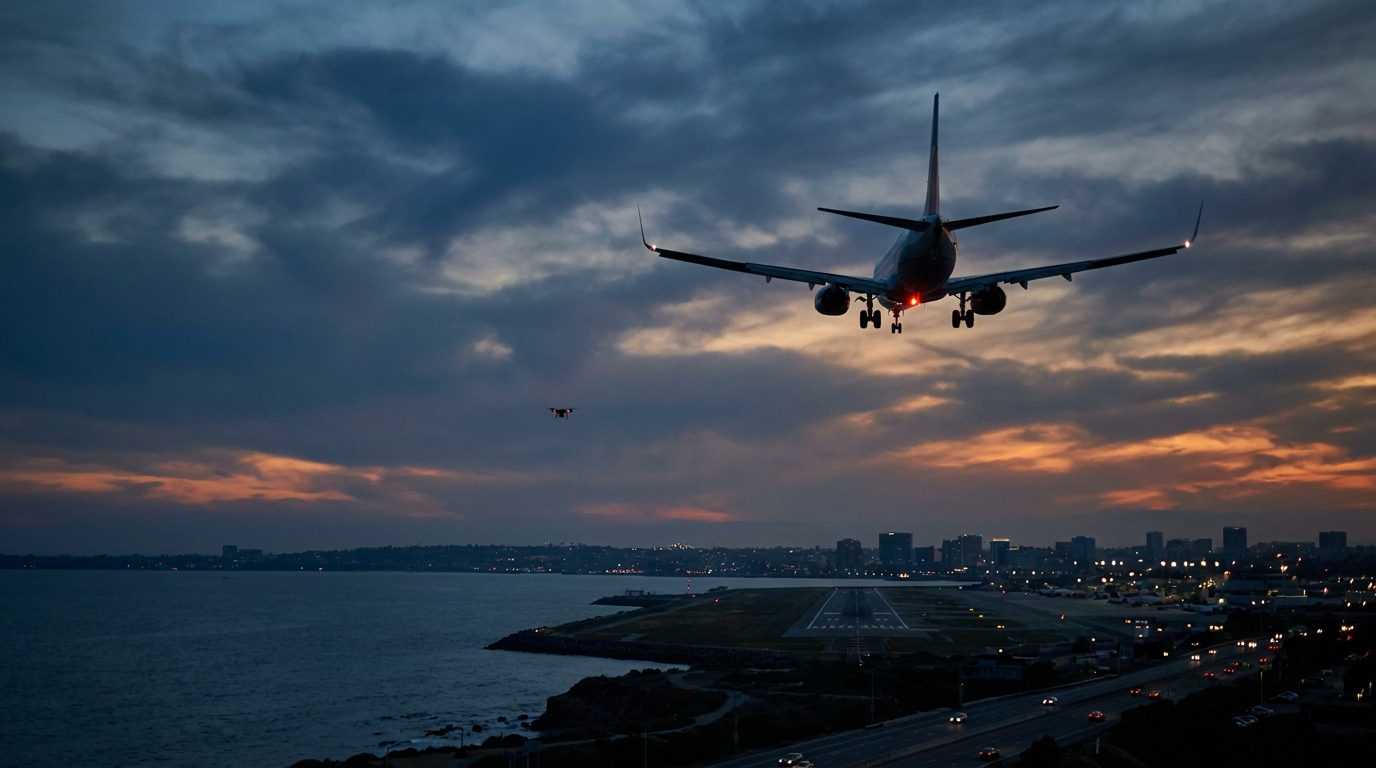
On Wednesday, April 29, a United Airlines flight inbound to San Diego International (KSAN) from San Francisco reported striking what the crew identified as a "shiny red drone" at roughly 3,000 feet on final approach. The Airbus A320 landed safely. United's maintenance team inspected the airframe and reported no damage. No one was hurt. By any objective measure of outcome, this was a non-event.
The numbers around it are not.
Three thousand feet AGL is 2,600 feet above the legal ceiling for any drone operating under Part 107 or recreational rules. The encounter occurred inside the San Diego Class B veil, the most tightly controlled airspace tier in the National Airspace System, where unauthorized unmanned traffic should not exist. And it happened during the single most safety-critical phase of a commercial flight: stabilized approach inside the final five miles to threshold.
This is the part of the story that matters for our industry, and the part that gets lost when the headline reads "drone strike." Let's unpack it the way an operator should.
What We Actually Know
The flight crew reported a visual encounter with a small unmanned aircraft, described as red, on approach to KSAN's Runway 27. ATC recordings reviewed by reporters captured the pilot calling out the sighting to the tower. United confirmed the aircraft landed safely and that post-flight inspection found no damage to the airframe. The FAA, per spokesperson comments to outlets including the Los Angeles Times and NBC 7 San Diego, said it was "aware of the report and reviewing it" — standard early-phase language that means the formal investigation has begun but no findings have been published.
What we do not know yet:
- Whether the object was confirmed as a drone or remains a "probable" sighting pending forensic review.
- Whether the operator has been identified through Remote ID broadcast capture, ADS-B-style tracking, or witness reports.
- Whether the FAA will pursue civil enforcement under 14 CFR § 91.13 (careless or reckless operation) or refer the matter to the U.S. Attorney for criminal charges under 49 U.S.C. § 46307.
The honest answer at this stage: the FAA is gathering evidence and is unlikely to comment substantively for weeks. (See the FAA's accident and incident index and general statement repository for primary-source updates.)
The Airspace Picture: Why 3,000 Feet Is the Wrong Altitude for Anyone
San Diego International has one of the most constrained terminal environments in U.S. commercial aviation. Its single 9,401-foot runway sits roughly two miles from downtown high-rises, with arriving traffic flying low approach paths over Balboa Park, Bankers Hill, and Loma Portal neighborhoods. The Class B veil extends from the surface to 12,500 feet and reaches outward in a layered shelf structure that any current Part 107 study guide covers in its first 20 pages.
For a recreational operator, the limit is 400 feet AGL within a Class B Facility Map grid (LAANC permitting required). For a Part 107 commercial pilot, the same 400-foot rule applies, with permitted altitudes of zero feet AGL near the airport itself unless an authorization is granted. There is no permission slip in any current FAA framework that allows a small UAS at 3,000 feet on a published instrument approach corridor.
So we are looking at one of three operator profiles:
- A recreational hobbyist who lost positional awareness: possibly using a consumer drone with altitude limits disabled or overridden, with no working knowledge of Class B airspace.
- A bad actor, testing reach or capturing footage with deliberate disregard for federal limits.
- A misidentification. Birds, mylar balloons, and small UAS are notoriously hard to distinguish from a flight deck at 200 knots, and the "shiny red" descriptor leaves room for that possibility.
Until forensic evidence (Remote ID logs, recovered hardware, witness ground sightings) lands, the industry should resist the urge to assume the worst-case profile. We've watched too many incidents, including the El Paso airspace shutdown — get prosecuted in the press before the data was in.
Industry Implications: The Enforcement Question Just Got Sharper
Whatever the United encounter turns out to be on the merits, the political timing is unkind to the drone industry. The FAA has spent April defending its regulatory posture on multiple fronts: the ICE/CBP NOTAM controversy, the open Part 108 BVLOS comment record, and renewed congressional scrutiny of Remote ID compliance rates. A high-altitude airliner encounter inside Class B is exactly the data point that re-energizes the "drones are a menace" framing on the Hill.
Three industry consequences are worth tracking:
1. Remote ID enforcement gets a new test case
Remote ID has been the law of the land for over a year, but enforcement actions remain rare and statistics on broadcast compliance are murky. If law enforcement at KSAN captured a Remote ID signal at the time of the encounter, and the operator was non-compliant, this becomes the FAA's most quotable enforcement vehicle since the rule went live. If no signal was captured, expect calls to mandate network-based Remote ID, which the original rulemaking explicitly rejected.
2. The Part 108 detect-and-avoid case writes itself
Part 108, in its current draft form, builds in mandatory Detect-and-Avoid (DAA) at the operator level for routine BVLOS work. Critics have argued the DAA mandate is over-engineered for low-altitude inspection missions. An airliner-versus-drone collision at 3,000 feet is the precise scenario DAA technology is designed to defeat, when the drone is the cooperative party. For background, see our breakdown of the Part 108 final rule and the broader BVLOS market analysis.
3. Counter-drone authority pressure intensifies
Local airport authorities have been lobbying for expanded counter-UAS detection (and, in some proposals, kinetic mitigation) authority for two years. The Preventing Emerging Threats Act expansion has been stuck in committee. Incidents inside Class B move that needle. Expect renewed pressure on Congress to extend Section 210G-style authorities to large hub airports.
The Operator Perspective: What This Means for Us
If you're flying commercially under Part 107, here is the practical takeaway:
Your professional reputation just got a little harder to defend in public, and a lot more valuable inside the room. The general public does not distinguish between a Part 107 inspection pilot working a transmission corridor and a hobbyist who flew a Mini 4 Pro into a Class B approach corridor. We all share the same press cycle. Your differentiator is documented compliance: LAANC records, pre-flight risk assessments, post-flight logs, and the ability to produce them when an insurance carrier or client asks.
For operators preparing transition packages to Part 108, this incident hardens the argument that DAA investment is not optional bloat. It is the single capability that separates a credentialed operator from a hobbyist on paper, and increasingly in the eyes of regulators and customers. Our BVLOS compliance checklist covers what that documentation looks like in practice.
For training organizations and safety officers, refresh your airspace modules. The 400-foot ceiling is not a recommendation. The Class B veil is not optional knowledge. If your in-house operators cannot draw the KSAN Class B from memory, that's a training gap and it's billable to fix before something hits a 737.
What I'm Watching Next
Three signals to track over the next two to four weeks:
- FAA preliminary statement. If the agency issues anything beyond "we're reviewing it," the language they choose ("drone," "object," "unmanned aircraft," "unidentified") tells you how confident the evidence is.
- Remote ID capture confirmation. If law enforcement publicly identifies the operator quickly, Remote ID just earned its keep. If two weeks pass with no operator named, the case for stronger broadcast or network mandates gets louder.
- Congressional response. Watch the House Transportation and Infrastructure Subcommittee on Aviation. A hearing referenced by name to this incident is the leading indicator that legislative action is incoming.
Bottom Line
One non-injurious encounter does not define an industry. But this one happened in the wrong airspace, at the wrong altitude, in the wrong phase of flight, at the worst possible regulatory moment. Commercial operators who already do the work of compliance are the people best positioned to weather what comes next, because the regulators who write the next round of rules are watching to see who shows up with documentation and who shows up with excuses.
Show up with documentation.
Sources: NBC 7 San Diego initial reporting (April 29, 2026); Los Angeles Times ATC tape review; CBS News San Diego; FAA UAS regulatory portal; FAA Remote ID rule documentation; 14 CFR Part 107.
Wesley Alexander is a Senior Test Pilot and FAA drone regulations consultant. UAVHQ provides operator-focused intelligence on regulatory and safety developments in the commercial UAV industry.