
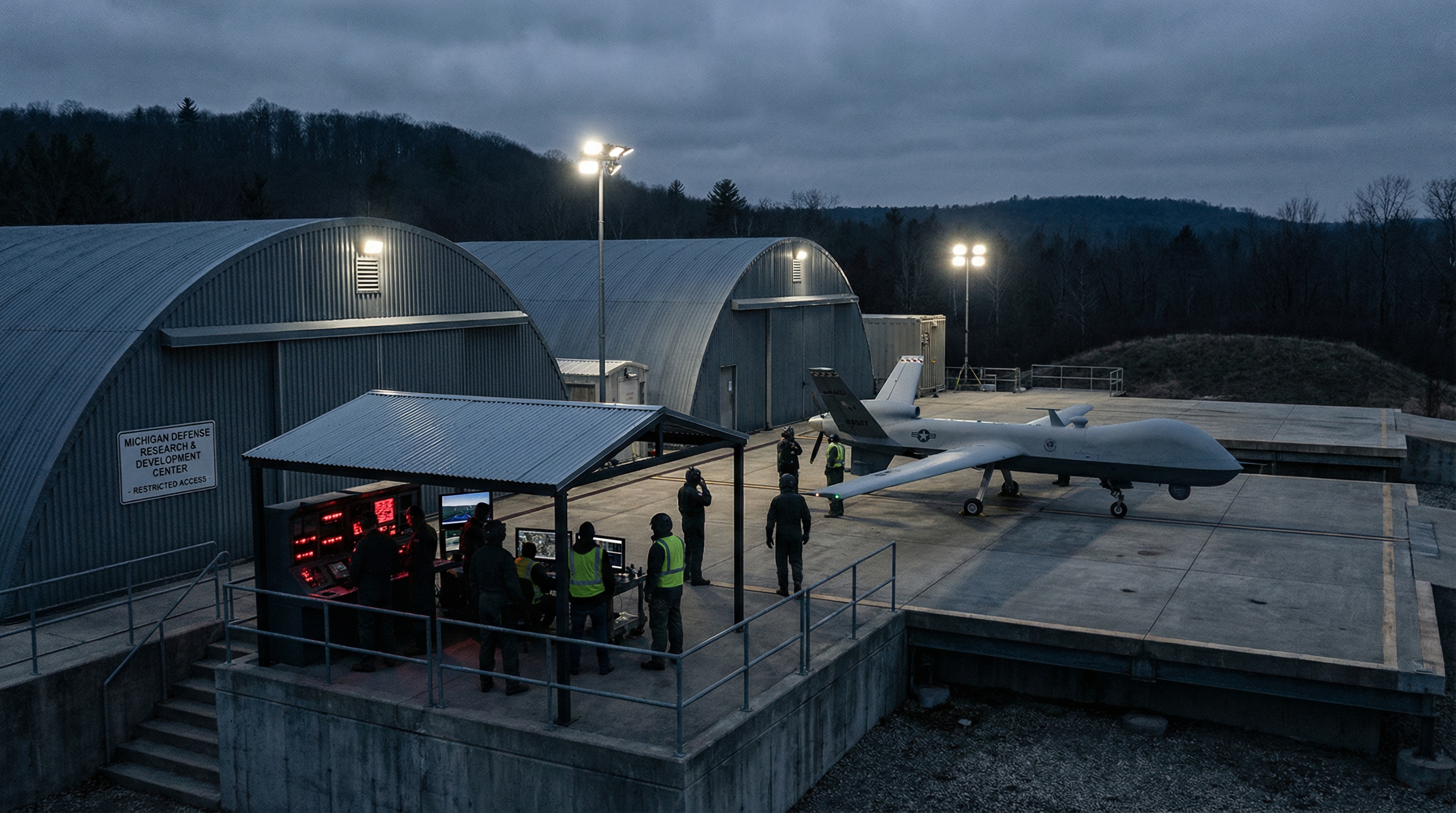
The U.S. Department of Defense has officially designated Michigan's National All Domain Warfighting Center (NADWC) as a National Range for Deep Uncrewed Aerial Systems training, transforming the Great Lakes State into America's premier drone testing and development hub. This strategic move positions Michigan at the forefront of the nation's push for drone dominance in an increasingly contested aerial battlefield.
From Arsenal of Democracy to Drone Dominance
Michigan's transformation from automotive powerhouse to defense innovation center reached a new milestone this week. Governor Gretchen Whitmer, speaking at the Munich Security Conference, characterized the designation as a turning point that builds on the state's legacy as the "Arsenal of Democracy" from World War II.
The National All Domain Warfighting Center now anchors what is essentially America's largest joint training range east of the Mississippi River. The facility encompasses nearly 200,000 acres at Camp Grayling Joint Maneuver Training Center and more than 17,000 square miles of special use military airspace at Alpena Combat Readiness Training Center.
"Michigan made products that dominate roads around the world. Next stop, the sky."
— Governor Gretchen Whitmer
Scale That Matters: A Proving Ground Built for Operational Tempo
This isn't a drone hobby park or academic research facility. The NADWC represents a serious operational proving ground built to handle the complexity and scale of modern uncrewed aerial systems. The range is certified under the Joint National Training Capability program and offers diverse terrain, robust electromagnetic spectrum access, and what military planners call "all-weather operational testing."
Major General Paul D. Rogers, adjutant general and director of the Michigan Department of Military and Veterans Affairs, emphasized that the facility provides the scale, airspace, and multi-domain environment necessary for realistic operational tempo testing. This means soldiers, airmen, joint partners, and allied forces can now integrate drones into live fire exercises, combined arms operations, and advanced swarm scenarios.
The mention of swarm operations is particularly significant. Future battlefields won't be defined by a single aircraft overhead, but by dozens or even hundreds of drones operating in coordinated formations—what military strategists describe as "digital flocks moving with purpose."
Strategic Timing Meets Market Reality
The Michigan designation comes at a crucial inflection point for the global drone industry. Market projections show the sector exploding from nearly $14 billion in 2024 to more than $65 billion by 2032. This isn't incremental growth—it's a launch sequence driven by both defense modernization and commercial expansion.
Recent defense contractor performance underscores this momentum. AeroVironment (NASDAQ: AVAV) saw its stock surge 7.84% following a $75 million U.S. Air Force task order for biotechnology and smart materials development. KeyBanc raised its price target to $330, signaling strong investor confidence in the defense drone sector.
The strategic imperative is clear: closing the gap with Russia and China, both of which have aggressively expanded drone production and battlefield integration. The coordination failures exposed during the El Paso counter-drone crisis have only intensified the urgency for domestic testing infrastructure. President Trump's executive actions aimed at strengthening domestic drone manufacturing, including Defense Secretary Pete Hegseth's symbolic drone-delivered memo signing on the Pentagon lawn, demonstrate the administration's commitment to American drone dominance.
Beyond Military Applications
Michigan's drone ecosystem extends far beyond military applications. Police departments across the state are expanding UAS programs for law enforcement and public safety. Utilities are deploying drones for infrastructure inspection and maintenance. Amazon is expanding Prime Air delivery operations in metro Detroit, dropping packages under five pounds within a 7.5-mile radius of its Hazel Park facility.
This civilian-military integration creates what defense analysts call a "dual-use development pipeline"—where innovations tested in military environments quickly find commercial applications, and vice versa.
Industrial Culture Meets Military Infrastructure
Michigan's competitive advantage isn't just geographic—it's cultural and industrial. The state brings a deep manufacturing mindset, established supply chains, and a workforce experienced in building complex systems at scale. When you combine this industrial ecosystem with permissive operating authorities and world-class military infrastructure, you create a rare test-to-production pipeline in a single geography.
The state has been building toward this moment for years. Recent initiatives include autonomous drone competitions, a statewide Advanced Air Mobility Initiative, and securing a new fighter mission at Selfridge Air National Guard Base. The NADWC designation stacks on top of existing momentum rather than creating it from scratch.
Navigating Legal and Regulatory Challenges
As drone adoption expands, so do regulatory complexities. Michigan faces unique challenges, including an ongoing legal dispute over the state's 2015 ban on using drones for deer hunting. An Ohio entrepreneur is challenging the ban, arguing that certain drone uses fall under First Amendment protections. Such cases highlight the broader challenge policymakers face in defining where innovation ends and regulation begins.
The growing complexity of airspace management is evident. With military training, commercial deliveries, law enforcement operations, and civilian recreation all competing for the same vertical space, Michigan is essentially becoming a real-world laboratory for integrated airspace management—one that could benefit from lessons learned during the Pentagon-FAA joint anti-drone laser tests at White Sands.
Industry Implications: What This Means for Drone Operators
For commercial drone operators, Michigan's elevation to premier testing status creates several opportunities and considerations:
- Testing and Certification Opportunities: Companies developing advanced UAS technologies now have access to one of the nation's most sophisticated testing environments. This could accelerate prototype-to-production timelines for commercial systems.
- Workforce Development: Michigan's investment in drone training capabilities will likely produce a generation of highly skilled UAS technicians, pilots, and engineers—creating a talent pipeline for the broader industry.
- Supply Chain Integration: The state's existing manufacturing infrastructure, combined with defense spending, could make Michigan an attractive location for drone component manufacturing and final assembly.
- Regulatory Precedents: How Michigan manages complex airspace integration will likely influence federal policy development for BVLOS operations and urban air mobility. Operators should review our complete Part 107 guide to understand the current certification landscape.
Looking Ahead: From Training Range to Innovation Hub
The NADWC designation transforms Michigan from a participant in the drone revolution to a platform for shaping its direction. The question isn't whether this will accelerate drone development—it's how effectively Michigan can translate military testing advantages into commercial leadership.
If the state successfully bridges its military edge with workforce development, commercial spinoffs, and domestic manufacturing strength, it won't just host drone training—it will help define the next era of aerospace technology. The Arsenal of Democracy that once built tanks and bombers may soon be remembered as the birthplace of autonomous swarms.
For an industry projected to grow nearly five-fold by 2032, Michigan's combination of scale, infrastructure, and industrial culture positions it uniquely to capture both defense contracts and commercial opportunities. Organizations looking to capitalize on these developments can explore our professional drone consulting services for strategic guidance. The designation is ultimately a bet that the state that taught the world to build cars can teach the world to build the autonomous aerial systems of the future.
That's a bet worth watching closely.
Need Expert Drone Consulting?
UAVHQ offers professional consulting for BVLOS waivers, Part 107/108 compliance, enterprise drone programs, and regulatory strategy. 25+ years of aviation expertise at your service.
Explore Our Services →