

By Wesley Alexander • August 27, 2026 • 6 min read
Tactical Summary
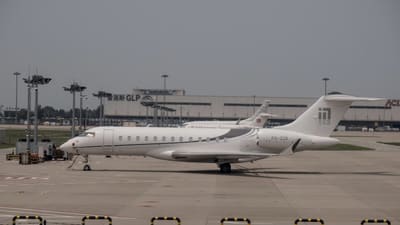
A NetJets Bombardier Global 6500 crew reported a near miss with a large silver object shortly after departing Westchester County Airport on July 4, according to Simple Flying and MiGFlug reporting based on ATC audio and flight-tracking data. The aircraft was climbing through about 15,800 feet when the crew reported an object passing down the right side of the aircraft. The crew described it as smaller than an aircraft but "definitely bigger than a drone," and the jet continued to Colombia with no reported damage.
The most important sentence is the one UAV operators should not skip: the object has not been publicly identified.
That means this is not a clean "drone hit a jet" story. It is a reported high-altitude near miss with an unknown object in busy New York departure airspace. That distinction matters because serious operators do not build safety programs around guesses. They build them around reporting discipline, detection limits, and repeatable response.
What We Know
The reported aircraft was NetJets flight NJE426K, a Bombardier Global 6500 departing Westchester County Airport for Pereira, Colombia. Simple Flying reported that the aircraft took off at 12:00 p.m. local time and that the near miss occurred roughly ten minutes after departure while climbing through 15,800 feet. MiGFlug's summary described the aircraft as continuing safely, with no damage reported and the jet later returning to service.
The crew's description is operationally awkward in exactly the way real airspace reports often are. The object was large, silver, close, and fast enough relative to the aircraft that there was no time to positively identify it. It was not described as a normal consumer quadcopter. It was also not confirmed as a drone, balloon, aircraft, debris, or anything else.
For aviation safety, that uncertainty is not a reason to shrug. It is the point.
Do Not Turn Unknown Into Drone
The drone industry has a bad habit of arguing backwards from headlines. If a pilot sees an object, anti-drone voices may treat it as a rogue UAS. Drone advocates may dismiss it as a balloon, bird, or glare. Neither reaction is useful at 15,800 feet in a climb corridor.
The disciplined version is simpler:
- A professional flight crew reported a close pass with an unidentified object.
- The report occurred at an altitude far above normal legal small-UAS operations.
- The object was described as larger than a typical consumer drone.
- No public source has confirmed what it was.
- The operational gap is detection and attribution, not certainty.
That is the lesson for commercial UAS teams, airport operators, and counter-UAS planners. If you cannot identify the object, you cannot classify the hazard. If you cannot classify the hazard, you cannot build a reliable response beyond avoidance and reporting.
Why 15,800 Feet Matters
A near miss at pattern altitude is one problem. A reported object at nearly 16,000 feet is a different one.
That altitude sits in the world of fast-moving aircraft, climb profiles, IFR separation, and limited reaction time. A crew has seconds to see, assess, and report. A controller may have nothing correlated on radar. A nearby operator, if there is one, may be invisible to the aviation system unless Remote ID, radar, RF, ADS-B correlation, or visual evidence creates a trail.
For lawful drone operators, the altitude itself is the warning. If an object that looks drone-like or drone-adjacent is being reported there, the legitimate industry needs a clear way to separate authorized low-altitude UAS work from unidentified high-altitude hazards. Otherwise every ambiguous object becomes a reputational problem for everyone operating remotely piloted aircraft.
The Detection Problem Nobody Likes
This incident fits a wider aviation-safety problem: crewed aircraft are reporting objects that are difficult to classify after the fact. Simple Flying placed the NetJets event alongside recent reports involving a United 737 MAX near Newark and a JetBlue A321 that reportedly hit a drone on approach to JFK. We covered that case, and the operator action it demanded, in the JetBlue JFK drone strike report. The pattern also echoes the LAPD helicopter collision over Tarzana, where the lesson was altitude discipline, not speculation.
That does not prove the NetJets object was a drone. It proves the airspace system is still weak at answering three basic questions quickly:
- Was there an object? Pilot reports matter, but they need correlation where possible.
- What was it? Drone, balloon, debris, bird, aircraft, or something else requires evidence.
- Who, if anyone, controlled it? Without attribution, enforcement and prevention both stall.
Counter-UAS vendors often market detection as a clean answer. Real events are messier. Radar tracks can be ambiguous. RF detection misses autonomous or non-emitting objects. Optical systems need line of sight. Remote ID helps only when a compliant UAS is broadcasting and within range. None of that means detection is pointless. It means the detection plan has to be layered, logged, and honest about uncertainty.
Operator Takeaways
For commercial UAS operators, the playbook is not complicated, but it does have to be real:
- Keep operations boring and documentable. Airspace authorization, crew roles, Remote ID status, aircraft registration, launch/recovery location, and emergency procedures should be recorded before the flight, not reconstructed afterward.
- Brief lost-link and flyaway response as if someone will ask. If your aircraft goes somewhere unexpected, the first useful artifact is a timestamped record of what happened and what you did.
- Know the local reporting chain. Near airports and major corridors, operators should know who gets called: ATC facility, airport operations, law enforcement, client security, or internal safety lead.
- Do not speculate publicly. If a nearby incident occurs, "we were not operating in that area/time/altitude" is useful if true and documented. "It was probably a balloon" is not.
- Support better attribution. Remote ID, telemetry retention, geofencing logs, and incident-ready records protect legitimate operators as much as they help regulators. They also matter now that the counter-UAS rulemaking is live: see the Safer Skies C-UAS comment window and what operators should file.
For airport and public-safety teams, the matching lesson is to preserve evidence quickly: crew report, radar replay, ADS-B context, RF logs, Remote ID captures, security-camera time windows, and any public reports from the ground. A strange object is not solved by a press release. It is solved by a chain of evidence.
The UAVHQ Read
The NetJets report should be treated carefully. There is no confirmed drone. There is no confirmed collision. There is no public identification of the object. But it is still operator-relevant because it sits at the intersection of crewed aviation safety, unknown-object reporting, and the limits of today's low-altitude detection picture.
The correct response is not panic. It is discipline.
Legitimate UAS operators win when their flights are easy to distinguish from the unknowns: authorized, logged, traceable, compliant, and boring. Airport and counter-UAS teams win when they can move a report from "large silver object" to a supported classification quickly enough to matter. Until that becomes routine, every unexplained near miss becomes one more reminder that integration is not just about letting drones into airspace. It is about proving what is in the air when something goes wrong.
Sources
- Simple Flying: "Large Silver Object": NetJets Pilots Report Near Miss At 15,800 Feet Over New York
- MiGFlug: A NetJets Jet's Near Miss With a Silver Object
- Aviation Shop: NetJets Jet Reports Near Miss With Silver Object Over NY
NetJets Silver Object Near Miss New York Drone Airspace Safety Unknown Object Detection Counter UAS Remote ID Pilot Report Westchester Global 6500 Aircraft Near Miss