
FAA No Drone Zones at the FIFA World Cup 2026: $100,000 Fines, TFRs, and What Operators Need to Know
Wesley Alexander | May 4, 2026
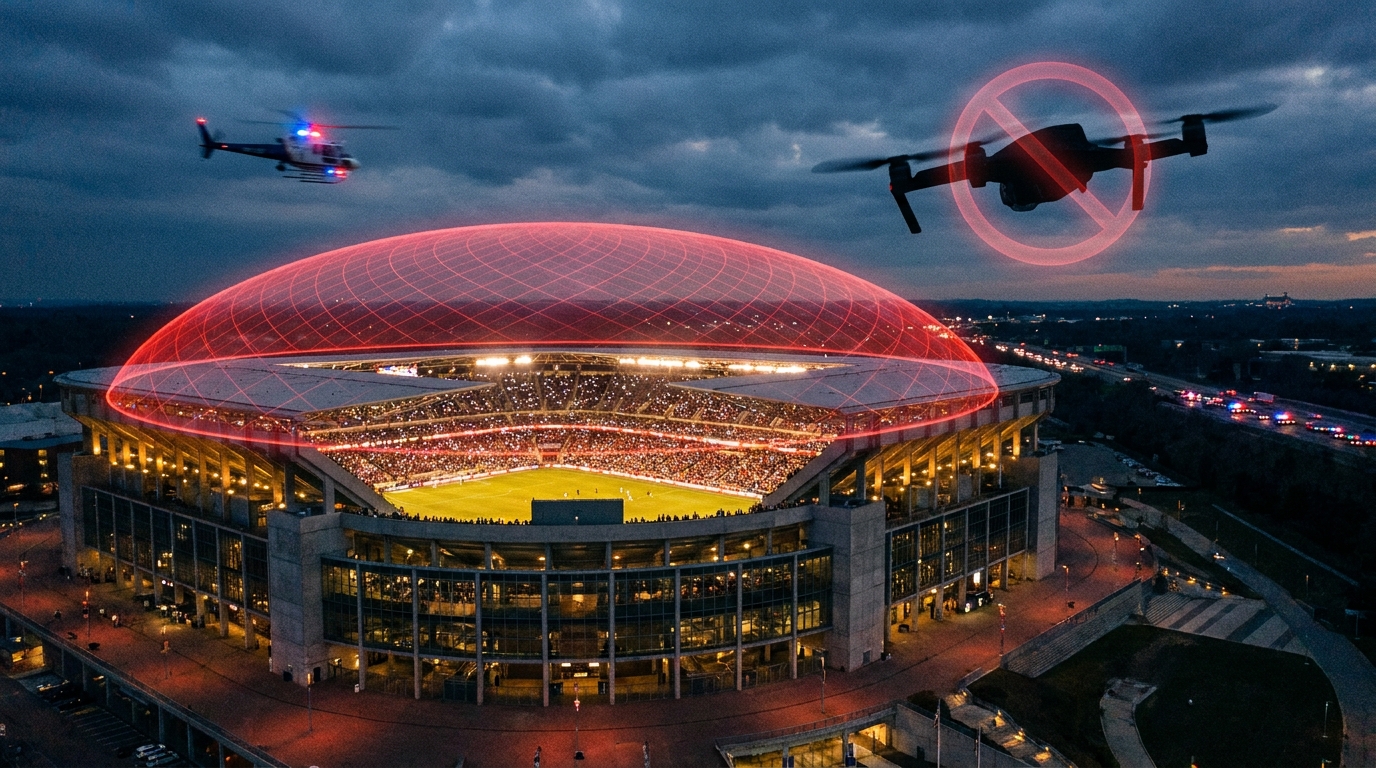
Five weeks before the opening match, the Federal Aviation Administration has officially designated every FIFA World Cup 2026 stadium and event venue a strict "No Drone Zone", with civil penalties up to $75,000 per violation, criminal fines up to $100,000, and federal authority to detect, track, and seize unauthorized aircraft. The tournament is the largest single-event airspace coordination effort in US drone-era history, spanning eleven US host cities, two foreign co-hosts, and roughly thirty-nine days of continuous match operations between June 11 and July 19.
For Part 107 operators, this is not just a compliance reminder. It is a live test of how the post-Super Bowl, post-Disney, post-United Airlines enforcement environment will behave when the eyes of the world are on US airspace. If you fly commercially anywhere near a host city this summer, the rules of engagement have changed.
Key Facts (Verified)
- Coverage: All 16 World Cup venues and surrounding event spaces designated "No Drone Zones" by the FAA, with co-host coordination across the United States, Canada, and Mexico.
- Civil exposure: Up to $75,000 per violation under FAA civil-penalty authority.
- Criminal exposure: Up to $100,000 in criminal fines, plus potential immediate arrest, in coordination with the FBI.
- Mechanism: Temporary Flight Restrictions (TFRs) under 14 CFR §91.137 / §91.141 around match windows, with no Part 107 carve-out during active TFRs.
- Counter-UAS authority: The FBI is authorized to use specialized mitigation tools to intercept and seize drones in restricted areas, under existing federal C-UAS statutes.
- Tournament dates: Opening match June 11, 2026 (Mexico City). Final July 19, 2026 (MetLife Stadium, NJ). 104 matches total.
- No exemptions: Even licensed Part 107 operators with prior airspace authorization are not exempt during active restrictions, per the FAA's published guidance.
What the FAA Actually Said
The agency's safety plan, announced in coordination with the FBI and host-city law enforcement, treats the World Cup the same way it treats the Super Bowl, the Olympics, and presidential events: as a special-security airspace event under the Federal Aviation Regulations. From the FAA's own release, as reported by PetaPixel on May 4:
"A 'No Drone Zone' means that no individual is allowed to launch, land, or operate a drone within restricted airspace around World Cup venues... Taking off, landing, or flying a drone within these restricted areas is a serious violation of federal and local regulations." FAA, FIFA World Cup 2026 safety plan release
Two operationally important things sit inside that quote. First, the prohibition is on launch, land, or operate, not just powered flight. That captures the most common Part 107 footfault, which is launching outside the TFR boundary and drifting in. Second, the agency explicitly notes that prior authorization, including LAANC clearances, will not be honored during active restriction windows. If a TFR is hot and your LAANC came down yesterday, your authorization is suspended in fact even if your phone still says green.
The Penalty Stack: Where $75K and $100K Actually Come From
Two different statutory pipes are in play here, and they are not interchangeable.
Civil: 49 U.S.C. §46301
The $75,000 figure is consistent with the inflation-adjusted civil-penalty ceiling under 49 U.S.C. §46301, the same authority that drives every routine Part 107 enforcement case. As we covered in our FAA Compliance Program breakdown, the statutory cap for an individual or small business is $50,000 per violation, with the inflation adjustment under 14 CFR Part 13 producing the higher figure cited in the World Cup plan. The FAA does not have to assess the cap, but during a special-security event, the agency's Sanction Guidance treats stadium TFR breaches as aggravated by definition.
Criminal: 49 U.S.C. §46307 and 18 U.S.C. §39B
The $100,000 number, plus arrest exposure, lives on the criminal side. 49 U.S.C. §46307 criminalizes operation in restricted airspace as a misdemeanor, and 18 U.S.C. §39B, enacted in 2018, makes interfering with manned aircraft using a drone a federal felony with up to ten years in prison if injury results. When the FAA says criminal fines up to $100,000, they are signalling that prosecutorial referral is on the table for World Cup violations, not just paper enforcement.
Why both apply
The same flight can trigger both pipes. A civil penalty letter under §46301 plus a criminal referral to the US Attorney is the pattern we saw after the 2024 Super Bowl LVIII breach and again after the 2025 SoFi Stadium incident. Operators who think "I'll just pay the fine" do not understand that the FBI's C-UAS detection pipeline now feeds straight into the same enforcement architecture used at NSSE-designated events.
The TFR Mechanic: Stadium TFRs Plus VIP Movements
Stadium TFRs at the World Cup will look like the existing FDC NOTAMs that cover regular-season NFL, MLB, and major college football games, but expanded in radius and duration. The standard FDC sports TFR is a 3-nautical-mile, 3,000-foot AGL ring around the stadium from one hour before to one hour after the event, with no UAS operations permitted inside. World Cup match TFRs are expected to follow that template at minimum, and several venues may see expanded VIP-movement TFRs under §91.141 if heads of state attend, particularly the final at MetLife.
For the eleven US host cities, that means concurrent overlapping restrictions: airport Class B and Class C airspace as the baseline, layered FDC sports TFRs around the venues, plus possible Special Use Airspace activations and counter-UAS detection bubbles that, while not airspace per se, will absolutely produce enforcement referrals. The eleven US venues are Atlanta (Mercedes-Benz), Boston (Gillette), Dallas (AT&T), Houston (NRG), Kansas City (Arrowhead), Los Angeles (SoFi), Miami (Hard Rock), New York/New Jersey (MetLife), Philadelphia (Lincoln Financial), San Francisco (Levi's), and Seattle (Lumen).
That is not a small geography. Real-estate photographers, infrastructure inspectors, public-safety drone teams not directly attached to an event, and commercial operators servicing logistics around host cities all need to be planning around these windows now, not the week of.
Counter-UAS Authority: This Is Not a Drill
The most operationally significant line in the FAA release is the explicit FBI counter-UAS authority. Under the Preventing Emerging Threats Act of 2018, DHS and DOJ have statutory authority to detect, track, identify, and mitigate drone threats at "covered facilities or assets." The Department of War and FAA recently completed joint counter-drone laser testing at White Sands, and the broader C-UAS posture has hardened considerably across 2025-2026.
For a Part 107 operator, the practical takeaway is that flying inside an active TFR at a host venue is no longer a question of whether you will be detected. Stadium-class detection systems combining RF, radar, and acoustic sensors are now standard at NSSE-designated venues. The question is whether you get a Letter of Investigation in the mail, a knock on the door from the FBI, or, in the worst case, your aircraft lawfully knocked out of the sky over a crowd of 80,000.
UAVHQ Analysis: The Operator's Pre-Tournament Checklist
1. Map every active job within 5 NM of a host venue
If you have a contract that puts you anywhere near one of the eleven US host stadiums during June or July, pull the schedule now. The FIFA match calendar is public. Your client may not realize their warehouse rooftop inspection happens to fall during a quarterfinal four miles up the road.
2. Treat LAANC as advisory, not authoritative, during match windows
LAANC authorizations do not override TFRs. The B4UFLY app and the FAA TFR portal are your authoritative sources during the tournament. Build a habit of checking both before every flight, the same way you would for VIP movement during a presidential visit.
3. Document everything as if a US Attorney will read it
This is the lesson from every previous high-visibility incident. Operators who can produce contemporaneous pre-flight checklists, weather briefings, airspace screenshots, and crew briefings tend to land in the FAA's Compliance Program track. Operators who cannot, do not.
4. Brief any subcontractors and crew on the No Drone Zone explicitly
Vicarious liability is real. If you are running a drone services company and a 1099 pilot under your insurance breaches a World Cup TFR, your commercial drone program is exposed. Add a written acknowledgment of the World Cup restrictions to your standard pre-flight paperwork for the duration of the tournament.
5. Resist the temptation to film the spectacle
Every major event produces the same predictable pattern of opportunistic recreational flyers thinking they will get a quick aerial of the stadium. Some of those will be your friends, your neighbors, or your clients. The right answer is to point them at the Disney World cases and the European venue protocols we covered earlier this year. The penalty math does not work out.
Industry Implications
Three things matter beyond the immediate compliance picture.
First, the World Cup is going to be the largest real-world stress test of integrated FAA, FBI, and local-law-enforcement counter-UAS coordination ever conducted in US airspace. Whatever lessons come out of June and July will shape the C-UAS authorities Congress is currently considering for state and local law enforcement. The drone industry should be paying attention to how detection-to-mitigation workflows perform at scale, because those workflows are coming to every NFL stadium afterwards.
Second, the tournament will accelerate the policy split we have been tracking between the security side of US drone policy and the commercial side. The FAA is simultaneously running a special-security lockdown across eleven cities and trying to finalize Part 108 BVLOS rules that depend on broader airspace integration. Those two postures are not contradictory, but they require operators and policymakers to hold both ideas at once: airspace can be permissive in some contexts and locked down in others, and the line between them is moving.
Third, this is a credibility moment for the commercial drone industry. If the tournament passes without a high-profile incident involving a Part 107-licensed operator, it strengthens the industry's hand in the Part 108 fight and in the ongoing debate over drone-policy asymmetry. If it does not, the rulemakers will remember.
The Bottom Line
The FAA has telegraphed exactly what it intends to do for thirty-nine days this summer: enforce strict No Drone Zones at every World Cup venue, treat TFR breaches as aggravated cases, and use the full civil-criminal penalty stack up to $100,000 plus arrest. Federal counter-UAS detection and mitigation authority is in play. There are no Part 107 carve-outs during active restrictions.
For professional operators, the work to do is small but non-negotiable. Pull your June and July schedule now. Cross-reference against the World Cup match calendar and the eleven US host venues. Build TFR-checking into every pre-flight for the duration of the tournament. Brief your crew. Document everything. And tell your recreational-flyer friends, in plain language, that the airspace around these stadiums is the most actively monitored civilian airspace in US drone-era history.
This is what the post-Super Bowl, post-Disney enforcement environment looks like at full scale. Fly accordingly.
Sources
PetaPixel, FAA Warns of Criminal Fines Up to $100,000 for Drones Near World Cup Stadiums (May 4, 2026) FAA Temporary Flight Restrictions Portal 49 U.S.C. §46301, Civil Penalties (Cornell LII) 49 U.S.C. §46307, Penalty for Interference with Air Navigation 18 U.S.C. §39B, Unsafe Operation of Unmanned Aircraft 14 CFR Part 107, Small Unmanned Aircraft SystemsOperating Near a World Cup Host City This Summer?
UAVHQ provides regulatory strategy and Part 107 compliance consulting from a Senior Test Pilot with 25+ years of aviation experience. If your June or July operations brush up against TFR-affected airspace, get a real opinion before the first match.
Explore Our Services →